





AI Recruiting Tools vs Traditional ATS - Which One Fits You
Compare AI Recruiting Tools vs Traditional ATS to understand how AI improves hiring speed, accuracy, and efficiency while shaping the future of recruitment.
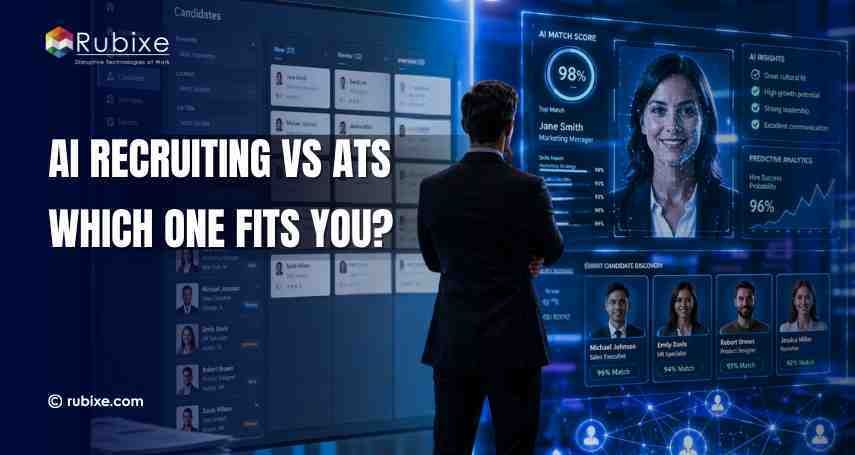
Hiring today goes far beyond sorting resumes and moving candidates through fixed stages. The process has gradually moved toward systems that can read patterns, understand context, and evaluate fit across larger volumes of data, making hiring decisions more structured and consistent.
This shift explains why AI Recruiting Tools are increasingly being compared with Traditional ATS. One approach is built around organizing applications, while the other focuses on improving decision quality, speed, and accuracy in recruitment outcomes.
What Is a Traditional ATS?
A Traditional ATS (Applicant Tracking System) is a software system designed to collect, store, and manage job applications in a structured format. It acts as a centralized database for recruitment teams to track candidates through different hiring stages.
Most ATS platforms focus on workflow organization rather than intelligence. They help recruiters manage resumes, schedule interviews, and track candidate status across pipelines. While Traditional ATS systems improve organization, they still depend heavily on manual decision-making for candidate evaluation.
What Traditional ATS Does Well
Despite its limitations, Traditional ATS still plays an important role in structured hiring environments.
It is effective in:
-
Organizing large volumes of applications
-
Tracking candidates across recruitment stages
-
Centralizing communication between hiring teams
-
Maintaining compliance and documentation
A 2022 Capterra study found that nearly 75% of businesses using ATS reported reduced hiring time and lower recruitment costs. This highlights how Traditional ATS continues to support efficiency in structured recruitment workflows.
These strengths make ATS useful for administrative consistency. However, as hiring complexity increases, its limitations become more visible compared to modern AI Recruiting Tools.
How Traditional ATS Works
A Traditional ATS operates on a rule-based system where resumes are filtered based on predefined criteria and keyword matching.
Rule-Based Candidate Screening: Candidates are shortlisted when their resumes match specific keywords from job descriptions, while others are automatically filtered out.
Centralized Resume Storage: All applications are stored in a structured database, allowing recruiters to access and review candidates from a single dashboard.
Manual Decision Dependency: Even after filtering, final hiring decisions still depend on the recruiter's judgment and manual evaluation.
Limited Evaluation Depth: A Traditional ATS does not assess deeper aspects such as career progression, skill relevance, or contextual fit.
This is where AI Recruiting Tools begin to offer a more advanced approach to hiring.
Critical Limitations of Traditional ATS
As hiring becomes more competitive and complex, the limitations of Traditional ATS become increasingly visible. These systems often struggle to meet modern recruitment expectations around speed, intelligence, and accuracy.
-
Keyword dependency often filters out relevant candidates when exact terms are missing in resumes.
-
Lack of intelligence limits evaluation of skills, behavior patterns, and long-term role fit.
-
Scaling challenges emerge when handling high-volume hiring across multiple roles.
-
Limited personalization reduces the ability to match candidates beyond basic criteria.
-
Slow decision cycles impact overall hiring speed and candidate experience.
These challenges are driving organizations to explore AI Recruiting Tools as a more advanced and efficient alternative. This is why many companies now consider upgrading and often search for solutions like AI recruitment to reduce hiring time and improve efficiency.
What Are AI Recruiting Tools?
AI Recruiting Tools are intelligent hiring systems that use machine learning, natural language processing, and predictive analytics to improve recruitment decisions.
Unlike Traditional ATS, these tools do not simply store resumes. They actively analyze candidate profiles, match skills to job roles, and predict hiring suitability. This makes Artificial Intelligence Recruiting Tools more adaptive, intelligent, and aligned with modern hiring requirements.
How AI Recruiting Tools Work?
AI Recruiting Tools function by combining data processing, machine learning, and pattern recognition to improve hiring decisions. They continuously analyze candidate and job data to identify the best possible match with higher accuracy and speed.
Job Matching: AI Recruiting Tools compare job requirements with candidate profiles to identify strong alignment.
Resume Analysis: Systems interpret resumes in context, going beyond keyword matching to understand real experience.
Machine Learning: AI models improve over time by learning from past hiring decisions and outcomes.
Predictive Scoring: Candidates are ranked based on suitability, skill relevance, and historical hiring success patterns.
Automation Layer: Screening, shortlisting, and initial evaluation are automated to reduce manual effort. For instance, a candidate with strong project experience but missing exact keywords may get filtered out in ATS, while AI systems can still identify role relevance.
Key Features of AI Recruitment Tools
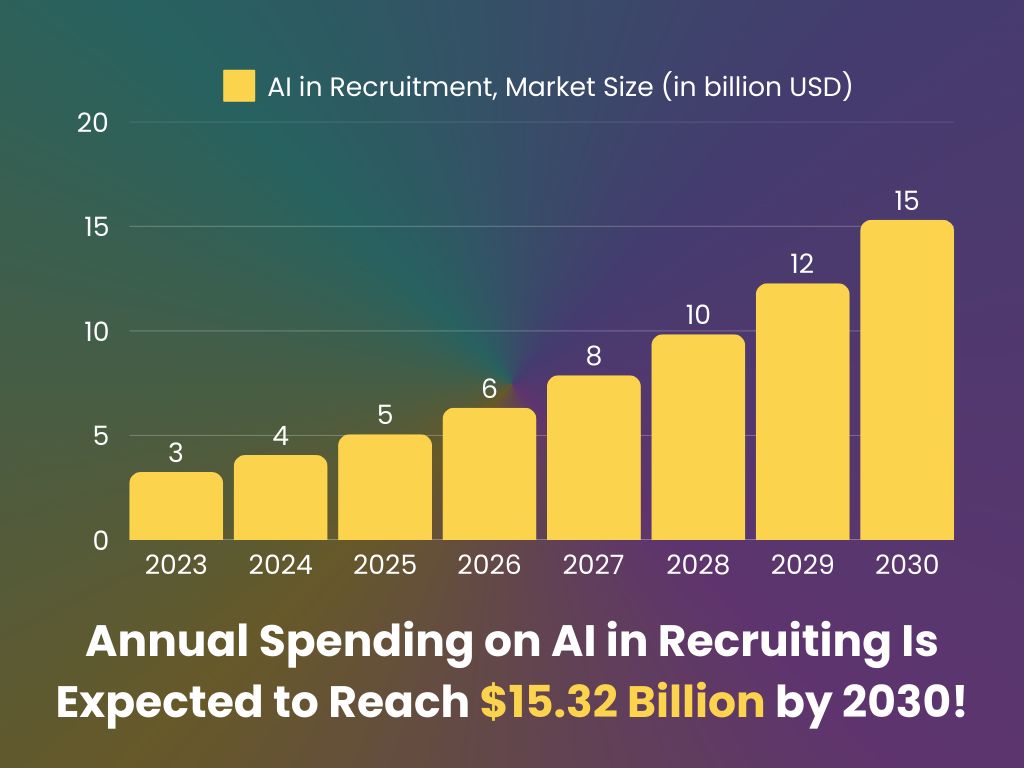
source:boterview.com
AI Recruiting Tools come with advanced capabilities that go beyond traditional recruitment systems. They are designed to improve accuracy, reduce manual effort, and enhance decision-making across the hiring process.
These features work together to create a more structured and intelligent hiring workflow.
-
Intelligent Resume Parsing: Recruiting Tools analyze resumes in context rather than depending only on keyword matching.
-
Predictive Candidate Scoring: Candidates are ranked based on skill fit, experience relevance, and hiring success patterns.
-
Automated Shortlisting: Systems automatically filter and shortlist candidates who best match job requirements.
-
Bias Reduction: Recruiting Tools help reduce human bias by standardizing evaluation criteria.
-
Smart Interview Scheduling: Interview coordination is automated to improve speed and reduce manual communication effort.
Many organizations also integrate AI hiring software to further streamline recruitment workflows and improve operational efficiency.
AI Recruiting Tools vs Traditional ATS: Direct Comparison
Understanding the difference between Traditional ATS and AI Recruiting Tools becomes easier when we evaluate how each system performs across key recruitment functions. While both are designed to support hiring, their approach to screening, decision-making, and scalability is fundamentally different.
This comparison highlights why organizations are gradually shifting toward more intelligent hiring systems.
|
Aspect |
Traditional ATS |
AI Recruiting Tools |
|
Candidate Screening
|
Relies on keyword matching to filter resumes, which may miss relevant profiles. |
Uses contextual analysis to understand skills, experience, and role fit more accurately. |
|
Speed |
Depends heavily on manual review and recruiter intervention. |
Automates screening and shortlisting for faster hiring cycles. |
|
Accuracy |
Provides moderate accuracy based on fixed rules and keywords. |
Delivers higher accuracy using predictive models and learning algorithms. |
|
Scalability |
Struggles with large volumes of applications during high hiring demand. |
Handles large-scale hiring efficiently without a performance drop. |
|
Decision Support |
Offers limited insights, mostly focused on tracking and organization. |
Provides data-driven recommendations to improve hiring decisions. |
This comparison makes it clear why Artificial Intelligence Recruiting Tools are becoming a key part of the future of hiring, as organizations move toward faster, more accurate, and intelligence-led recruitment systems.
How AI Enhances Recruitment Efficiency
Recruitment efficiency improves significantly when organizations shift from Traditional ATS to AI Recruiting Tools. This transition helps reduce manual effort, improve decision speed, and enhance the candidate quality outcomes.
As a result, recruitment becomes faster, more structured, and aligned with the future of hiring.
-
Faster Screening: AI Tools automatically filter relevant candidates, reducing manual resume review time.
-
Time Reduction Impact: AI recruitment reduces hiring time by streamlining shortlisting and evaluation processes.
-
Better Candidate Quality: AI evaluates deeper patterns like skill growth, experience relevance, and role alignment.
-
Decision Efficiency: Recruiters can focus more on final decision-making instead of repetitive filtering tasks.
-
Integrated Hiring Ecosystem: AI Recruiting Tools combined with AI Staffing services create a more connected and efficient recruitment workflow.
How to Migrate from ATS to AI Recruiting
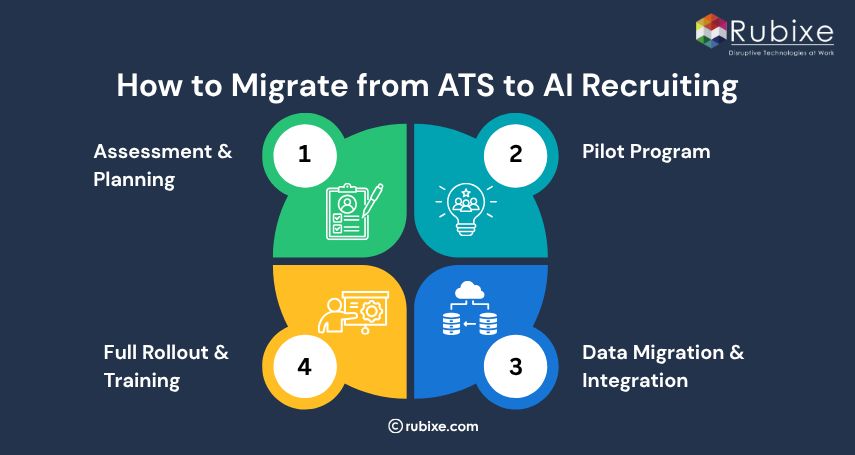
Transitioning from Traditional ATS to AI Recruiting Tools requires structured execution rather than abrupt change. A phased approach ensures better adoption, reduced disruption, and more reliable hiring outcomes.
Assessment & Planning
Organizations begin by identifying gaps in their current recruitment system and defining where AI can improve outcomes. This stage helps set clear expectations and aligns stakeholders before implementation begins.
Pilot Program
A small-scale implementation is tested to validate performance before full deployment. This allows teams to evaluate real-world impact and refine processes early.
Data Migration & Integration
Existing recruitment data from Traditional ATS is cleaned and integrated into AI systems. Proper data structuring at this stage ensures higher accuracy and system reliability.
Full Rollout & Training
Teams are trained to use Artificial Intelligence Recruiting Tools effectively, ensuring smooth adoption across workflows. Training helps recruiters shift from manual handling to intelligent system-driven hiring.
During this phase, organizations often depend on AI for hiring support to ensure proper alignment and implementation.
Benefits of AI Recruiting Tools
The adoption of AI Recruiting Tools delivers measurable improvements across recruitment functions. These improvements directly impact speed, accuracy, and overall hiring efficiency.
-
AI Recruiting Tools reduce hiring time by automating screening and shortlisting, which significantly speeds up recruitment cycles.
-
AI systems improve candidate quality by evaluating skills, experience, and role relevance rather than depending only on keywords.
-
Automation enables faster screening by quickly identifying the most relevant candidates from large applicant pools.
-
Recruiters can then focus only on high-potential profiles instead of reviewing every application.
-
Artificial Intelligence Recruiting Tools ensure better decision consistency by using standardized evaluation logic across all candidates.
-
These systems support scalable recruitment by handling high application volumes without performance loss.
Compared to Traditional ATS, AI-driven systems provide a more intelligent and adaptive hiring framework. This shift is also shaping the broader future of hiring, where recruitment becomes more predictive and less manual.
If your hiring process still depends on manual filtering, it may be time to evaluate how AI can improve speed and decision accuracy across your recruitment workflow. AI Recruiting Tools offer a clearer path toward faster screening, better candidate quality, and more consistent hiring decisions.
The decision comes down to choosing an AI solution that aligns with current recruitment goals and future scalability needs.