
End-to-End AI Solutions for Faster Revenue Growth
End-to-end AI solutions connect data, automation, and insights to boost conversions, improve customer experience, and drive faster, scalable revenue growth.
If AI is everywhere, why are most companies still struggling to see real revenue impact from it?
Over the last two decades, I've had the privilege of working with companies across industries, from scrappy startups to Fortune 500s, helping them figure out where technology can truly move the needle.
And if there's one thing I've seen over and over again, it's this, businesses that treat AI as a collection of disconnected tools rarely see real results. The ones that genuinely transform their revenue? They build end-to-end AI solutions, systems where every part of the customer journey, from first touch to final transaction, is connected by intelligence.
That's exactly what end-to-end AI solutions are designed to solve. Instead of automating isolated tasks, they create a unified intelligence layer across your entire revenue lifecycle, marketing, sales, customer success, pricing, and retention, all working from the same data, in real time.
Why Are Most Businesses Still Not Seeing AI Results?
Most businesses are using AI tactically, not strategically.
They experiment with chatbots, run automated ads, or plug in recommendation engines. While useful, these are isolated efforts. They don’t create a unified system.
What’s missing is connection.
End-to-end AI solutions solve this problem by linking data, decisions, and actions across the entire business, creating a continuous, intelligent revenue engine.
The Numbers That Matter
|
Metric |
Insight |
|
35% |
Amazon’s total revenue comes from its AI-powered recommendation engine
|
|
80% |
The content watched on Netflix is driven by AI personalization
|
|
$1B+ |
The incremental revenue generated by Starbucks through AI-driven personalization annually
|
Notice what these numbers have in common: they don't come from a single AI feature. They come from AI that is woven into the entire customer experience, from discovery to checkout to loyalty. That is the power of thinking end-to-end.

What "End to End" actually means in practice
An end-to-end AI implementation doesn't just automate one step; it connects every step. Here's a simplified view of what that looks like across a typical B2B or D2C revenue cycle:
-
Acquisition: AI identifies your highest-converting audience segments and automatically adjusts ad targeting, bid strategies, and creative in real time, reducing cost per lead while improving quality.
-
Qualification: Instead of sales reps manually sorting through leads, predictive models score every inbound contact based on firmographics, behaviour, and intent signals, so your team focuses only on the deals most likely to close.
-
Personalization: Every email, landing page, and product recommendation is dynamically tailored to the individual, not a segment of 10,000 people. This alone can lift conversion rates significantly.
-
Pricing: Dynamic pricing models adjust in real time based on demand, competitor data, and user behaviour, capturing more margin without losing customers to price sensitivity.
-
Retention: Behavioural signals, login frequency, support interactions, and feature usage feed into churn prediction models that flag at-risk customers weeks before they cancel, giving your team time to intervene.
When these five layers talk to each other - sharing data, learning from each other's outputs - you stop having a set of AI tools and start having an AI-powered revenue engine.
"This sounds great for Amazon or Netflix - but what about mid-sized businesses with limited resources?"
Completely fair pushback. And the good news is that end-to-end AI solutions are no longer exclusive to companies with billion-dollar tech budgets. Platforms like Salesforce Einstein, HubSpot AI, and Zoho Zia now bring connected AI capabilities to businesses of all sizes. The key is not to boil the ocean; start with one high-value use case, prove the ROI, and expand from there.
Real-world case study: Starbucks Deep Brew
Starbucks - The Deep Brew Platform
Starbucks is one of the clearest examples of what a true end-to-end AI solution looks like at scale.
Starting around 2019, the company built an internal AI platform called Deep Brew - designed to connect intelligence across personalization, inventory management, labour scheduling, and loyalty.
The personalization engine analyses each customer's order history, local weather, time of day, and even regional preferences to serve customized offers through the Starbucks app.
The result: the Starbucks Rewards programme crossed 34 million active members in the US (as of late 2023, per Starbucks Investor Relations), driven in significant part by offers that feel individually tailored rather than mass-broadcast.
The lesson here isn't "be Starbucks." It's that the highest ROI came not from any single AI feature, but from connecting those features into a system that learns and improves continuously.
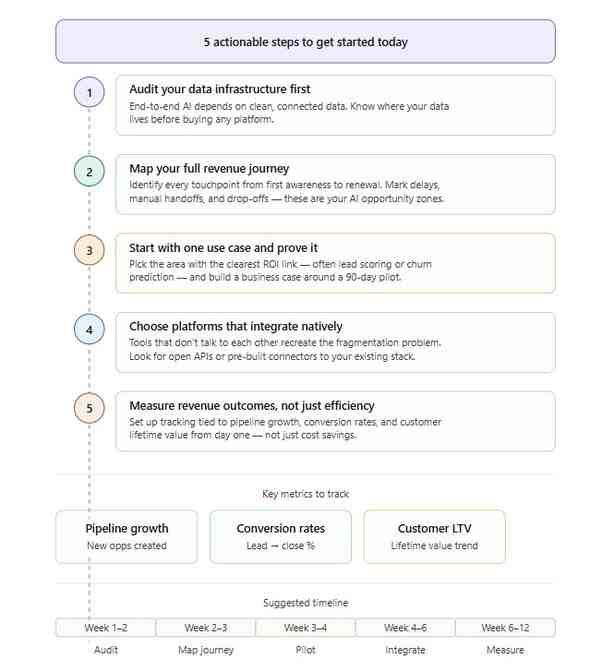
 Actionable Steps To Get Started Today
-
Audit your data infrastructure first: End-to-end AI solutions depend on clean, connected data. Before buying any platform, understand where your data lives and whether your core systems (CRM, website, product) can share it.
-
Map your full revenue journey: Identify every customer touchpoint from first awareness to renewal. Mark where delays, manual handoffs, or drop-offs exist. These are your highest-value AI opportunity zones.
-
Start with one use case and prove it: Don't try to automate everything at once. Pick the area with the clearest ROI link (often lead scoring or churn prediction) and build a business case around a 90-day pilot.
-
Choose platforms that integrate natively: Tools that don't talk to each other recreate the fragmentation problem. Look for platforms with open APIs or pre-built connectors to your existing stack.
-
Measure revenue outcomes, not just efficiency: Many AI projects get measured on cost savings or time saved. Set up tracking tied directly to pipeline growth, conversion rates, and customer lifetime value from day one.
The companies winning today aren't necessarily the ones with the biggest budgets.
They're the ones thinking about AI as a connected revenue system, not a set of isolated features.
FAQs on End-to-End AI Solutions
1. What are end-to-end AI solutions?
End-to-end AI solutions are integrated systems that connect all business functions from marketing to customer retention into one intelligent workflow.
2. How do end-to-end AI solutions increase revenue?
They improve key areas like targeting, personalization, pricing, and retention, working together to drive higher conversions and long-term growth.
3. Are end-to-end AI solutions expensive?
Not necessarily. Today, many platforms offer scalable and cost-effective options designed for mid-sized businesses.
4. How long does implementation take?
Most businesses start seeing initial results within 60 - 90 days, depending on the use case and data readiness.
Ready to Build Your AI Revenue Engine?
If you're looking to implement end-to-end AI solutions that actually drive measurable revenue, the first step is clarity.
-
Identify where your current system breaks
-
Connect your data across platforms
-
Start with one high-impact AI use case
The faster you act, the harder it becomes for competitors to catch up.