














6 Biggest Myths About AI Use Cases in Agriculture
Understand the 6 biggest myths about AI use cases in agriculture and how AI helps farmers improve yields, reduce risks, and modernize farming for the future of AI.
Every farming season comes with uncertainty - from unpredictable rain and pest attacks to rising costs and lower profits. Farmers today face more pressure than ever, and traditional methods alone are no longer enough.
Yet many still believe artificial intelligence is only for tech companies, not agriculture. In reality, AI use cases in agriculture are already helping farmers reduce risks, improve crop yields, detect diseases early, and make smarter farming decisions every day.
Why These Myths Exist - and Why They Matter
Many farmers still doubt AI because earlier farming technologies were expensive, complicated, and often failed to solve real agricultural problems. But modern AI Use Cases in Agriculture are now helping farms improve productivity, reduce waste, and make smarter decisions with real-time data and automation.
-
Past Technology Failures Built Distrust: Many farmers previously invested in tools and machinery that were costly, difficult to maintain, or failed to deliver expected results.
-
Lack of Rural Internet and Technical Support: Older digital farming systems depended heavily on internet access and technical expertise, making them difficult to use in remote farming areas.
-
Traditional Farming Experience Still Dominates Decisions: Farmers often rely on years of practical experience, making them cautious about adopting new AI-driven farming methods.
-
Modern AI Is Delivering Real Farming Results: Today’s AI-powered agriculture tools help with crop monitoring, smart irrigation, pest detection, and yield prediction, proving their real-world value across farms globally.
6 Myths Farmers Still Believe About AI in Agriculture
Myth 1: "AI Is Only for Big Corporate Farms"
The Truth: AI tools today scale to any farm size - including small family operations.
Many farmers think AI technology is too expensive or complicated for small-scale farming. But that is no longer true.
-
Affordable smartphone apps
-
Low-cost drones
-
Easy-to-use crop monitoring tools
are helping even small farmers improve productivity, reduce crop loss, and make better farming decisions without spending huge amounts of money.
Myth 2: "AI Can't Handle Unpredictable Weather"
The Truth: Weather unpredictability is exactly the problem AI was built to solve.
Modern agricultural AI systems pull data from satellite feeds, IoT weather sensors, and historical climate records to generate hyperlocal weather forecasts with 48 to 72-hour accuracy windows.
This allows farmers to make irrigation, harvesting, and pesticide application decisions based on real-time environmental data rather than guesswork.
Myth 3: "Drones and Sensors Are Too Expensive and Complicated"
The Truth: Entry-level drones for farm monitoring now cost less than $1,000, and most can be easily operated using simple mobile apps.
Drone technology has become one of the fastest-growing AI use cases in agriculture.
Modern drones with smart cameras and AI software can scan large farming areas in a single flight and detect crop stress, nutrient problems, and pest attacks early, even before farmers can see visible damage with their eyes.
Myth 4: "AI Can't Detect Crop Diseases or Pests Accurately"
The Truth: AI-powered pest detection is now faster and more accurate than traditional manual crop inspections.
AI systems trained with millions of crop images can quickly identify plant diseases and pests with very high accuracy.
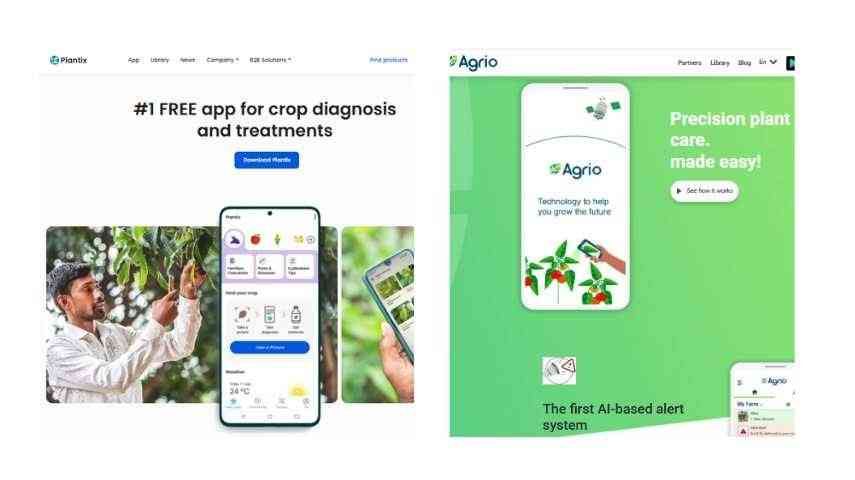
Farmers can simply take a photo of a damaged leaf using apps like Plantix and Agrio to get instant disease detection and treatment suggestions without needing an expert to visit the farm.
 Myth 5: "AI Livestock Tracking Is Science Fiction"
The Truth: AI-powered livestock monitoring is already a standard practice on dairy and cattle farms across North America, Europe, and Australia.
AI technology is now helping farmers monitor animal health more easily and accurately.
Smart sensors, GPS collars, and AI cameras can track
-
animal movement
-
eating habits
-
body temperature
-
health behavior in real time
Platforms like Connecterra and Allflex use AI and machine learning to detect early signs of illness or fertility issues - often before farmers notice them manually.
Myth 6: "Yield Prediction Is Just Guesswork - AI Can't Change That"
The Truth: AI-powered yield prediction models are transforming how farmers plan, finance, and market their harvests.
By integrating satellite imagery, historical yield data, soil composition analysis, and weather forecasts, machine learning models can now predict end-of-season crop yields with 85 - 90% accuracy months before harvest.
This enables smarter decisions around crop insurance, futures contracts, storage capacity, and logistics planning.
Real - World Case Study: John Deere See & Spray Technology
One of the most powerful examples of AI Use Cases in Agriculture is the technology developed by John Deere.
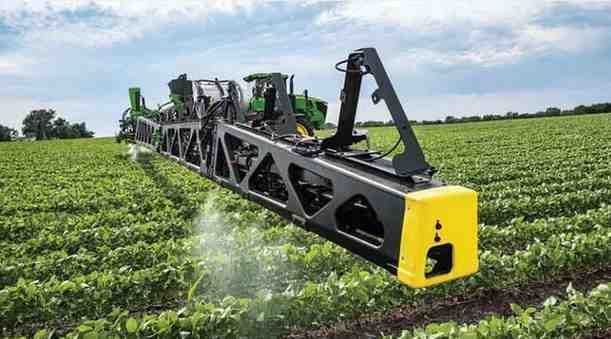
Their See & Spray™ technology uses computer vision and AI-powered systems to identify weeds in real time during spraying operations.
How It Works
The system uses cameras and machine learning algorithms to distinguish weeds from crops. Instead of spraying chemicals across the entire field, the machine targets only unwanted weeds.
Key Benefits
-
Reduced herbicide usage
-
Lower farming costs
-
Better crop protection
-
Improved environmental sustainability
-
Higher operational efficiency
According to John Deere See & Spray Technology, this precision spraying technology helps farmers apply chemicals more accurately while minimizing waste.
This case study clearly shows how AI is already delivering measurable benefits in modern farming.
 Traditional Farming vs. AI-Powered Farming: A Comparison
|
Feature |
Traditional Farming |
AI-Powered Farming |
|
Irrigation Management |
Fixed schedules, manual monitoring |
Real-time sensor data, automated adjustment |
|
Pest & Disease Detection |
Visual scouting, reactive treatment |
AI image recognition, predictive alerts |
|
Crop Monitoring |
Weekly field walks |
Continuous satellite + drone surveillance |
|
Yield Prediction |
Experience-based estimates |
ML models with 85 - 90% accuracy |
|
Herbicide Application |
Broadcast spraying (entire field) |
Targeted spot-spraying (weeds only) |
|
Livestock Health |
Daily manual checks |
24/7 sensor monitoring with AI alerts |
|
Soil Analysis |
Seasonal lab tests |
Continuous IoT sensor data + AI modeling |
|
Decision-Making |
Intuition and experience |
Data-driven insights with actionable reports |
|
Labor Requirements |
Many manual tasks |
Reduced automation handles routine work |
|
Input Cost Control |
Limited visibility |
AI optimization reduces waste by 15 - 30% |
The Future of AI in Farming
The next wave of AI use cases in agriculture is already taking shape. Autonomous tractors equipped with computer vision are beginning commercial operations, capable of planting, cultivating, and harvesting without a human in the cab.
Generative AI tools are being piloted to help farmers write crop management plans, interpret sensor data, and communicate with agri-finance institutions.
Vertical farming operations are using AI to control every environmental variable, light spectrum, CO₂ levels, and nutrient delivery, with a level of precision impossible to achieve manually. And blockchain-integrated AI systems are creating fully traceable supply chains from seed to shelf, unlocking premium market access for farmers who adopt them.
The farms that invest in AI literacy today will be the farms that survive and thrive in the next decade.
Challenges Farmers May Face When Adopting AI
Honest adoption starts with acknowledging real barriers:
-
Connectivity gaps: Many rural areas still lack reliable broadband, limiting cloud-based AI tools. Offline-capable systems and satellite internet solutions like Starlink are beginning to address this.
-
Upfront investment costs: Even as prices fall, the initial cost of sensors, drones, or AI software can be prohibitive for small operations without access to agri-finance.
-
Data literacy: Interpreting AI outputs requires some level of training. Misreading a recommendation can lead to poor decisions.
-
Integration complexity: Legacy farm equipment may not be compatible with modern AI platforms without additional hardware or middleware.
-
Trust and change resistance: Decades of farming tradition create legitimate hesitation around handing decisions to algorithms, particularly when the stakes are an entire season's income.
Practical AI Adoption Tips for Farmers
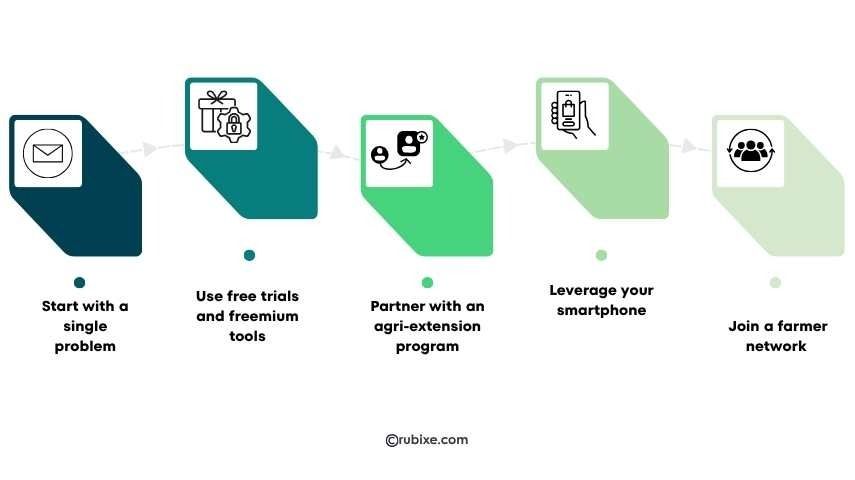
You do not need to change your entire operation overnight. Here is how to start:
-
Start with a single problem - choose one pain point (irrigation, pest monitoring, or yield tracking) and find an AI tool specifically built to solve it.
-
Use free trials and freemium tools - many platforms offer free tiers for small acreages. Plantix, for example, is free for disease detection.
-
Partner with an agri-extension program - government agricultural bodies and universities often subsidize or provide free access to precision farming tools.
-
Leverage your smartphone - AI use cases in agriculture increasingly run on mobile, requiring no special hardware at all.
-
Join a farmer network - communities of early adopters share real-world results, troubleshooting advice, and vendor reviews that no sales pitch can match.
Ready to Bring AI Into Your Farming Operations?
Whether you want to improve one farming process or fully modernize your agricultural business, this is the right time to start using AI in agriculture. From precision farming tools to smart crop monitoring systems, AI can help farmers save time, reduce losses, and improve productivity.
The future of farming is already changing with AI technology, and the farms that adapt early will have the biggest advantage.