




How Does AI Recruitment Automation Reduce Hiring Time?
Reduce time-to-hire by up to 50% with AI recruitment automation. Learn how automated screening and scheduling speed up hiring without losing quality.
If hiring a single role is taking weeks, the issue is rarely the candidate pool - it is the process behind it. Manual resume screening, delayed interview coordination, and inconsistent shortlisting create bottlenecks that slow everything down. AI recruitment automation addresses these gaps by handling high-volume, repetitive tasks with speed and accuracy. Instead of adding more recruiters, organizations are now fixing the process itself using AI hiring software.
Let’s break down how the system works in real scenarios, where time is actually saved, and how businesses are reducing hiring cycles while maintaining better control over candidate quality.
AI Recruitment Automation Explained
AI recruitment automation is the use of artificial intelligence to handle repetitive and data-driven hiring tasks such as resume screening, candidate evaluation, and interview coordination with speed and consistency.
It works by analyzing hiring data the way a recruiter would - but at a much faster scale. Instead of manually reviewing each application, the system reads resumes, understands job requirements, and identifies the most relevant candidates automatically.
This is made possible through:
-
Natural Language Processing (NLP): interprets resumes and job descriptions in context
-
Machine Learning (ML): learns from past hiring decisions to improve candidate selection
-
Scoring models: rank candidates based on skills, experience, and role fit
The purpose of AI recruitment automation is not to replace recruiters. Its role is to remove time-consuming tasks such as resume filtering, initial communication, and interview scheduling.
By handling these operational steps, it allows recruiters to focus on evaluating candidates, conducting meaningful interviews, and making informed hiring decisions.
A study by LinkedIn Talent Solutions (2024) highlights that over 67% of hiring teams use AI tools to improve hiring speed and quality.
According to Gartner HR Research: AI can automate up to 40% of recruitment tasks
Key Use Cases of AI in Recruitment
Resume Parsing: AI converts unstructured resumes into structured data by identifying skills, experience, and education. This makes it easy to filter and organize large volumes of applications instantly.
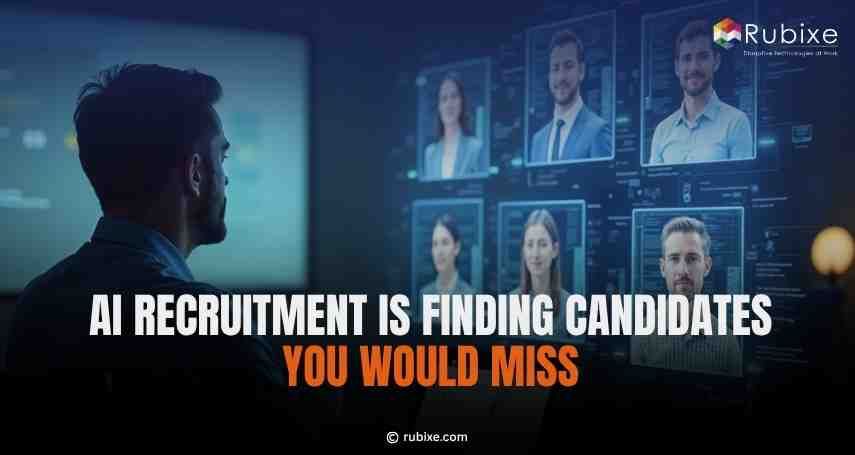
AI Resume Screening: AI goes a step further by evaluating resumes against job requirements. AI resume screening filters out irrelevant profiles and highlights the most suitable candidates within minutes, significantly reducing manual screening time.
Candidate Matching: Instead of relying only on keywords, AI understands the role context and matches candidates based on relevant and transferable skills. It also prioritizes high-fit candidates, making shortlisting faster and more accurate.
Chatbots: AI chatbots handle early-stage communication by answering candidate queries, collecting basic information, and sharing updates. This keeps the process moving without delays and reduces manual effort.
Interview Automation: AI tools streamline interviews by scheduling them automatically, conducting initial screening rounds, and analyzing responses using behavioral signals. This helps teams move candidates forward quickly with better clarity.
Benefits of AI Recruitment Automation
AI recruitment automation delivers value where hiring usually slows down, time, cost, quality, and scale. Instead of adding more effort, it improves how the process runs.
1. Time Efficiency
The biggest impact is on speed. Resume screening that usually takes hours or even days is completed within minutes. Shortlisting becomes faster, and interview coordination happens without repeated follow-ups. This reduces delays across the entire hiring cycle.
2. Cost Reduction
When repetitive tasks are automated, the need for manual effort drops. Teams spend less time on administrative work, which directly lowers hiring costs. It also reduces the need to scale recruitment teams during high-volume hiring.
3. Improved Hiring Quality
AI evaluates every application using consistent criteria. Candidates are shortlisted based on relevance, skills, and experience rather than manual judgment alone. This leads to more reliable shortlisting and better hiring decisions at later stages.
4. Scalability
AI systems can handle large volumes of applications without slowing down. Whether it is 100 or 10,000 resumes, the processing time remains stable. This makes it easier to manage bulk hiring without compromising speed or accuracy.
In practice, these benefits work together faster processes reduce costs, better screening improves quality, and scalability ensures the system performs consistently even under pressure.
According to McKinsey (2023): Automation in HR improves productivity by 20–30%
How AI Recruitment Automation Reduces Hiring Time
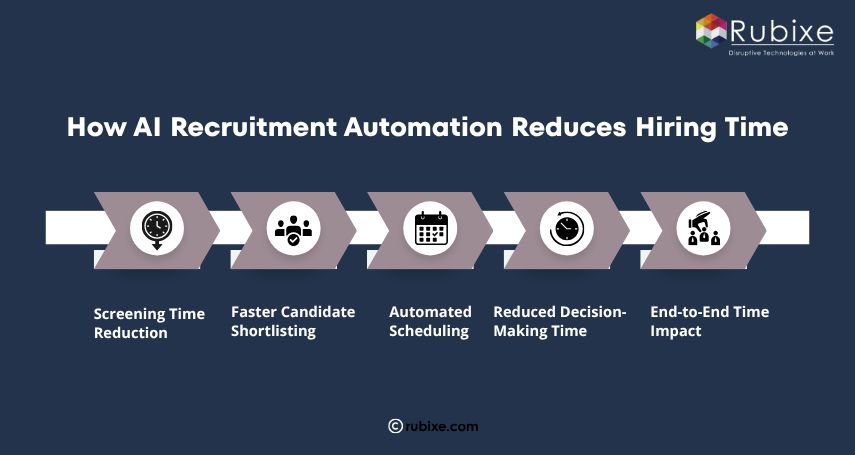
This is where the real impact happens. Hiring delays usually build up across multiple stages not just one. AI recruitment automation reduces time by fixing each of these stages with speed and consistency.
1. Screening Time Reduction
Screening is where most hiring time is lost.
In a typical scenario, a recruiter may review around 300 resumes for a single role. Even if each resume takes just a few seconds, the total time quickly adds up to several hours. More importantly, most of that effort goes into filtering out irrelevant profiles.
With AI in place, this process changes completely. The system reads and evaluates all resumes instantly, based on skills, experience, and role requirements. Instead of going through every application, recruiters receive a filtered list of the most relevant candidates.
The result is clear - what used to take hours is completed in minutes, reducing screening time by nearly 70–80%.
2. Faster Candidate Shortlisting
After screening, the next delay comes from comparing candidates and deciding who should move forward.
AI simplifies this by ranking candidates automatically. It removes irrelevant profiles, identifies duplicates, and presents a shortlist based on how well each candidate matches the role.
This means recruiters are not starting from scratch - they are working with a prioritized list. As a result, shortlisting that usually takes a day or two can be completed much faster with better clarity.
3. Automated Scheduling
Scheduling interviews often creates unexpected delays. Coordinating between candidates and interviewers involves multiple emails, follow-ups, and rescheduling.
AI removes this friction by handling scheduling automatically. It checks availability, suggests time slots, sends invites, and even triggers reminders.
What usually takes a few days of coordination can be reduced to a few hours, keeping the hiring process moving without interruptions.
4. Reduced Decision-Making Time
Decision-making slows down when there is too much unstructured information. Recruiters and hiring managers spend time comparing candidates, reviewing notes, and aligning internally.
AI addresses this by providing structured insights such as candidate scores, skill comparisons, and role-fit analysis. This makes it easier to evaluate candidates quickly and confidently.
As a result, teams spend less time in discussions and reduce unnecessary interview rounds.
5. End-to-End Time Impact
When improvements at each stage are combined, the overall hiring timeline reduces significantly. Screening becomes faster, shortlisting is clearer, scheduling is immediate, and decisions are more structured.
In real hiring environments, this often leads to a reduction of 40–50% in total hiring time, depending on the role and volume of applications.
In simple terms, AI recruitment solutions do not speed up just one part of hiring, it improves the entire workflow. That is what makes the reduction in hiring time both consistent and scalable.
According to IBM Institute for Business Value: AI-driven recruitment can reduce time-to-hire by up to 50%
Let’s look at a real example to understand this clearly: A mid-sized IT company hiring for 20 roles:
|
Stage |
Before AI Recruitment Automation |
After AI Recruitment Automation |
|
Screening |
5 Days |
1 Day |
|
Shortlisting |
3 Days |
1 Day |
|
Scheduling |
4 Days |
1 Day |
|
Total Time |
12 Days |
3-5 Days |
Result: ~65% reduction in hiring time
AI vs Traditional Recruitment: What’s the Difference?
|
Factor |
Traditional Recruitment |
AI Recruitment Automation |
|
Screening |
Manual |
Automated |
|
Speed |
Slow |
Fast |
|
Candidate Matching |
Keyword-based |
Context-based |
|
Scheduling |
Manual |
Automated |
|
Decision Making |
Experience-driven |
Data-driven |
|
Scalability |
Limited |
High |
Build Faster Hiring Systems with Rubixe
If hiring delays are slowing your business growth, the problem is usually within the process, not the team. Rubixe helps businesses implement AI recruitment automation with practical workflows that reduce screening time, eliminate coordination gaps, and improve hiring decisions.
From selecting the right AI hiring software to building scalable recruitment systems, the focus stays on practical results.
Connect with the Rubixe team to evaluate your current hiring process and identify where AI can create immediate impact. Start building a smarter, faster recruitment system designed for real business results.
AI recruitment automation reduces hiring time by removing delays at every stage of the hiring process. From resume screening to scheduling and decision-making, each step becomes faster and more structured. The real advantage comes from combining automation with clear workflows and continuous optimization. Organizations that implement it effectively see faster hiring cycles, better candidate quality, and improved overall efficiency.