






Top AI ML Development Services for Growing Businesses
Explore the top AI ML development services helping growing businesses automate operations, improve decision-making, reduce costs, and scale faster with intelligent technology solutions.
Businesses are under constant pressure to move faster, reduce inefficiencies, and make smarter decisions with growing volumes of data. Traditional systems often struggle to keep pace with changing customer behavior, operational complexity, and rising market competition.
That shift explains why AI ML development services have become a major growth driver across industries. Companies today use artificial intelligence and machine learning to automate workflows, improve forecasting, personalize customer experiences, and optimize business operations at scale.
Organizations adopting AI strategically are improving productivity, accelerating decision-making, and creating stronger long-term operational efficiency, while competitors continue to rely heavily on manual systems.
Why Businesses Are Investing in AI ML Development Services
Artificial intelligence and machine learning have evolved far beyond experimental technology. Businesses now integrate AI into daily operations to improve speed, accuracy, and scalability.
According to PwC, AI could contribute nearly $15.7 trillion to the global economy by 2030. Gartner also reports that businesses increasing AI adoption continue prioritizing automation, predictive analytics, and intelligent decision systems.
The challenge for many companies involves implementation.
Building AI infrastructure internally requires expertise in:
-
Data engineering
-
Machine learning models
-
Cloud architecture
-
Predictive analytics
-
Intelligent system integration
That complexity drives demand for professional AI ML development services.
An experienced AI company helps businesses design, deploy, and optimize AI-powered systems aligned with operational goals and future scalability.
What Are AI ML Development Services?
AI ML development services involve building intelligent systems that learn from data, automate business processes, and improve decision-making through predictive analysis.
These services support businesses across multiple functions, including:
|
Business Function |
AI ML Capability |
|
Customer service |
Intelligent automation |
|
Sales forecasting |
Predictive analytics |
|
Fraud detection |
Pattern recognition |
|
Inventory planning |
Demand forecasting |
|
Marketing personalization |
Behavioral analysis |
|
Process automation |
Workflow optimization |
Businesses increasingly adopt AI services to improve operational efficiency while reducing repetitive manual work.
Top AI ML Development Services Businesses Use Today
Growing businesses adopt AI differently depending on operational goals, industry requirements, and scalability needs.
Several AI ML development services consistently deliver strong business impact.
1. Machine Learning Model Development
Machine learning models analyze historical data and improve continuously over time.
Businesses use machine learning to:
-
Predict customer behavior
-
Forecast demand
-
Detect anomalies
-
Improve pricing strategies
-
Optimize supply chains
For example, an e-commerce company can use machine learning models to recommend products based on browsing behavior and purchase history. That improves customer engagement and increases conversion rates significantly.
Machine learning also improves forecasting accuracy in industries such as retail, logistics, healthcare, cybersecurity, and finance.
2. Predictive Analytics Solutions
Predictive analytics helps businesses anticipate future outcomes using historical and live data.
Companies use predictive systems for:
-
Revenue forecasting
-
Customer churn prediction
-
Maintenance planning
-
Risk assessment
-
Sales trend analysis
Predictive analytics helps leadership teams make faster and more informed decisions.
For example, a manufacturing company using predictive maintenance systems can identify equipment issues before breakdowns occur, reducing downtime and maintenance costs.
Businesses adopting AI and ML in automation often improve operational planning significantly.
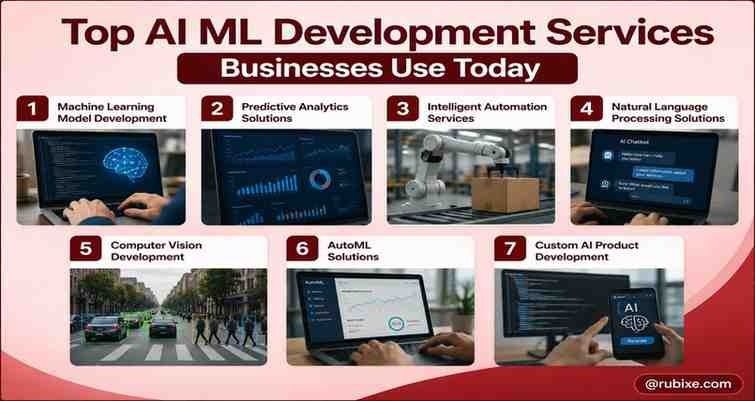 3. Intelligent Automation Services
Many organizations spend excessive time on repetitive operational tasks.
Intelligent automation combines AI with workflow automation to improve efficiency across departments.
Common applications include:
-
Invoice processing
-
HR workflows
-
Customer support
-
Document verification
-
Data entry
-
Compliance monitoring
According to Deloitte, companies implementing intelligent automation report major reductions in operational costs and process delays.
4. Natural Language Processing Solutions
Natural Language Processing allows systems to understand and process human language.
Businesses use NLP technologies for:
-
Virtual assistants
-
Chatbots
-
Sentiment analysis
-
Voice recognition
-
Automated document analysis
AI-powered communication systems help companies improve customer engagement and response efficiency.
5. Computer Vision Development
Computer vision enables machines to interpret visual data.
Industries using computer vision include:
-
Manufacturing
-
Healthcare
-
Retail
-
Security
-
Automotive
Applications often involve:
-
Quality inspection
-
Facial recognition
-
Defect detection
-
Medical imaging analysis
-
Automated monitoring
For example, manufacturers use computer vision systems to identify production defects instantly, improving quality control while reducing inspection time.
6. AutoML Solutions
Many growing businesses lack large internal AI teams capable of building complex machine learning systems manually.
AutoML platforms simplify model development by automating several machine learning processes, including:
-
Data preparation
-
Model selection
-
Performance optimization
-
Hyperparameter tuning
AutoML helps businesses accelerate AI adoption while reducing technical complexity.
This approach benefits organizations aiming to deploy AI efficiently without extensive development overhead.
7. Custom AI Product Development
Many businesses require specialized AI systems designed around unique operational requirements.
Custom AI products may include:
-
Recommendation engines
-
AI copilots
-
Predictive dashboards
-
Workflow intelligence platforms
-
Smart CRM systems
-
Operational analytics tools
Custom development provides stronger flexibility and scalability compared to generic software solutions.
How AI ML Development Services Help Growing Businesses
The biggest advantage of AI adoption involves operational efficiency combined with smarter decision-making.
Faster Decision-Making
AI systems process large datasets rapidly, helping businesses improve:
-
Revenue forecasting
-
Customer analysis
-
Inventory planning
-
Operational monitoring
-
Market trend evaluation
Faster insights improve strategic execution.
Reduced Operational Costs
Automation reduces dependency on repetitive manual work.
Businesses using AI ML development services often lower costs across:
-
Customer support
-
Administrative workflows
-
Data processing
-
Reporting systems
-
Compliance management
Operational efficiency improves scalability significantly.
Better Customer Experiences
Modern customers expect:
-
Personalized communication
-
Faster support
-
Relevant recommendations
-
Seamless digital experiences
AI systems help businesses deliver stronger customer engagement through predictive personalization and intelligent support automation.
Streaming platforms, e-commerce companies, and financial institutions already rely heavily on AI-driven personalization systems.
Improved Business Scalability
Growing businesses often struggle when operations expand faster than internal systems can handle.
AI-powered automation helps organizations scale workflows without proportional increases in operational complexity.
That creates stronger long-term efficiency.
Industries Seeing Strong Growth Through AI ML Development
AI adoption continues accelerating across multiple sectors.
Healthcare
Healthcare providers use AI for:
-
Diagnostic support
-
Medical imaging analysis
-
Patient monitoring
-
Predictive care planning
AI improves operational efficiency while supporting clinical accuracy.
Retail and E-Commerce
Retail companies use AI for:
-
Personalized recommendations
-
Dynamic pricing
-
Inventory forecasting
-
Customer analytics
Amazon’s recommendation engine reportedly contributes a significant percentage of overall sales revenue.
Manufacturing
Manufacturers deploy AI systems for:
-
Predictive maintenance
-
Robotics automation
-
Supply chain optimization
-
Quality inspection
Reducing downtime alone creates substantial cost savings.
Financial Services
Financial organizations use AI for:
-
Risk assessment
-
Credit analysis
-
Automated compliance
-
Trading intelligence
AI improves both security and operational speed.
Where Businesses Often Go Wrong With AI Adoption
Many organizations invest in AI without establishing clear operational goals.
That creates implementation problems quickly.
1. Focusing on Technology Instead of Business Outcomes
Successful AI implementation begins with operational challenges and measurable objectives.
Businesses should identify:
-
Which processes create inefficiencies
-
Which workflows require automation
-
Which decisions depend heavily on data analysis
A strong strategy improves implementation success significantly.
2. Poor Data Quality
AI systems rely heavily on structured and accurate data.
Incomplete datasets weaken model performance and reduce prediction accuracy.
3. Choosing Generic Solutions
Every business operates differently.
Generic AI systems often fail to support industry-specific workflows effectively.
Custom implementation usually creates stronger long-term scalability.
4. Ignoring Employee Adoption
Technology adoption succeeds when teams understand how AI improves workflows.
Training and operational alignment remain essential during implementation.
5. How to Choose the Right AI ML Development Partner
Selecting the right development partner influences long-term AI success heavily.
Businesses should evaluate several factors carefully.
6. Industry Experience
AI implementation varies across industries.
A healthcare AI solution differs significantly from manufacturing automation or retail analytics.
Industry expertise improves deployment quality.
7. Scalability
AI systems should support future growth.
Strong solutions scale across:
-
Larger datasets
-
Higher workloads
-
Multiple departments
-
Cloud environments
8. Long-Term Support
AI systems improve continuously through optimization and monitoring.
Businesses should prioritize providers offering ongoing refinement and support services.
Companies exploring scalable AI automation tools often benefit from long-term implementation partnerships.
The Future of Business Growth Will Depend on Intelligent Automation
AI adoption continues to accelerate because businesses increasingly depend on operational speed, predictive intelligence, and automation efficiency.
Organizations using AI ML development services effectively gain:
-
Faster execution
-
Better forecasting
-
Improved scalability
-
Stronger customer experiences
-
Reduced operational costs
-
Smarter decision-making
Meanwhile, businesses relying heavily on manual systems face increasing pressure from faster-moving competitors.
AI and machine learning will continue shaping how businesses operate, compete, and grow over the next decade.
FAQs
1. What are AI ML development services?
AI ML development services involve building intelligent systems that automate workflows, analyze data, improve forecasting, and support business decision-making using artificial intelligence and machine learning.
2. How do AI ML services help businesses?
AI ML services help businesses improve efficiency, reduce operational costs, automate repetitive tasks, and generate stronger business insights from data.
3. Which industries use AI ML development services the most?
Healthcare, retail, manufacturing, finance, logistics, and e-commerce industries actively use AI and machine learning technologies.
4. What is AutoML?
AutoML automates several machine learning development processes, such as model selection, optimization, and data preparation, helping businesses accelerate AI deployment.
5. How do businesses choose the right AI company?
Businesses should evaluate industry expertise, scalability, technical capabilities, long-term support, and implementation experience before selecting an AI partner.
AI and machine learning have become major drivers of operational growth, automation efficiency, and business scalability. Organizations adopting intelligent systems strategically improve decision-making, customer engagement, and long-term productivity.
The right implementation partner helps businesses avoid costly deployment mistakes while accelerating innovation opportunities.
For organizations exploring intelligent automation, scalable digital systems, and advanced AI implementation, Rubixe delivers business-focused solutions designed to support sustainable growth in an increasingly competitive market. Connect with Rubixe experts to explore AI strategies tailored to your operational and business goals.