










Why Most AI Consulting Projects Fail Before Delivering Results
Many AI consulting projects fail before delivering results. Discover common challenges, costly mistakes, and proven strategies for AI success.
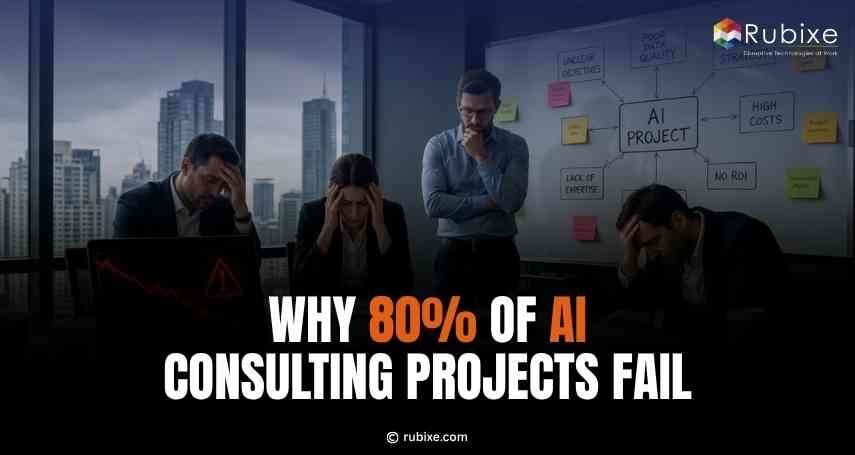
AI adoption has moved from experimentation to enterprise priority. Enterprises, startups, and mid-sized companies are investing heavily in automation, predictive analytics, AI-powered operations, and generative AI systems.
Yet a large percentage of initiatives fail before reaching production due to poor planning and the absence of an experienced AI consulting partner.
According to IBM, only 25% of companies achieve the AI outcomes they expected from implementation efforts.
Poor planning, disconnected data systems, unclear ownership, and unrealistic expectations continue to derail projects before meaningful business impact appears.
The problem rarely begins with technology. Strategy gaps create a bigger risk.
Companies rush into AI adoption without fully understanding deployment requirements, governance structures, workflow integration, or operational alignment. That is where a clear understanding of AI Consulting plays a critical role.
The Hidden Reason Many AI Projects Collapse Early
 Most failed AI projects begin with enthusiasm instead of operational clarity.
Leadership teams hear success stories about automation or generative AI and immediately begin searching for tools. Vendors promise rapid transformation. Internal teams feel pressure to “implement AI fast.”
What gets ignored:
-
Process maturity
-
Integration complexity
-
Change management
-
Long-term maintenance
-
ROI validation
The result is predictable.
The AI model may technically function, yet the business sees little operational improvement.
A retail company may deploy demand forecasting AI while inventory systems remain fragmented across departments.
A healthcare provider may introduce AI-powered diagnostics without structured patient data.
A logistics startup may automate customer support while escalation workflows remain broken.
Technology alone cannot repair operational gaps.
1. AI Consulting Fails When Business Problems Are Undefined
One of the biggest mistakes companies make is starting with tools instead of business outcomes.
An AI consultant cannot create value from vague objectives like:
-
“We want AI automation”
-
“We need generative AI”
-
“We want smarter operations”
Strong AI Consulting begins with an AI maturity assessment to evaluate an organization’s capability to adopt and scale AI.
The first question should always be:
Which business bottleneck creates the highest financial or operational loss?
|
Business Problem |
AI Opportunity |
|
High customer support load |
AI-assisted ticket triage |
|
Manual invoice processing |
Intelligent document automation |
|
Poor sales forecasting |
Predictive analytics |
|
High employee attrition |
Workforce prediction models |
|
Supply chain delays |
AI demand forecasting |
Without defined operational targets, AI becomes an expensive experiment.
A strong AI consulting framework connects technology decisions directly to operational KPIs.
2. Poor Data Quality Quietly Destroys AI Performance
Many executives underestimate how dependent AI systems are on data quality.
AI models learn patterns from historical information. If the data is inconsistent, incomplete, duplicated, or outdated, outputs become unreliable.
According to Gartner, poor data quality costs organizations an average of $12.9 million annually.
This issue becomes severe during enterprise AI implementation.
Common data problems include:
-
Multiple disconnected software systems
-
Unstructured documents
-
Missing historical records
-
Inconsistent customer information
-
Department-level data silos
An inexperienced AI consulting firm may jump directly into model development.
Mature AI Consulting starts with infrastructure and data readiness.
For instance, a financial services company wants fraud detection automation. Initial model accuracy remains extremely poor. Investigation reveals transaction records across regions followed different formatting standards.
The AI model was functioning correctly. The data ecosystem was broken.
After standardizing datasets and creating centralized pipelines, prediction accuracy improved significantly.
AI success often depends more on data engineering than algorithm complexity.
3. Leadership Expectations Often Damage AI Projects
Many AI initiatives fail because executives expect immediate transformation.
Business leaders sometimes assume AI deployment will instantly reduce costs, improve productivity, and replace manual operations.
In practice, successful implementation happens in phases.
A mature AI adoption cycle usually looks like this:
-
Business assessment
-
Data preparation
-
Pilot deployment
-
Workflow integration
-
Performance refinement
-
Scaling operations
Skipping these stages creates internal chaos.
According to McKinsey, organizations achieving the highest AI impact focus heavily on operational redesign and governance alongside technology implementation.
A strategic AI consultant should help leadership teams build realistic deployment timelines, adoption roadmaps, and ROI expectations.
That reduces friction between executives, IT teams, operations, and employees.
4. AI Consulting Projects Fail Without Cross-Team Ownership
AI implementation affects multiple departments simultaneously.
That creates a major operational challenge.
When ownership remains unclear, AI projects slow down or collapse completely.
Typical failure patterns include:
-
IT teams waiting for business approvals
-
Operations teams resisting workflow changes
-
Leadership expecting instant ROI
-
Data teams lacking governance authority
-
Employees avoiding adoption
Successful AI Consulting framework creates alignment between:
-
Leadership
-
Operations
-
IT infrastructure
-
Data engineering
-
Compliance
-
End users
This coordination matters more than most companies realize.
Even powerful AI systems fail when employees refuse to integrate them into daily workflows.
5. Many AI Consulting Companies Oversell Capabilities
The AI consulting market has exploded rapidly. Many providers now position themselves as AI experts despite limited implementation experience.
That creates a dangerous environment for businesses investing large budgets.
Some AI consulting companies focus heavily on presentations and prototypes while lacking experience in:
-
Enterprise integration
-
AI governance
-
Scaling infrastructure
-
Long-term optimization
-
Security compliance
-
Operational deployment
This creates a gap between demo-stage excitement and production-level execution.
Experienced firms approach projects differently.
They assess operational readiness before recommending solutions. They identify risks early. They challenge unrealistic expectations. They prioritize business value over trend-driven experimentation.
That strategic discipline protects companies from costly implementation failures.
Why AI Projects Fail After Successful Pilots

A pilot proving technical feasibility does not guarantee business scalability.
This is where many companies get trapped.
An AI model may perform well inside controlled testing environments yet struggle after deployment across departments, users, or regions.
Common scaling challenges include:
-
Infrastructure limitations
-
Cloud cost escalation
-
API instability
-
Workflow bottlenecks
-
Security restrictions
-
Compliance requirements
According to IDC, worldwide AI spending is expected to exceed $630 billion by 2028, increasing pressure on organizations to scale implementations effectively.
An experienced AI consulting firm plans scalability from the beginning instead of treating it as a later-stage problem.
That includes:
-
Infrastructure architecture
-
Monitoring systems
-
Governance controls
-
Workflow adaptability
-
Performance optimization
The Biggest Difference Between Failed and Successful AI Consulting
Successful companies treat AI as an operational transformation initiative.
Failed companies treat AI as a software purchase.
That difference changes everything.
Strong AI Consulting focuses on:
-
Business Alignment: AI initiatives connect directly to measurable operational outcomes.
-
Risk Reduction: Security, compliance, scalability, and governance are addressed early.
-
Workflow Integration: AI systems support existing operations instead of disrupting them unnecessarily.
-
Long-Term Optimization: Models evolve continuously using performance monitoring and updated datasets.
-
Employee Adoption: Teams receive training, process clarity, and operational support.
This is where strategic firms create long-term value.
What Businesses Should Evaluate Before Hiring an AI Consultant
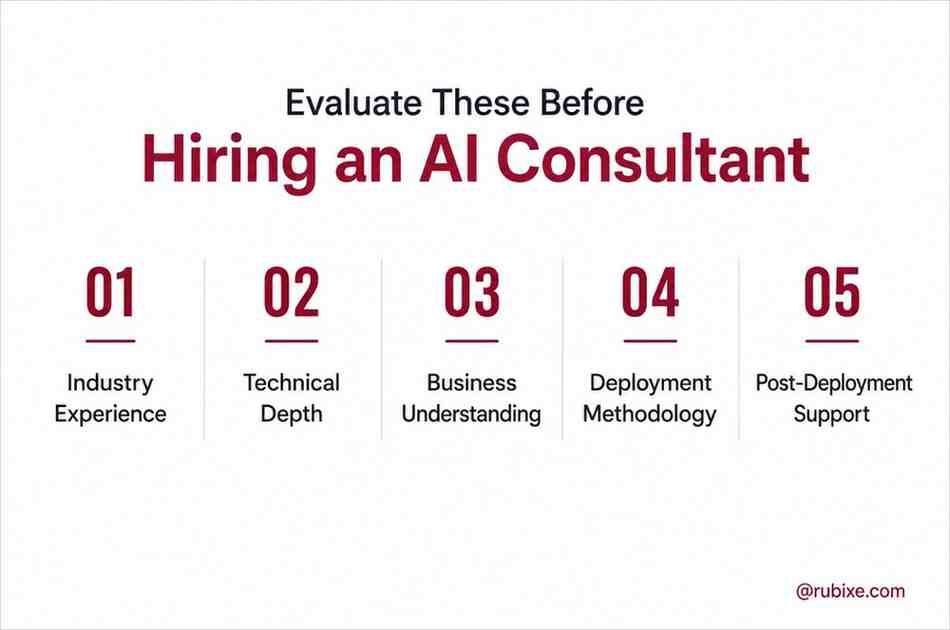 Before selecting an AI consultant, companies should evaluate several critical areas.
1. Industry Experience
Has the firm handled deployment challenges within your sector?
Healthcare, finance, logistics, retail, and manufacturing all carry different operational requirements.
2. Technical Depth
Can the team manage:
-
Data pipelines
-
AI architecture
-
Cloud deployment
-
Security
-
Integration
3. Business Understanding
Technology expertise alone is insufficient.
Strong AI Consulting requires operational thinking and commercial awareness.
4. Deployment Methodology
Ask for a detailed AI consulting roadmap, including:
-
Assessment phase
-
Pilot stage
-
Deployment timeline
-
Governance process
-
Scaling strategy
5. Post-Deployment Support
AI systems require continuous optimization after launch.
Without long-term monitoring, performance degradation becomes inevitable.
A Smarter Approach to AI Consulting
Companies achieving strong AI outcomes follow a more disciplined approach.
Instead of asking:
“Which AI tool should we buy?”
They ask:
-
Which operational bottlenecks create the highest losses?
-
Which processes contain repetitive decision patterns?
-
Which data assets already exist internally?
-
Which teams will use the system daily?
-
Which KPIs will measure success?
That shift changes AI from experimentation into strategic infrastructure. The right AI services help organizations reduce deployment risk, improve operational efficiency, and create scalable business value over time.
Successful AI implementation depends on far more than choosing the right tools. Businesses need strong operational alignment, reliable data systems, scalable infrastructure, and a clear deployment strategy to achieve measurable results.
At Rubixe, AI consulting focuses on identifying operational bottlenecks early, reducing deployment risks, and building AI solutions aligned with real business outcomes.
By combining operational understanding with strategic AI implementation planning, the team helps businesses avoid costly mistakes, improve scalability, and build AI systems that support long-term operational growth.
Businesses that approach AI strategically are far more likely to achieve sustainable growth, operational efficiency, and successful large-scale adoption. Choosing the right AI consulting partner plays a critical role in that success.
FAQs
1. Why do most AI projects fail before deployment?
Most failures happen because of poor planning, unclear business objectives, weak data infrastructure, unrealistic expectations, and a lack of operational alignment across teams.
2. How does AI Consulting reduce project failure risk?
AI Consulting helps businesses evaluate readiness, improve data quality, create deployment strategies, align teams, and connect AI initiatives to measurable business outcomes.
3. What should companies look for in AI consulting companies?
Businesses should evaluate industry expertise, deployment experience, technical capabilities, governance processes, scalability planning, and post-launch support.
4. How long does a successful AI implementation usually take?
The timeline varies based on complexity, infrastructure readiness, and business goals. Enterprise-scale deployments often require several months across assessment, pilot testing, integration, and optimization stages.
5. Why do AI pilots succeed while large deployments fail?
Pilots operate inside controlled environments. Large-scale deployment introduces infrastructure challenges, workflow integration issues, security requirements, and user adoption complexities.