







Cognitive Automation vs Intelligent Automation: Key Differences
Cognitive vs Intelligent Automation explained. Learn key differences, use cases, and how to choose the right automation strategy for better ROI.
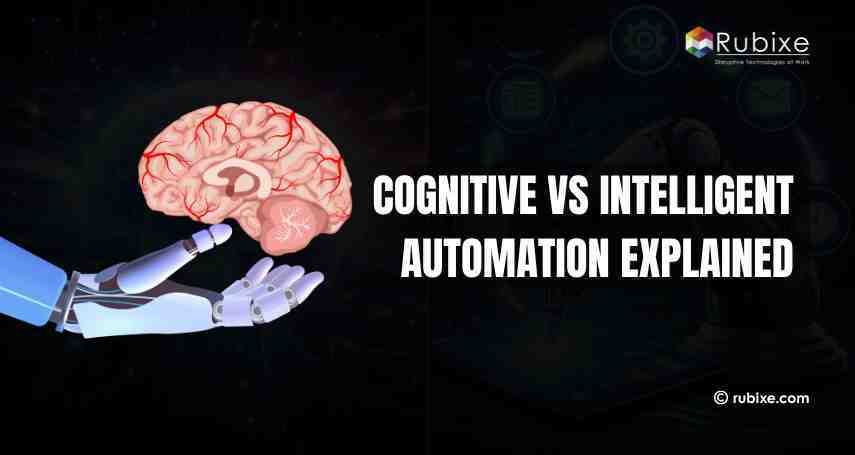
Cognitive Automation focuses on human-like decision support for specific tasks, while Intelligent Automation automates complete workflows using AI, RPA, and predictive analytics. Businesses choose Cognitive Automation for task-level intelligence and Intelligent Automation for end-to-end process efficiency and scalability.
What is Cognitive Automation?
Cognitive Automation focuses on mimicking human judgment to handle tasks that require interpretation and learning. It is designed to work with unstructured data and assist humans in decision-making. Organizations can leverage it to improve accuracy and efficiency in task-level processes.
Overview
Cognitive Automation refers to systems that mimic human thinking to execute tasks requiring judgment, interpretation, and learning. Unlike traditional automation, which is rule-based, cognitive automation leverages NLP, pattern recognition, and machine learning to process unstructured data, make recommendations, and support decision-making.
Core Capabilities
Natural Language Processing (NLP): Understands text-based inputs such as emails, chat messages, or forms, enabling automated interpretation of human communication.
Pattern Recognition: Identifies trends and anomalies across large datasets, helping detect irregularities or opportunities quickly.
Decision Support: Provides insights or recommendations to human operators for complex tasks, guiding better choices.
Data Interpretation: Converts unstructured information into actionable insights, ensuring meaningful output from raw data.
Learning & Adaptation: Continuously improves performance by learning from past tasks and outcomes, enhancing accuracy over time.
Typical Use Cases
-
Customer support ticket triage: Automatically categorizes and prioritizes incoming tickets for faster resolution and better customer satisfaction.
-
Invoice processing and approvals: Extracts key data from invoices and speeds up approvals, reducing manual errors and processing time.
-
Compliance checks and risk assessment: Analyze documents and workflows to flag compliance issues or potential risks proactively.
-
Basic data validation tasks: Ensures data accuracy by checking entries against rules and historical patterns, minimizing errors.
Cognitive automation is ideal for tasks that require judgment rather than end-to-end process control, and it forms the foundation for more advanced Intelligent Process Automation systems.
What is Intelligent Automation?
Intelligent process automation combines AI and Robotic process automation (RPA) to automate entire workflows. It can make predictive decisions and handle complex processes end-to-end.
Robotic process automation, a key part of intelligent automation, can deliver up to 50% productivity improvement in automated tasks and 80% faster data entry, demonstrating how automation reduces manual effort and accelerates processing.
Companies adopt IA to boost efficiency, reduce errors, and scale operations with minimal human intervention.
Overview
Intelligent Automation merges AI, RPA, and analytics to automate business processes. Unlike cognitive automation, IA manages end-to-end workflows, enabling predictive and adaptive decision-making across departments.
Core Capabilities
RPA + AI Integration: Executes repetitive tasks while learning from outcomes, ensuring efficiency and consistency.
Predictive Analysis: Predictive analysis in decision-making enables systems to anticipate trends, risks, and opportunities to guide proactive business strategies.
Machine Learning Integration: Continuously improves performance from historical and real-time data, refining predictions over time.
Process Orchestration: Coordinates multiple tasks and systems seamlessly, optimizing end-to-end workflows.
Analytics & Reporting: Provides actionable insights and dashboards for monitoring process performance and impact.
Typical Use Cases
-
End-to-end financial reconciliation: Automates reconciliation workflows, detects anomalies, and accelerates close cycles for better financial accuracy.
-
Predictive maintenance in manufacturing: Forecasts equipment failures and schedules timely maintenance to reduce downtime and costs.
-
Supply chain optimization: Streamlines procurement, inventory, and delivery processes for improved efficiency and responsiveness.
-
Automated onboarding and HR processes: Handles employee onboarding tasks, documentation, and compliance checks to improve HR productivity.
Intelligent automation transforms businesses by enabling faster, data-driven decision-making and seamless process management.
Key Differences Between Cognitive Automation and Intelligent Automation
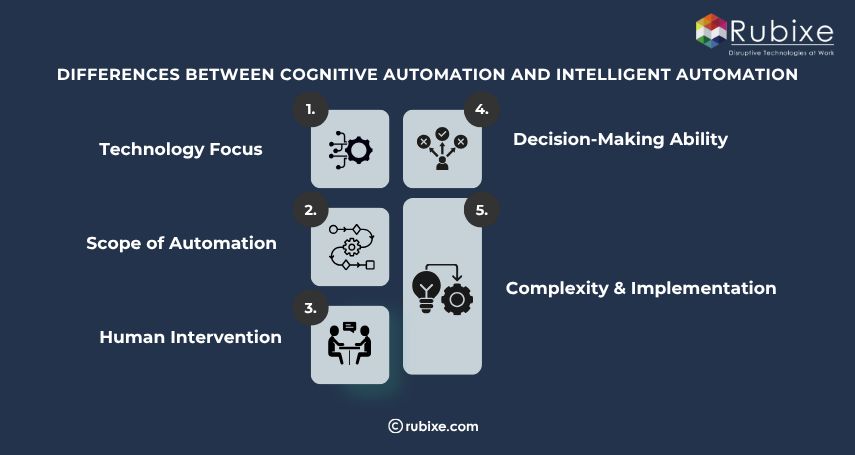
Businesses must clearly understand the distinction between task-level intelligence and process-level automation. Cognitive automation focuses on augmenting human decision-making in specific tasks, whereas intelligent automation manages end-to-end workflows, executing complex processes autonomously.
Recognizing these differences is crucial for deciding technology investments, implementation strategies, and the future of automation initiatives.
Technology Focus
-
Cognitive Automation: Primarily leverages AI algorithms, natural language processing (NLP), pattern recognition, and basic machine learning. It can read emails, analyze documents, and provide actionable recommendations to human operators, but it relies on humans for execution.
-
Intelligent Automation: Combines AI, Robotic Process Automation (RPA), predictive analytics, and advanced data modeling. This allows entire workflows to run autonomously, like invoice processing, claims management, or supply chain orchestration, while continuously learning and improving decisions.
-
Example: Cognitive automation can extract invoice data and flag anomalies for a human reviewer, while intelligent automation can extract, validate, approve, and post invoices automatically.
Scope of Automation
-
Cognitive Automation: Focused on task-level automation, handling discrete activities such as data entry, document classification, or ticket categorization. It’s ideal for augmenting repetitive or structured decisions.
-
Intelligent Automation: Operates at process-level automation, integrating multiple systems and tasks into a seamless workflow. It can handle end-to-end processes like employee onboarding, procurement, or customer service operations without manual intervention.
-
Example: Cognitive automation reads and summarizes incoming resumes, while intelligent automation can manage the entire hiring workflow from resume screening to interview scheduling.
Human Intervention
-
Cognitive Automation: Requires human oversight for final decision-making. It provides insights, predictions, or alerts, but cannot take full autonomous action.
-
Intelligent Automation: Requires minimal supervision. It executes workflows autonomously, handling exceptions and making predictive decisions based on AI insights.
-
Example: In finance, cognitive automation can flag suspicious transactions for review, whereas intelligent automation can automatically freeze accounts, notify compliance, and log cases for investigation.
Decision-Making Ability
-
Cognitive Automation: Supports human decisions by providing recommendations, data analysis, or alerts. It reduces workload but does not make final decisions independently.
-
Intelligent Automation: Makes autonomous, data-driven decisions, combining multiple inputs, predictive models, and historical data to choose the optimal course of action.
-
Example: In a supply chain, cognitive automation can suggest restocking levels, while intelligent automation can place orders, adjust delivery schedules, and notify stakeholders automatically.
Complexity & Implementation
-
Cognitive Automation: Easier to implement, often deployed in small-scale environments with limited integration needs. ROI is faster, but impact is narrower.
-
Intelligent Automation: More complex, requiring robust integration with multiple systems, predictive modeling, and continuous monitoring. Implementation may take longer, but it offers greater scalability and strategic value. This shift reflects the future of intelligent automation, where systems move toward full autonomy.
-
Example: Cognitive automation might automate invoice approvals in one department; intelligent automation can manage financial workflows across multiple departments, including reporting and compliance checks.
|
Aspect |
Cognitive Automation |
Intelligent Automation |
|
|
Moderate – focuses on data extraction, pattern recognition, and recommendations |
High – integrates AI with RPA, predictive models, and analytics for end-to-end decisions |
|
Automation Scope |
Task-level – handles individual, discrete tasks |
Process-level – automates entire workflows from start to finish |
|
Human Supervision |
Required – humans review outputs or make final decisions |
Minimal – system can run autonomously with exception handling |
|
|
Supports decisions – provides insights for humans |
Makes predictive decisions – selects actions based on AI models and historical data |
|
|
Medium – simpler integration, less system-wide impact |
High – requires multi-system integration, robust data pipelines, and continuous learning |
|
|
Quick wins in specific tasks |
Strategic transformation impacting productivity, efficiency, and customer experience |
|
|
Document summarization, email triage, and invoice data extraction |
Automated onboarding, supply chain orchestration, claims processing, predictive maintenance |
Benefits of Cognitive vs Intelligent Automation
Automation can improve efficiency, reduce costs, and enhance decision-making. Cognitive automation delivers task-level efficiency, while intelligent automation boosts end-to-end workflow performance. Organizations can choose the right approach to maximize ROI and business outcomes.
Cognitive Automation Benefits
-
Accuracy & Consistency: Reduces human errors.
-
Faster Task Completion: Speeds approvals, processing, and document handling.
-
Decision Support: Provides actionable insights without replacing humans.
-
Improved Data Utilization: Converts unstructured data into meaningful insights, enabling better visibility and more informed decisions.
-
Reduced Manual Workload: Minimizes repetitive tasks for employees, allowing them to focus on higher-value and strategic activities.
Intelligent Automation Benefits
-
End-to-End Process Efficiency: Eliminates bottlenecks across workflows.
-
Cost Reduction: Reduces operational expenditure.
-
Scalability: Handles higher volumes with minimal resources.
-
Predictive Decision-Making: Leverages data for proactive problem-solving.
-
Higher ROI: Maximizes resources while improving outcomes.
By understanding these distinctions, organizations can select the right automation approach for their specific needs.
Choosing the Right Automation Strategy
Selecting the right automation strategy ensures efficiency and long-term benefits. Companies must assess their current workflows, consider hybrid approaches, and work with capable partners to implement solutions successfully.
Assess Business Needs: Determine whether the focus is on task-level efficiency (cognitive automation) or full process optimization (intelligent automation).
Hybrid Approaches: A hybrid approach often combines the key components of IPA, such as cognitive capabilities, RPA, and analytics.
Partner Selection: Selecting the right AI implementation partner or AI Automation service provider ensures smooth deployment and measurable ROI.
Future Trends in Automation
Automation is evolving rapidly with AI, predictive analytics, and IoT integration. Understanding future trends helps organizations stay competitive and adopt strategies that maximize efficiency and intelligence.
-
AI-Driven Automation Evolution: Smarter, self-learning tools
-
Predictive & Self-Learning Systems: Continuous adaptation
-
Integration with IoT & Cloud: Real-time monitoring and responses
-
Components of IPA: Cognitive + RPA + analytics for integrated workflows
-
Future of Intelligent Automation: Autonomous systems with minimal supervision
Businesses choosing between Cognitive Automation and Intelligent Automation should focus on operational goals, scalability needs, and workflow complexity. The right automation strategy improves efficiency, reduces manual effort, and creates long-term business value.
Partner with an AI implementation partner to implement cognitive automation or intelligent process automation, unlocking data-driven, predictive workflows.