





What Is a Generative AI Chatbot? Why Traditional Chatbots Fail
Most chatbots can reply, but struggle with real conversations. Discover how generative AI chatbots understand context, handle complex queries, and deliver meaningful interactions.
Most chatbots respond. Few Actually Understand.
Most businesses today use chatbots to handle conversations. They respond instantly, answer basic queries, and reduce manual workload. But when interactions become complex, most chatbots fall short. They follow scripts, miss context, and fail to deliver meaningful responses.
This is where a Generative AI Chatbot changes the equation. Instead of depending on predefined rules, it understands context, generates responses dynamically, and adapts to user intent. It turns conversations into intelligent interactions that support both customers and business operations.
What Are Generative AI Chatbots?
A Generative AI Chatbot is an advanced conversational system that uses artificial intelligence to generate human-like responses in real time. Unlike traditional bots that depend on fixed rules and scripted replies, these chatbots can understand intent, process context, and create responses dynamically.
They are built to handle conversations that go beyond simple queries. Whether it’s customer support, product recommendations, or internal workflows, they adapt based on the input they receive. This makes them more flexible and capable of handling real-world interactions.
Businesses adopting conversational AI are moving from basic automation to systems that can manage conversations with depth and relevance. This shift is driven by the need to improve user experience while reducing dependency on manual support teams.
How Generative AI Chatbots Work
To understand how a Generative AI Chatbot operates, it helps to break down the process into key stages. These systems combine multiple layers of intelligence to process inputs and generate responses.
-
Input Understanding: The chatbot first interprets the user query using natural language processing. It identifies intent, keywords, and context to understand what the user is asking. This step ensures the system captures meaning rather than just matching words.
-
Context Processing: The system evaluates the conversation history and contextual data. This allows it to maintain continuity across multiple interactions, making conversations feel more natural and connected.
-
Response Generation: Using large language models, the chatbot generates responses based on the input and context. Instead of selecting predefined replies, it creates responses dynamically, making each interaction unique.
-
Output Delivery: The generated response is delivered in a conversational format. It is structured to be clear, relevant, and aligned with user expectations.
-
Continuous Learning: The system improves over time by learning from interactions and feedback. This enables better accuracy and more refined responses with each use.
Core Technologies Behind Generative AI Chatbots
The capabilities of a Generative AI Chatbot come from the combination of multiple technologies working together.
Natural Language Processing (NLP): Enables the chatbot to understand human language, including context, tone, and intent. It helps process both structured and unstructured inputs effectively.
Large Language Models (LLMs): These models generate responses by analyzing vast amounts of data. They allow chatbots to produce human-like and context-aware replies.
Machine Learning (ML): Improves the system over time by learning from interactions and patterns. It ensures continuous improvement in response quality.
Knowledge Integration: Chatbots connect with internal databases, APIs, and knowledge systems to provide accurate and relevant information.
System Integrations: They integrate with CRM, support tools, and business applications to perform actions beyond conversations.
Organizations leveraging Gen AI in digital transformation are embedding these technologies into their workflows to improve efficiency and decision-making.
Key Characteristics of Generative AI Chatbots
Generative AI chatbots are designed to provide more natural and intelligent interactions compared to traditional bots. Their capabilities make them ideal for modern business communication and operational efficiency.
-
Context-aware conversations: These chatbots maintain continuity across multiple interactions, ensuring the conversation feels seamless and personalized. Businesses looking to implement intelligent chat systems should choose the best chatbot to maximize engagement and customer satisfaction.
-
Human-like response generation: Responses generated by these chatbots feel natural and engaging, closely mimicking human conversation, which improves customer trust and experience.
-
Multi-turn conversation handling: Unlike rule-based bots, generative AI chatbots can manage multi-step conversations without losing context, enabling more complex query handling.
-
Personalization: By leveraging user behavior and preferences, these chatbots deliver tailored responses that enhance interaction quality and user experience.
-
Scalability: Generative AI chatbots can manage a high volume of interactions simultaneously, making them suitable for large enterprises and growing businesses.
These characteristics ensure that organizations not only improve customer engagement but also streamline internal workflows and operations.
Generative AI Chatbots vs Traditional Chatbots
Understanding the difference between traditional chatbots and generative AI chatbots highlights their impact on business operations.
|
Feature |
Traditional Chatbots |
Generative AI Chatbots |
|
Response Generation |
Depends on predefined rules |
Generates responses dynamically |
|
Response Generation |
Generates responses dynamically |
Provides static answers |
|
Adaptability |
Requires manual updates |
Improves through continuous learning |
|
Updates & Learning |
Handles simple queries |
Handles simple queries |
This shift is not about better conversations. It is about building systems that can support business workflows and decision-making processes.
Why Traditional Chatbots Fail in Real-World Use
Traditional chatbots work well in controlled environments. But in real business scenarios, conversations are rarely predictable. Users ask questions in different ways, switch context, and expect relevant answers instantly. This is where rule-based systems start to break down.
Limited Understanding of Context:
Traditional chatbots rely on keyword matching and predefined flows. They struggle when users phrase the same question differently or move across topics in a single conversation.
This often leads to irrelevant responses and broken user experiences.
Rigid Decision Trees:
Most traditional bots follow fixed paths. If a user goes outside the defined flow, the system cannot recover effectively. This makes conversations feel restrictive and frustrating for users.
High Maintenance Effort:
Every new query or scenario requires manual updates. As business needs grow, maintaining these systems becomes time-consuming and inefficient. Scaling a rule-based chatbot often increases complexity instead of reducing it.
Inability to Handle Complex Queries:
Traditional chatbots are designed for simple tasks. When queries involve multiple variables or require reasoning, they fail to provide meaningful answers. This limits their usefulness in real business workflows.
Poor Personalization:
Without a deeper understanding of data, traditional bots cannot tailor responses to user behavior or history. This results in generic interactions that do not improve engagement or conversions.
Applications of Generative AI Chatbots
Generative AI chatbots are being used across multiple business functions, where conversations play a critical role.
Customer Support: They handle queries, resolve issues, and provide consistent responses. This reduces response time and improves customer satisfaction.
Sales and Lead Qualification: Businesses use chatbots to build lead generation chatbot systems that capture user intent, qualify prospects, and guide them through the sales funnel.
Healthcare Assistance: Chatbots assist with appointment scheduling, patient queries, and basic medical guidance, improving accessibility and efficiency.
E-commerce and Recommendations: They analyze user behavior to suggest relevant products and improve the shopping experience.
Internal Business Operations: From HR onboarding to IT support, chatbots streamline internal processes and reduce manual workload.
Many organizations depend on AI chatbot development services to implement these use cases effectively and align them with business goals.
Benefits of Generative AI Chatbots
The value of a Generative AI Chatbot becomes clear when looking at business outcomes.
-
Faster response times that improve customer experience
-
Reduced operational costs by minimizing manual effort
-
Improved accuracy through consistent and data-driven responses
-
24/7 availability to handle interactions without delays
-
Scalability to manage growing user demands
These benefits make chatbots a key component in modern business operations.
How to Implement a Generative AI Chatbot
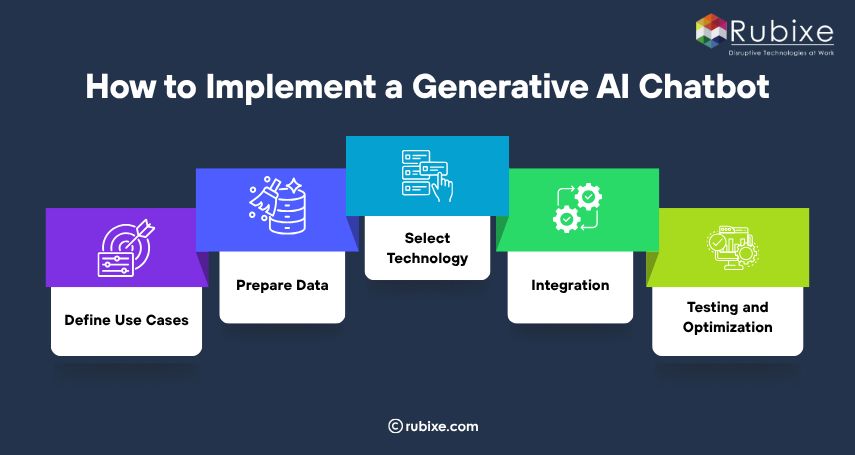
Implementing a Generative AI Chatbot requires careful planning and alignment with business objectives. Each step ensures the chatbot delivers real value and integrates smoothly into your workflows.
-
Define Use Cases: Identify where the chatbot will add value, whether in support, sales, or operations. Consider the customer journey and internal processes to ensure maximum impact.
-
Prepare Data: Ensure data is structured, relevant, and ready for AI processing. Clean, high-quality data allows the chatbot to generate accurate and context-aware responses.
-
Select Technology: Choose the right tools and platforms based on business needs. Evaluate scalability, customization options, and compatibility with existing systems.
-
Integration: Connect the chatbot with existing systems and workflows. Seamless integration ensures data flows smoothly and user interactions are consistent across platforms.
-
Testing and Optimization: Continuously monitor performance and improve responses. Gather user feedback to refine interactions and ensure the chatbot evolves with business needs.
Choosing the right partner is critical, especially when working with a generative AI development company that understands both technology and business requirements. A strategic partner ensures faster deployment, better ROI, and a chatbot that aligns with long-term digital transformation goals.
What Businesses Need to Get Right Before Deploying a Generative AI Chatbot
Successful implementation depends on getting the fundamentals right.
-
Clearly defining the purpose and scope of the chatbot
-
Ensuring data quality and availability
-
Aligning with security and compliance requirements
-
Integrating seamlessly with existing workflows
-
Selecting the right technology and implementation partner
Businesses that carefully plan these aspects are more likely to achieve long-term success.
If your current chatbot is limited to basic responses, it may be time to rethink your approach. Choosing the best chatbot solution means focusing on intelligence, adaptability, and long-term value.
Work with experts who understand both technology and business outcomes. The right implementation can turn your chatbot into a system that not only responds but truly understands.