



Want More Customers? AI in Retail Is Changing Everything
Want more customers? AI in the retail industry improves sales, customer experience, inventory management, and business growth for retailers with AI solutions daily.
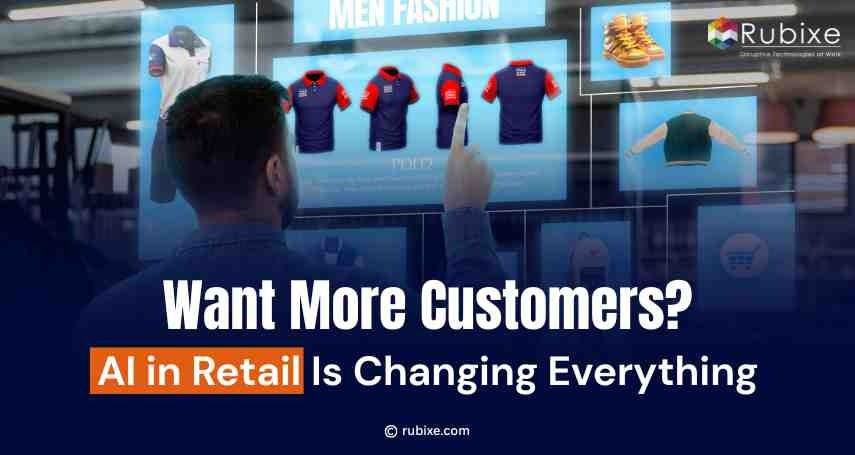
If your sales are flat, your customer service is slow, or your inventory decisions are hurting profits, AI in retail can help solve those problems faster.
Retailers today are using AI to predict customer behavior, automate decisions, and personalize shopping experiences in real time.
Businesses implementing AI in the retail industry are already seeing 10–15% revenue growth and up to 30% lower operational costs. At Rubixe, we have helped 200+ retail businesses implement AI solutions that deliver measurable results within 6 months.
What Is AI in Retail and Why Does It Matter Today?
AI in retail industry uses machine learning, automation, and data analytics to run smarter stores. It removes guesswork from decisions that cost retailers money every day.
The global AI in retail industry market was valued at $11.61 billion in 2024. It is projected to reach $40.74 billion by 2030, growing at 23% per year. That growth is driven by one fact:
According to NVIDIA's 2024 State of AI in Retail report:
-
69% of retailers using AI reported higher annual revenue
-
72% saw a reduction in operating costs
These are not predictions. These are results from stores that made the switch.
What Problems Are Retailers Facing Right Now?
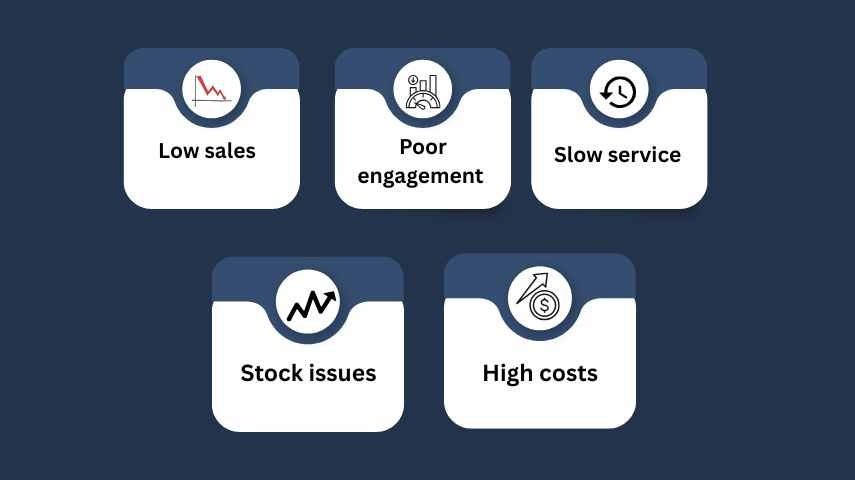
Most retailers struggle with the same five problems. AI in the retail industry solves all of them.
-
Low sales - Customers browse but don't buy
-
Poor engagement - Generic marketing gets ignored
-
Slow service - Long wait times push customers away
-
Stock issues - Too much of the wrong product, too little of the right one
-
High costs - Manual processes eat into margins
These problems compound over time. Without the right tools, they get worse - not better.
 How Does AI in Retail Solve Low Sales and Poor Engagement?
AI solves low sales by making every shopping experience feel personal. It shows the right product to the right customer at the right time.
When a shopper visits your website, AI tracks what they browse, skip, and buy. It uses that data to recommend relevant products instantly. McKinsey found that AI - driven personalization increases retail revenue by 10 - 15% on average.
For a store doing ₹50 lakh a month, that is an extra ₹5 - 7.5 lakh - every single month.
What Does AI Personalization Look Like in Practice?
Q: How does AI personalization actually work in a retail store?
A: AI learns from every customer interaction. It then uses that learning to make smarter suggestions.
Here are three real examples:
-
A shopper browses running shoes → AI recommends matching socks and insoles
-
A customer abandons their cart → AI sends a personalized discount reminder
-
A loyal buyer returns → AI greets them with items based on past purchases
This is exactly what Rubixe builds for retail clients - personalization engines that turn browsers into buyers within weeks of going live.
How Does AI Fix Slow Customer Service in Retail?
AI fixes slow service by replacing long wait times with instant, 24/7 automated responses. Customers get answers in seconds - not minutes.
AI chatbots handle stock queries, order tracking, return policies, and more. Forrester Research found that AI chatbots resolved 70% of customer queries instantly, lifting Net Promoter Scores by 15 points.
That is a major jump in customer satisfaction - with zero extra staff.
Q: Should retailers replace their support team with AI chatbots?
A: No - AI should handle the routine 70% so your team can focus on complex issues.
Small and mid-sized retailers benefit most here. AI gives you enterprise-level support capability at a fraction of the cost. Rubixe has deployed AI support systems for retail clients that handle hundreds of simultaneous conversations - without a single hold time.
How Does AI Solve Retail Inventory Problems?
AI solves inventory problems by predicting what you need before you run out. It removes the guesswork from stock management entirely.
The average retailer loses 10% of annual revenue due to stockouts alone. That is money walking out the door every day. AI demand forecasting looks at weather, local events, seasonal trends, competitor activity, and historical data - all at once.
Retailers using AI inventory systems achieve:
-
95% demand forecasting accuracy
-
40% lower inventory carrying costs
-
60% fewer stockouts
What Makes AI Inventory Forecasting Better Than Spreadsheets?
Spreadsheets look backward. AI looks forward - at dozens of signals simultaneously.
A spreadsheet tells you what sold last month.
AI tells you what will sell next week - and adjusts automatically as conditions change. That difference is worth millions for high-volume retailers.
What Does a Real AI Retail Success Story Look Like?
Walmart is the world's best example of AI in the retail industry done right.
Walmart operates 11,000+ stores, serves 240 million customers weekly, and manages one of the most complex supply chains on earth. Their AI transformation included:
-
Computer vision systems scanning shelves for stock gaps and pricing errors in real time
-
Machine learning models forecasting demand by location, season, and behavior
-
AI route optimization that eliminated 30 million unnecessary truck miles (Virtasant, 2024)
-
Generative AI searches across their website and mobile app for personalized results
-
AI chatbots that drove a 25% increase in customer satisfaction scores in North America (CDO Times, 2024)
In Q3 2023, Walmart posted 24% year-over-year growth - significantly credited to AI investment.
Source: Virtasant Retail AI: Emulate Walmart's Strategy
Is AI in Retail Only for Large Businesses Like Walmart?
No - AI tools today are affordable and accessible for retailers of any size. You do not need a Walmart-sized budget to see Walmart-level results.
Platforms like Shopify, Salesforce, and Zoho now have AI built in. At Rubixe, we offer tailored AI solutions for small and mid-sized retailers. Most clients see measurable ROI within 6 months of implementation.
How Should Retailers Start Using AI?
Retailers should start with one clear business problem instead of trying to automate everything at once.
Step 1: Identify the Biggest Challenge
Focus on:
-
low sales
-
inventory issues
-
customer support delays
-
poor engagement
Step 2: Choose One AI Solution
Start with:
-
AI chatbot
-
recommendation engine
-
inventory forecasting tool
-
marketing automation system
Step 3: Track Results
Measure:
-
customer response time
-
conversion rates
-
sales growth
-
inventory accuracy
Step 4: Scale Gradually
Expand AI implementation after proving ROI successfully. Most businesses begin seeing measurable improvements within 60 - 90 days.
Common Questions About AI in the Retail Industry
-
How long does it take to implement AI in a retail business?
Most implementations take 4–12 weeks, depending on complexity. Simple chatbots or recommendation engines go live faster. Full inventory or supply chain AI takes longer.
-
Will AI replace retail staff?
No. AI handles repetitive tasks so your staff can focus on customers. Human skills, empathy, judgment, and relationship-building remain irreplaceable. AI makes your team more effective, not redundant.
-
How much does AI cost for a retail business?
Costs vary widely. Entry-level AI tools start at a few thousand rupees per month. Custom solutions for mid-sized retailers range from ₹5 - 25 lakh, depending on the scope. Most retailers recover the cost within 6 - 12 months through sales growth and cost savings.
-
Is customer data safe when using AI in retail?
Yes - when implemented correctly. Reputable AI providers use encryption, access controls, and comply with data protection regulations. Always choose a partner who is transparent about how your customer data is stored and used.
-
What is the biggest mistake retailers make with AI?
Trying to implement too much too fast. Retailers who rush into AI without a clear goal often see poor results. Start small, solve one problem well, and grow from there.
3 Statistics That Prove AI in Retail Is No Longer Optional
Every retailer should know these numbers before making a decision.
1. 89% of retail and CPG companies are already using or testing AI in production.
2. The global AI in retail market grows at 23% per year - from $11.61 billion in 2024 to $40.74 billion by 2030. The window for early adoption is still open - but closing.
3. Retailers using AI report 5 - 15% annual revenue growth and 10 - 30% cost reduction across logistics, marketing, and operations (AllAboutAI, 2025). These are average figures - top performers do even better.
Frequently Asked Questions (FAQ)
What does AI actually do in a retail store?
AI automates stock management, personalizes recommendations, powers customer support chatbots, and optimizes pricing. It makes retail operations faster, smarter, and more profitable. The impact is measurable within weeks of going live.
How does Rubixe help retail businesses specifically?
Rubixe designs and deploys custom AI solutions for retail, from inventory forecasting to customer engagement tools. We have worked with 200+ clients and delivered results within 6 months. Our solutions are built for businesses at every scale.
Can AI improve customer loyalty in retail?
Yes. AI-powered personalization makes customers feel understood. When people see relevant products, get fast support, and receive timely offers, they come back. McKinsey research links AI personalization to a 30% increase in customer loyalty rates.
What types of retail businesses benefit most from AI?
E-commerce stores, fashion retailers, grocery chains, electronics shops, and multi-location outlets benefit significantly. Any retailer with customer data and recurring inventory decisions can benefit from AI. The more transactions you have, the more powerful AI becomes.
How do I know if my retail business is ready for AI?
If you have customer transaction data, a website or app, and at least one recurring operational problem, you are ready. You do not need complex infrastructure. A good AI partner like Rubixe will assess your readiness and recommend a starting point that fits your budget.
Key Takeaways
-
AI in the retail industry solves real, costly problems - low sales, slow service, poor engagement, and inventory loss - with measurable results.
-
The numbers are clear: 69% of retailers using AI report higher revenue; the market grows at 23% per year (NVIDIA 2024, Grand View Research).
-
Walmart's AI success - 24% YoY growth, 30 million miles saved, 25% satisfaction improvement proves what is possible when AI is fully adopted.
-
You do not need a big budget to start. Most retailers see positive ROI within 6 months with the right partner and a focused starting point.
-
Rubixe has helped 200+ retail businesses implement AI solutions that deliver real results - starting with one clear problem and scaling from there.