
How AI Recruitment Solutions Improve Candidate Quality
Struggling to hire quality candidates? Learn how AI recruitment solutions improve screening, reduce bias, and help you hire smarter and faster.
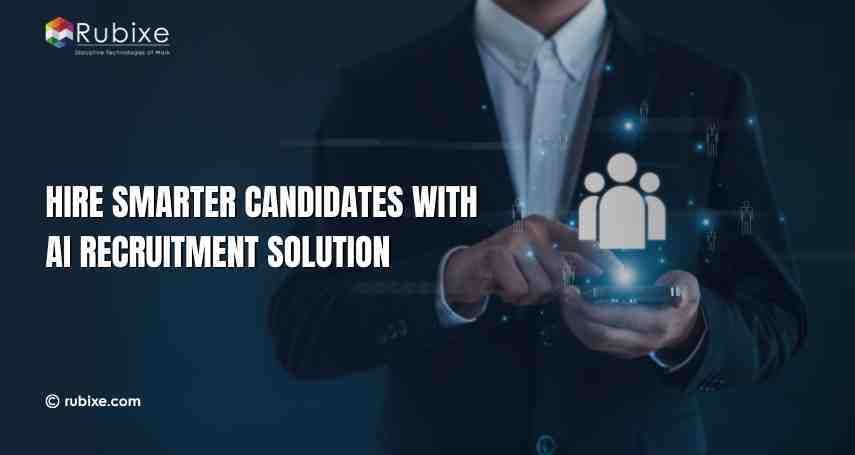
Hiring the right talent has become one of the biggest challenges for modern businesses. Job postings often attract hundreds of applications, but only a few match the actual role requirements.
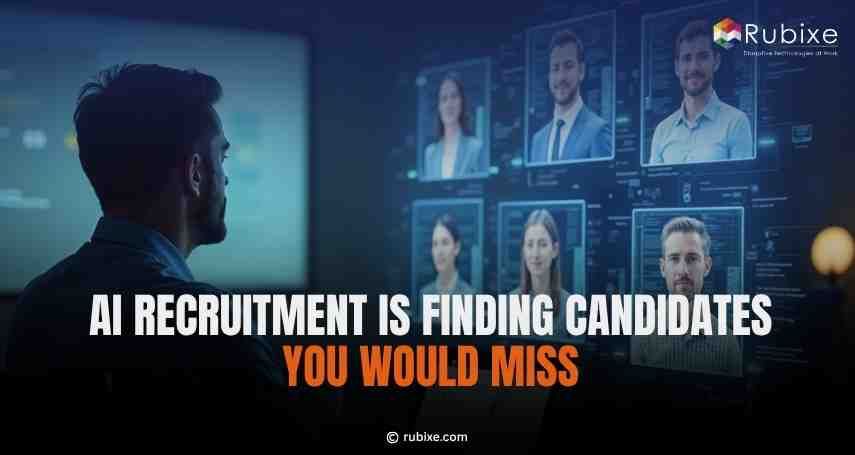
This is where AI recruitment solutions are changing the hiring process - helping companies screen smarter, reduce bias, and identify high-quality candidates faster.
“Rubixe has implemented AI-based screening workflows for enterprises to reduce manual screening time by up to 40 - 60%.”
What is an AI Recruitment Solution
An AI recruitment solution is a technology-driven platform that leverages artificial intelligence, machine learning, and data analytics to automate and optimize the hiring process.
Unlike traditional methods, which depend heavily on manual screening and subjective judgments, AI recruitment tools analyze vast amounts of candidate data, highlighting the importance of choosing an AI recruitment solution that aligns with your organization’s hiring goals.
Key Capabilities:
-
Automated Resume Screening: Quickly evaluates resumes based on qualifications, skills, and experience.
-
Predictive Candidate Scoring: Ranks applicants by likelihood of success in the role.
-
Intelligent Matching: Compares candidate profiles against job requirements for precision hiring.
-
Bias Reduction: Minimizes human bias in shortlisting candidates.
By integrating these capabilities, companies not only improve efficiency but also enhance candidate quality, ensuring they hire talent that truly aligns with their needs.
How Does an AI Recruitment Solution Work
AI recruitment solutions work through a combination of algorithms, natural language processing (NLP), and predictive analytics. Here’s a breakdown of the process:
1. Data Collection
AI tools gather candidate information from resumes, LinkedIn profiles, portfolios, and other digital sources. They can even analyze social and professional data to assess cultural fit and soft skills.
2. Resume Parsing & Analysis
Using NLP and machine learning, AI extracts critical information such as education, skills, certifications, and work experience. It eliminates irrelevant details and highlights the most relevant attributes.
3. Candidate Scoring & Ranking
Each candidate receives a score based on how closely they match the job criteria. The system can weigh factors like experience, skill proficiency, and past performance, helping recruiters focus on high-potential candidates.
4. Automated Communication & Scheduling
Some AI platforms also handle interview scheduling, automated follow-ups, and candidate engagement, reducing HR workload and saving time while improving the candidate experience.
By automating these steps, AI hiring software works to deliver faster, smarter, and more accurate candidate selection.
How Rubixe Uses AI in Recruitment
Rubixe integrates AI-powered hiring workflows that help businesses:
- Reduce time spent on manual screening
- Improve quality of shortlisted candidates
- Speed up hiring decisions
- Enhance overall recruitment accuracy
By combining machine learning and automation, Rubixe enables companies to build stronger and more reliable talent pipelines.
How AI-Based Candidate Screening Enhances Quality
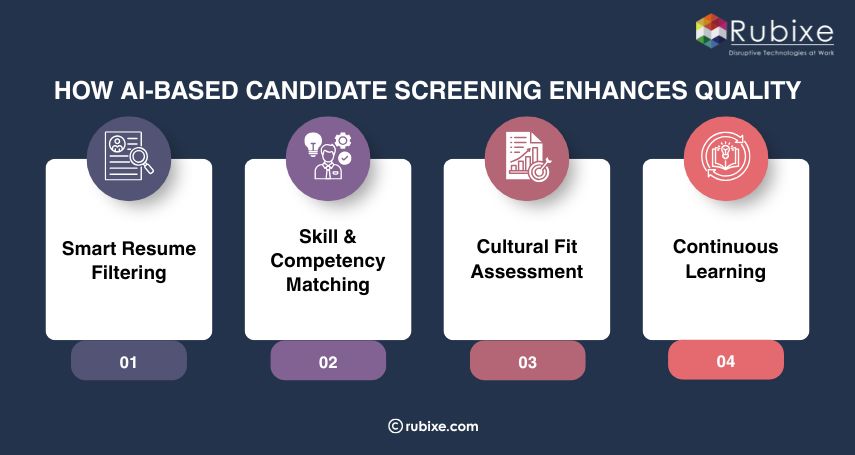
Screening candidates manually is time-consuming and prone to human bias. AI-based solutions prioritize the most qualified candidates and assess skills, experience, and fit objectively. This ensures the shortlist contains high-potential candidates, improving overall hiring quality.
1. Smart Resume Filtering
AI evaluates resumes against job requirements and identifies candidates most likely to succeed, reducing time wasted on unsuitable applicants.
2. Skill & Competency Matching
By analyzing skill sets, certifications, and experience, AI ensures candidates meet technical and soft skill requirements.
3. Cultural Fit Assessment
Some AI solutions assess personality traits and values, helping predict how well candidates will fit into your organizational culture.
4. Continuous Learning
AI systems improve over time, learning from past hires and feedback to enhance future candidate recommendations.
The result is a higher-quality talent pool and better alignment between candidates and roles.
Key Features of AI Recruitment Solutions for Hiring
Not all recruitment tools are created equal, and features can make a big difference in hiring outcomes. AI solutions combine resume analysis, predictive scoring, interview scheduling, and engagement automation. Together, these features help recruiters identify and engage the right candidates efficiently.
-
Predictive Analytics: Forecasts candidate success and retention likelihood.
-
Automated Interview Scheduling: Reduces administrative burden and speeds up hiring.
-
Chatbots for Candidate Engagement: Keep applicants informed and engaged throughout the process.
-
Diversity & Inclusion Tools: Minimizes unconscious bias in shortlisting.
-
Integration with HRIS & ATS: Seamless flow of candidate data across systems.
Each feature contributes to better candidate quality, faster hiring, and a more consistent recruitment process.
Key Benefits of Using AI Recruitment Tools for Hiring
SOURCE: resume.org
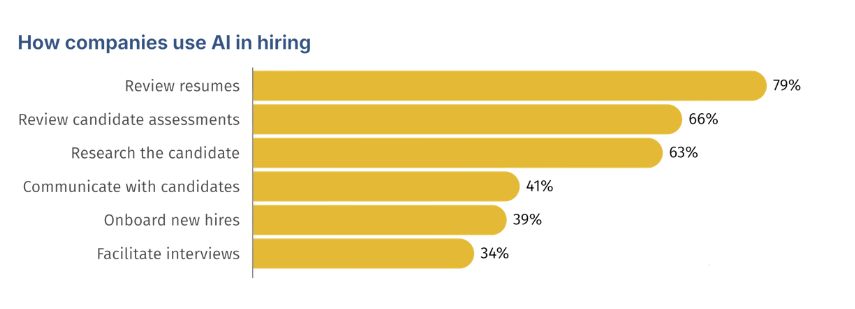
Using technology in hiring goes beyond saving time. AI recruitment tools improve candidate quality, reduce bias, and streamline the process from screening to onboarding. By automating screening and predictive scoring, AI transforms recruitment, making the hiring process faster and more consistent.
Implementing AI recruitment solutions provides measurable advantages:
-
Reduced Hiring Time – Automating repetitive tasks allows recruiters to focus on high-value decisions.
-
Higher Candidate Quality – Predictive analytics ensures only the most suitable candidates are shortlisted.
-
Enhanced Candidate Experience – AI chatbots and automated communication keep candidates engaged and informed.
-
Cost Efficiency – Faster hires reduce the cost-per-hire and minimize productivity loss due to vacancies.
-
Data-Driven Decisions – Recruitment decisions are based on data, not subjective judgment.
Companies embracing AI often see a noticeable improvement in hire quality and employee retention.
AI Screening vs Manual Screening: Which Delivers Better Candidate Quality?
Manual screening is slow, inconsistent, and prone to errors. AI-driven screening provides speed, accuracy, and data-backed decisions, making the comparison clear. Understanding the difference helps recruiters see why AI can significantly improve hiring quality.
|
Aspect |
AI Screening |
Manual Screening |
|
Speed |
Processes hundreds of resumes in minutes |
Slow, depends on recruiter bandwidth |
|
Accuracy |
Matches candidates based on data and predictive scoring |
Subjective, prone to bias |
|
Consistency |
Standardized evaluation |
Varies by recruiter |
|
Candidate Engagement |
Automated messaging keeps candidates informed |
Often inconsistent communication |
|
Long-Term Improvement |
Learns from past hires to improve screening |
Limited learning capability |
Clearly, AI-driven screening delivers higher-quality candidates faster and more reliably, making it a preferred choice for modern HR teams.
How to Implement AI Recruitment
Introducing AI into recruitment requires careful planning and alignment with existing processes.
Three in four recruiters in India are investing up to 70% of their hiring budgets in AI tools and recruitment technology, highlighting how organizations are prioritizing smarter hiring strategies.
Choosing the right AI solutions, training your HR team, and integrating with existing systems ensures AI delivers real results rather than just adding complexity.
-
Assess Your Recruitment Needs – Identify pain points, volume of hiring, and quality gaps.
-
Choose the Right AI Solution Provider – Evaluate vendors on features, integration capabilities, and scalability.
-
Integrate with Existing HR Systems – Connect AI tools with your ATS and HRIS for seamless workflows.
-
Train Your HR Team – Ensure recruiters understand how to leverage AI insights effectively.
-
Monitor & Optimize – Continuously evaluate AI performance and refine parameters to improve candidate quality.
Taking a strategic approach ensures that AI recruitment reduces hiring time and maximizes ROI.
Measuring Success with AI-Powered Recruitment Software
It is not enough to implement AI; you need to track whether it’s actually improving hiring outcomes. Metrics like time-to-hire, candidate quality, and recruiter productivity show if the system is working. Regular measurement also helps refine the process and maximize ROI.
-
Time-to-Hire: Measure reduction in average hiring time.
-
Candidate Quality Metrics: Track the performance and retention of AI-recommended hires.
-
Recruiter Productivity: Evaluate time saved on manual screening and administrative tasks.
-
Candidate Engagement Scores: Monitor satisfaction and experience through surveys or feedback.
-
Cost-per-Hire Reduction: Compare costs before and after AI implementation.
AI recruitment is transforming how companies hire by making the process faster, smarter, and more accurate. With AI-powered solutions, businesses can improve candidate quality while reducing time and cost per hire.
At Rubixe, AI-driven recruitment systems help organizations build stronger teams with data-backed hiring decisions.
If your HR team is overwhelmed and candidate quality is inconsistent, it’s time to embrace technology. AI recruitment solution providers can streamline your hiring, improve candidate quality, and transform recruitment into a faster, smarter, and more reliable process.