












AI Readiness Assessment: Framework, Checklist and Next Steps
A practical AI readiness assessment for enterprise teams: a six-dimension framework, a scored checklist, maturity levels, and clear next steps.
Many businesses invest in AI tools but struggle to turn their ideas into real results. Poor data, unclear goals, and skill gaps can hold back AI projects before they reach production.
An AI readiness assessment helps you identify these gaps and decide what your organization needs before investing further in AI.
This guide covers the six key areas of AI readiness, a practical checklist, four maturity levels, and the steps to move your AI projects forward.
What an AI readiness assessment covers
An AI readiness assessment scores your organization across a fixed set of dimensions, so a vague sense of "we should do more with AI" becomes a clear picture of what to fix and in what order. It answers three questions: which use cases are worth doing, what stands between you and shipping them, and what your first three moves should be.
It suits any team past the curiosity stage: a leadership group deciding where to invest, a function that wants to move a pilot into production, or a company that has tried AI and stalled.
Why assess readiness before you build
A large share of AI pilots never reach production. The common cause is groundwork left undone: use cases no one can value, data no one owns, and no plan for the model after launch. Teams buy tools before they know which problem the tool solves, then lose months.
A readiness assessment moves that risk to the front, where it is cheap to fix. You find the weak data set before you train on it. You name the business owner before you build. You set the guardrails before a model touches a customer.
A readiness assessment moves that risk to the front, where it is cheap to fix. You find the weak data set before you train on it. You name the business owner before you build. You set the guardrails before a model touches a customer.
The AI readiness framework: Six dimensions
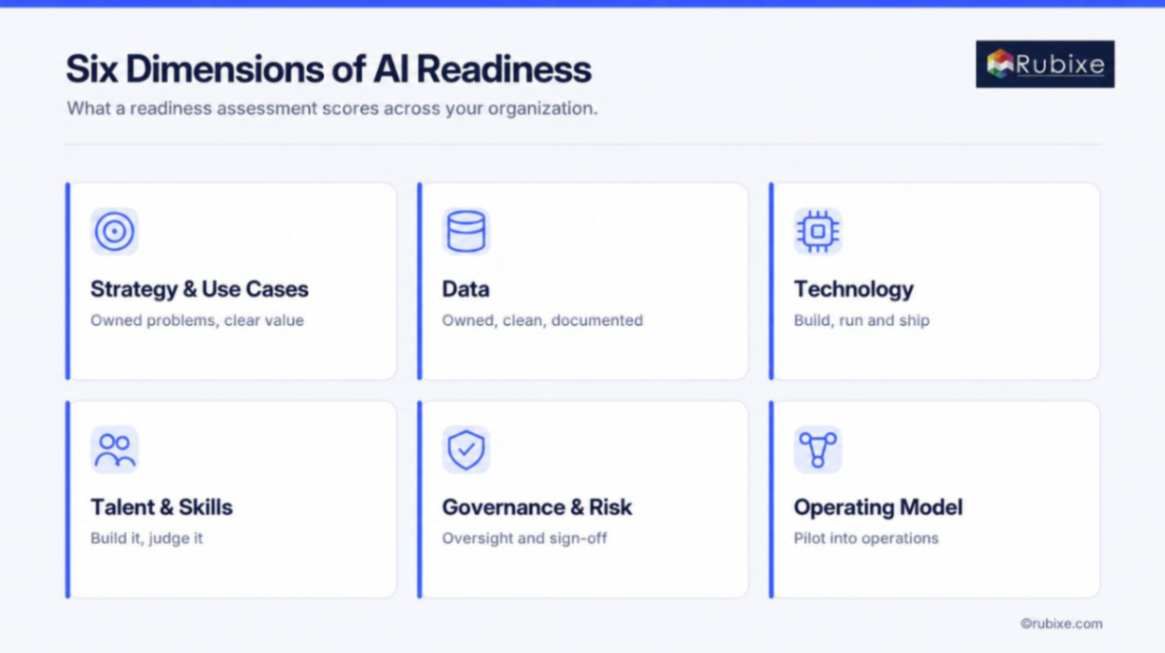
Rubixe assesses readiness across six dimensions. A team can be strong in one and weak in another, so you score each on its own. Your weakest dimension usually sets your ceiling, because a sharp model on poor data still fails.
1. Strategy and use-case clarity
AI work fails fastest when no one can say what problem it solves. Start with named problems, named owners, and a rough sense of the value at stake.
2. Data readiness
Models are only as good as the data behind them. This dimension asks whether the data your use cases need exists, who owns it, and how clean it is.
3. Technology and infrastructure
You need somewhere to build, run, and ship models, with security around the whole path. Pilots that live only in a data scientist's notebook rarely reach users.
4. Talent and skills
AI needs people who can build it and people who can judge it. Both the technical bench and the business teams matter here. When hiring is the constraint, an AI staffing partner can fill specific roles.
5. Governance, risk, and responsible AI
Every model makes decisions someone is accountable for. This dimension covers human oversight, bias and accuracy tracking, and sign-off from legal and compliance. Mature programs anchor this to an external standard such as the NIST AI Risk Management Framework or ISO/IEC 42001.
6. Operating model and change readiness
A pilot that works is only half the job. This dimension asks whether your organization can move it into daily operations and fund what comes next.
The AI readiness checklist
Run this against your own teams. Tick each item you can honestly confirm today.
Strategy and use-case clarity
-
You have named two or three business problems where AI could help, with a rough value for each.
-
Each candidate use case has a named business owner alongside a technical sponsor.
-
Leadership agrees on what success looks like and how you will track it.
-
You can explain why AI fits these problems better than a simpler rule or existing tool.
Data readiness
-
The data these use cases need exists, and you can locate it.
-
Someone owns each key data set and can vouch for its quality.
-
You know the data's gaps: missing fields, stale records, inconsistent formats.
-
Access, privacy, and consent rules for that data are documented.
Technology and infrastructure
-
You have somewhere to run models, cloud or on-prem, with room to grow.
-
Pipelines can move data to where models need it without manual exports.
-
Security review covers where data goes and who can see model outputs.
-
You can put a model into a live workflow instead of leaving it in a notebook.
Talent and skills
-
You have or can hire people who can build, evaluate, and maintain models.
-
Business teams understand enough about AI to spot good use cases and bad outputs.
-
Someone owns model quality after launch, including monitoring and retraining.
-
Leaders know the basics well enough to set direction and ask sharp questions.
Governance, risk, and responsible AI
-
You have a policy for how AI decisions get reviewed and challenged.
-
High-risk use cases have human oversight built in.
-
You track bias, accuracy, and drift, with a plan for when they slip.
-
Legal and compliance have signed off on how AI will be used.
Operating model and change readiness
-
A budget and roadmap exist beyond the first pilot.
-
Teams whose work AI touches are involved early, not surprised late.
-
A process exists to move a successful pilot into daily operations.
-
Someone tracks value delivered and reports it to leadership.
AI readiness maturity levels
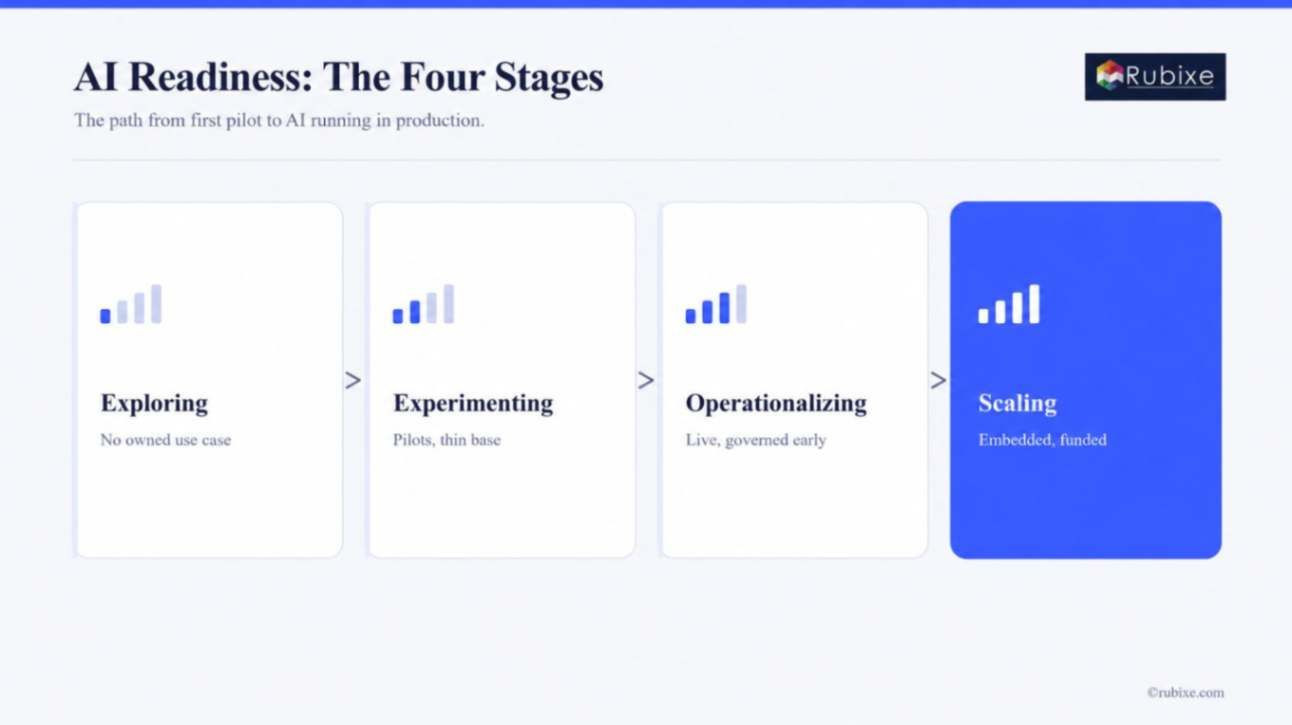
Use the checklist to place your organization on one of four stages.
|
Stage |
What it looks like |
Typical next move |
|
1. Exploring |
Curiosity, few skills, no owned use case, most boxes empty |
Run this assessment and pick one use case with a clear owner |
|
2. Experimenting |
Pilots running, but thin data and governance foundations |
Fix data ownership and quality for the pilot's domain |
|
3. Operationalizing |
One or two use cases in production, governance forming |
Standardize deployment and monitoring, document policy |
|
4. Scaling |
AI embedded in several workflows, talent and governance in place |
Build a portfolio view, reuse platforms, run it as a program |
How to score your assessment
Count the boxes you ticked in each dimension, then read the pattern, not the total. A team that ticks every box in five dimensions and none in data is a data problem waiting to surface, so the score for that dimension is the one to act on.
A rough guide: mostly empty across the board points to Exploring. Pilots running on thin foundations point to experimenting. Production use cases with governance are still forming point to operationalizing. Embedded, governed, and funded points to scaling.
Next steps
Three moves apply at every stage, in this order:
-
Pick one use case with a clear owner and a value you can state in a single sentence.
-
Fix the data that the use case depends on before you touch a model. Ownership and quality first.
-
Set the guardrails: who reviews outputs, and what happens when the model is wrong, decided before you ship.
Then follow the stage-specific move from the maturity table above. The goal at each stage is to lift your weakest dimension, since that is what holds the rest back.
Rubixe works with teams at each of these stages. An AI readiness assessment with Rubixe turns this checklist into a scored report for your organization, names the two or three moves that matter most, and maps them to a plan your leadership can fund. From there, the same team can build the first use case, set up the data and governance around it, and hand your people a system they can run.
Book an AI readiness audit with Rubixe to see where your organization stands and which move comes first.
Frequently asked questions
What is AI readiness?
AI readiness is the degree to which your organization can adopt AI and get value from it, across strategy, data, technology, skills, and governance. A readiness assessment scores you on those dimensions.
How long does an AI readiness assessment take?
For most mid-size to large organizations, a focused assessment runs two to four weeks, depending on how many teams and data sets are in scope. A single-use-case review can be quicker.
Who should be involved?
A business owner for each candidate use case, a data owner, someone from IT or platform engineering, and a representative from legal or compliance. Leadership sponsorship keeps the findings actionable.
What is the difference between AI readiness and AI maturity?
Readiness is whether you can start well. Maturity is how far you have already come. The maturity levels above give you both: where you sit now, and what moving up requires.
How often should you reassess?
Every six to twelve months, or after any major shift, such as a new use case, a platform change, or a new regulation that touches your data.
AI projects can struggle when your business lacks clear goals, reliable data, or the right skills. An AI readiness assessment helps you spot these gaps and decide what to fix first. Start by reviewing the six areas in this guide and scoring your current readiness. Focus on your weakest areas, choose one clear use case, and build a plan around it.