







What is Intelligent automation?
Learn how intelligent automation improves workflows, reduces errors, and drives smarter decisions using AI, ML, and analytics to scale business operations efficiently.
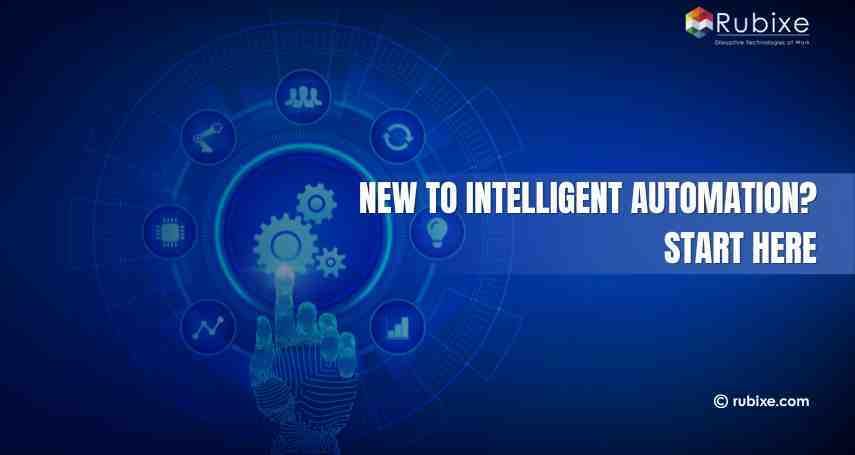
Most businesses have adopted automation in some form. Yet, few are leveraging it intelligently.
Simply speeding up repetitive tasks does not transform business outcomes. Intelligent automation is different: it combines AI, machine learning, and analytics to optimize workflows, improve decision-making, and continuously enhance operations.
It’s about working smarter, not just faster.
What Is Intelligent Automation?
Intelligent automation blends traditional automation with AI-driven decision-making to create workflows that learn and adapt over time. Unlike basic automation, which follows rigid rules, intelligent automation can process complex data, make decisions, and refine actions without constant human supervision.
Businesses using intelligent automation experience more than just faster processes. They see reduced errors, higher consistency, and the ability to scale operations without proportionally increasing resources.
Organizations leveraging robotic process automation often see initial efficiency gains, but adding intelligent layers multiplies productivity and insight.
How Does Intelligent Automation Work?
The workflow of intelligent automation is designed to mimic human decision-making, enhanced with speed and accuracy. At a high level, it involves data collection, processing, decision-making, task execution, and continuous learning.
-
Data Collection: Systems gather information from emails, databases, forms, and interactions. This ensures the automation engine has a holistic view of business processes. It allows for smarter, more contextual decision-making.
-
Data Processing: AI algorithms and machine learning models analyze patterns and extract actionable insights. Large datasets are converted into meaningful information that drives decisions efficiently.
-
Decision Making: The system evaluates processed data to determine the best course of action. By considering multiple variables simultaneously, it can make choices that would take humans significantly longer.
-
Task Execution: Automation executes the defined tasks, such as approvals, notifications, or document processing. The execution is consistent, timely, and less prone to errors.
-
Continuous Improvement: The system learns from outcomes and adapts over time. Each cycle improves efficiency, accuracy, and overall performance, making workflows smarter with every iteration.
Integrating NLP solutions for business allows these systems to understand unstructured text and communications, making the decision-making even more precise.
Components of Intelligent Automation
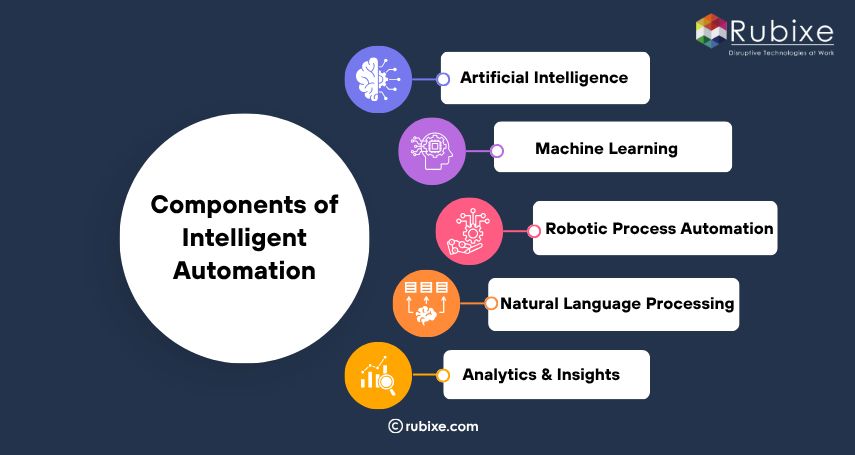
Intelligent automation is a combination of multiple technologies working together to deliver results that go beyond basic automation.
-
Artificial Intelligence (AI): Provides decision-making capabilities by analyzing data and predicting outcomes. It enables systems to mimic human reasoning and handle complex scenarios without explicit instructions.
-
Machine Learning (ML): Improves performance over time by learning from historical data and decisions. This allows automation to adapt to changing conditions and enhance accuracy in future tasks.
-
Robotic Process Automation (RPA): Executes repetitive, rule-based tasks efficiently and consistently. It ensures that high-volume operational processes are completed with speed and minimal errors.
-
Natural Language Processing (NLP): Enables the system to understand text, language, and communications, opening possibilities for customer support and document handling. NLP allows automation to interpret unstructured data and interact more naturally with users.
-
Analytics & Insights: Continuously monitors performance and provides insights to optimize processes. It helps identify bottlenecks, measure efficiency, and guide strategic improvements across workflows.
Organizations that integrate intelligent process automation with analytics often uncover inefficiencies that would have gone unnoticed, creating more value from their automation initiatives.
Features of Intelligent Automation
The distinguishing features of intelligent automation make it far more powerful than traditional automation.
Predictive Analytics:
Predictive analytics allows businesses to anticipate potential issues before they occur and identify opportunities for improvement. By analyzing historical data, the system can forecast demand fluctuations, process bottlenecks, or customer behavior trends, enabling proactive decision-making.
Self-Learning Systems:
Self-learning systems adapt based on new data and past outcomes, improving the quality and consistency of decisions over time. This continuous learning allows the automation to handle more complex scenarios without human intervention and reduces the need for frequent manual adjustments.
End-to-End Automation:
End-to-end automation ensures that complete workflows are optimized rather than just individual tasks. It connects multiple departments and processes such as finance, HR, and customer service allowing operations to flow seamlessly, which improves efficiency and reduces delays across the organization.
Real-Time Monitoring:
Real-time monitoring provides instant alerts and error detection, allowing businesses to address issues before they escalate. Continuous oversight ensures that performance standards are maintained, operational disruptions are minimized, and corrective actions are implemented quickly.
Seamless Integration:
Seamless integration with existing systems ensures minimal disruption while scaling operations. Intelligent automation can work alongside current software platforms, ERP systems, and communication tools, allowing organizations to upgrade processes without overhauling the IT infrastructure.
These features enable organizations to make informed decisions faster, maintain operational efficiency, and reduce manual effort.
Benefits of Intelligent Automation
Intelligent automation delivers measurable business impact across operations and departments.
-
Efficiency Gains: Tasks that used to take hours can be completed in minutes, freeing employees to focus on higher-value work.
-
Error Reduction: Automated checks reduce mistakes that typically occur in manual processing.
-
Cost Savings: Less manual effort lowers operational costs, especially in high-volume processes.
-
Scalability: Businesses can manage larger volumes of work without proportional increases in headcount or resources.
-
Enhanced Decision-Making: Data-driven insights allow managers and teams to make smarter, faster choices.
Organizations that work with AI automation solution providers often report significant improvements in productivity, workflow visibility, and overall ROI.
Applications of Intelligent Automation
Intelligent automation has wide-ranging applications across industries and business functions.
-
Customer Support: Automates ticket handling, chat responses, and complaint resolution while providing contextual insights for human agents.
-
Finance & Accounting: Handles invoice processing, reconciliations, and compliance checks, reducing errors and improving reporting speed.
-
HR & Recruitment: Automates resume screening, interview scheduling, and onboarding workflows, allowing HR teams to focus on strategy and engagement.
-
IT Operations: Monitors systems, triggers alerts, and resolves common IT issues automatically, improving uptime and efficiency.
-
Supply Chain & Manufacturing: Supports inventory management, demand forecasting, and quality checks, ensuring timely and accurate operations.
Partnering with companies specializing in AI and ML in automation ensures smooth implementation and maximum value from these use cases.
Things to Consider When Choosing an Intelligent Automation Solution
Selecting the right automation solution is critical to achieving business impact.
-
Compatibility with existing systems and workflows ensures seamless integration.
-
Ease of implementation and user adoption encourage teams to embrace the technology.
-
Flexibility to scale supports growing operational demands without rework.
-
Support for analytics and reporting enables continuous improvement.
-
Security, compliance, and data governance protect sensitive information and maintain regulatory standards.
Careful evaluation ensures that automation delivers measurable value rather than just technology implementation.
Future of Intelligent Automation
Intelligent automation is evolving quickly, and staying ahead of trends is key to maximizing benefits.
-
Agentic AI: Autonomous systems capable of independent decision-making will handle increasingly complex workflows.
-
Hyperautomation: Integrating multiple AI and automation tools to cover entire workflows end-to-end.
-
AI-Driven Analytics: Predictive insights embedded in operations for proactive decision-making.
-
Personalization at Scale: Tailored services and customer interactions based on behavior and preferences.
-
Low-Code/No-Code Platforms: Empower non-technical teams to create and modify automation workflows, democratizing access and speeding up adoption.
The future of agentic AI will redefine operational decision-making, making it more agile, efficient, and intelligent. Companies that anticipate these trends will maintain a competitive edge in performance, speed, and innovation.
Ready to move beyond manual processes and unlock the true potential of your operations?
Implementing intelligent automation can transform repetitive tasks into streamlined, data-driven workflows, giving your teams the freedom to focus on high-impact work. By combining AI, machine learning, and process automation, your business can achieve faster decisions, reduce errors, and scale efficiently.
Partnering with the right AI automation solution provider ensures you implement the right strategy for your unique needs.