Artificial intelligence adoption continues to grow across industries, yet many organizations struggle with the complexity of building machine learning models. Developing a machine learning solution traditionally requires expertise in data science, feature engineering, algorithm selection, and model optimization.
Automated machine learning addresses this challenge by automating many stages of the machine learning workflow. By simplifying model development, AutoML enables organizations to experiment with predictive analytics faster and integrate AI into real business processes.
What is AutoML?
Automated Machine Learning refers to technologies and frameworks that automate key stages of the machine learning lifecycle, including data preparation, feature engineering, model selection, hyperparameter tuning, and evaluation. In traditional machine learning development, data scientists must manually experiment with different algorithms, adjust parameters, and analyze results to identify the most effective model. This process can be time-consuming and requires significant technical expertise.
Automated machine learning platforms simplify this workflow by automatically testing multiple algorithms, optimizing model parameters, and selecting the configuration that performs best for a given dataset. By streamlining these complex steps, AutoML significantly reduces the time required to build and deploy machine learning models.
Organizations that integrate automated machine learning with broader digital transformation initiatives often see improvements aligned with core machine learning benefits, including faster insights, predictive analytics capabilities, and improved operational decision-making.
How Does AutoML Work?
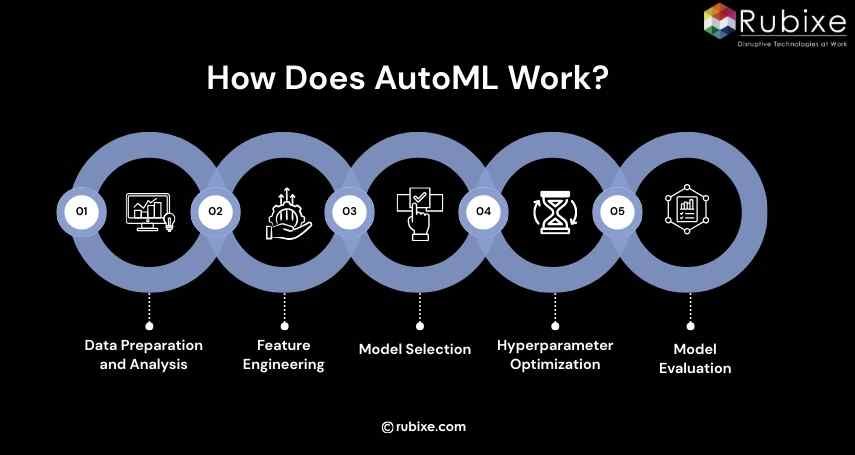
AutoML platforms automate many stages of the machine learning lifecycle. Although the internal architecture varies between platforms, most AutoML systems follow a similar workflow.
1. Data Preparation and Analysis
The process begins with dataset ingestion and exploration. AutoML tools examine dataset structure, identify missing values, detect anomalies, and apply preprocessing techniques such as normalization or encoding. Data preparation is critical because model accuracy depends heavily on data quality.
2. Feature Engineering
Feature engineering involves transforming raw data into meaningful variables that help machine learning models make accurate predictions. AutoML systems automatically generate new features, remove irrelevant variables, and evaluate the predictive importance of each feature.
3. Model Selection
AutoML tools test multiple algorithms to determine which model works best for a given dataset. These algorithms may include decision trees, random forests, gradient boosting models, neural networks, and support vector machines.
4. Hyperparameter Optimization
Every machine learning algorithm contains parameters that influence model performance. AutoML tools automate hyperparameter optimization by testing various parameter combinations using techniques such as grid search, random search, or Bayesian optimization.
5. Model Evaluation
AutoML platforms evaluate models using performance metrics such as accuracy, precision, recall, and F1 score. Cross-validation techniques ensure the model performs well on unseen data.
The AutoML Pipeline: From Data to Deployment
An AutoML pipeline refers to the structured sequence of processes that transform raw data into a trained machine learning model ready for production use.
Typical stages of an AutoML pipeline include:
1. Data Ingestion: Importing structured or unstructured datasets from databases, data lakes, or external sources.
2. Data Cleaning and Transformation: Handling missing values, removing outliers, normalizing data, and converting categorical variables.
3. Feature Engineering and Selection: Automatically creating new variables and selecting the most relevant features for model training.
4. Algorithm Selection: Testing multiple machine learning algorithms across different configurations.
5. Hyperparameter Optimization: Automatically tuning algorithm parameters to improve prediction accuracy.
6. Model Training and Validation: Running experiments across multiple models and evaluating them using validation datasets.
7. Model Deployment: Deploying the final model into production systems for real-time or batch predictions.
Automated pipelines help organizations standardize machine learning workflows and ensure consistent model development practices across teams. Studies on AutoML frameworks show that automated pipelines simplify complex experimentation while maintaining reproducibility and performance evaluation.
AutoML vs Traditional Machine Learning
Understanding the difference between AutoML and traditional machine learning helps organizations determine when automation is appropriate.
|
Aspect
|
Traditional Machine Learning
|
AutoML
|
|
Development approach
|
Manual experimentation
|
Automated experimentation
|
|
Model selection
|
Data scientists test algorithms manually
|
AutoML tests multiple algorithms automatically
|
|
Time required
|
Weeks or months
|
Hours or days
|
|
Feature engineering
|
Performed manually by experts
|
Automatically generated and evaluated
|
Traditional machine learning provides full control over model architecture and feature design, making it suitable for highly specialized problems. However, it requires significant time and expertise.
AutoML focuses on efficiency and accessibility. Automated systems evaluate hundreds of model combinations and parameter configurations within a short period. This allows teams to build predictive models quickly and iterate faster.
Industry studies suggest that AutoML can reduce development time dramatically by automating experimentation and model optimization while still achieving competitive accuracy on common business problems.
Many organizations adopt a hybrid approach: AutoML is used for rapid prototyping and baseline model generation, while traditional machine learning techniques refine models for complex applications.
Key Components of AutoML
AutoML platforms combine several technical components that automate complex machine learning processes.
-
Data Preprocessing Systems: Data preprocessing modules automatically clean datasets by handling missing values, removing duplicates, scaling features, and encoding categorical variables.
-
Feature Engineering Modules: Feature engineering tools automatically generate derived variables and evaluate their predictive power. These automated transformations improve model performance without requiring manual experimentation.
-
Model Training Engines: AutoML platforms test multiple machine learning algorithms simultaneously. Common algorithms include gradient boosting models, random forests, neural networks, and logistic regression.
-
Hyperparameter Optimization Systems: Hyperparameter optimization engines automatically search parameter spaces to find the best configuration for each algorithm. Techniques such as Bayesian optimization and evolutionary search improve efficiency.
-
Model Evaluation Frameworks: Evaluation systems compare models using metrics such as accuracy, recall, and mean squared error. Cross-validation helps ensure models perform well on unseen data.
-
Model Deployment Infrastructure: Advanced AutoML platforms include deployment capabilities that allow trained models to be exported as APIs, integrated into applications, or embedded within analytics platforms.
Organizations that integrate AutoML models into business workflows often combine them with intelligent automation technologies such as RPA and IPA , enabling data-driven decision-making across operational processes.
Use Cases of AutoML
Automated machine learning has gained adoption across industries because it enables rapid model development without extensive manual experimentation.
-
Predictive Analytics: Organizations use AutoML to forecast sales trends, predict demand fluctuations, and estimate financial risk.
-
Fraud Detection: Financial institutions apply automated machine learning models to identify suspicious transactions by analyzing behavioral patterns across large datasets.
-
Customer Behavior Analysis: Retail and e-commerce companies use AutoML to analyze customer behavior, predict churn, and personalize product recommendations.
-
Healthcare Diagnostics: Healthcare organizations use automated machine learning to assist with medical imaging analysis, disease prediction, and patient outcome modeling.
-
Predictive Maintenance: Manufacturers use AutoML to analyze sensor data from equipment and predict potential failures before they occur.
These applications demonstrate how automated machine learning enables organizations to extract actionable insights from large datasets without complex manual experimentation.
Benefits of AutoML Solutions
Automated machine learning offers several advantages that make it attractive for organizations adopting AI technologies.
1. Faster Model Development: AutoML significantly reduces the time required to build machine learning models by automating experimentation and optimization processes.
2. Accessibility for Non-Experts: Business analysts and developers can experiment with machine learning models without requiring advanced expertise in algorithm design.
3. Improved Experimentation: AutoML platforms evaluate multiple models and parameter configurations simultaneously, increasing the chances of identifying optimal solutions.
4. Scalability: Automated machine learning allows organizations to develop and deploy models across multiple datasets and use cases.
5. Reduced Operational Costs: By automating repetitive experimentation tasks, organizations can reduce the time and cost required for machine learning development.
According to research published by the International Data Corporation, global spending on AI technologies continues to grow rapidly as companies adopt intelligent systems to improve efficiency and data-driven decision-making.
Organizations that partner with experienced AI consulting companies often adopt AutoML as part of a broader AI implementation strategy.
Limitations of AutoML
Despite its advantages, automated machine learning also has limitations.
-
Limited Model Interpretability: Some AutoML models are complex ensembles or deep learning architectures, making it difficult to interpret decision logic.
-
Dependence on Data Quality: AutoML systems cannot compensate for poor-quality data. Inaccurate or incomplete datasets can still produce unreliable models.
-
Limited Customization: Highly specialized machine learning applications may require manual model design that AutoML platforms cannot easily support.
-
Computational Requirements: Running multiple experiments simultaneously can require significant computational resources, especially for large datasets.
Organizations should evaluate these factors carefully before implementing automated machine learning solutions.
Popular AutoML Tools
Several technology providers have developed platforms that simplify automated machine learning development.
-
Google Cloud AutoML: Provides automated machine learning tools for computer vision, natural language processing, and structured datasets.
-
Amazon SageMaker Autopilot: Automatically builds, trains, and tunes machine learning models within the AWS ecosystem.
-
H2O.ai AutoML: An open-source AutoML framework widely used for rapid experimentation and enterprise machine learning workflows.
-
Microsoft Azure AutoML: Supports automated model development for forecasting, classification, and regression tasks.
These platforms enable organizations to experiment with automated machine learning without building complex pipelines from scratch.
Organizations implementing AutoML frequently combine these platforms with enterprise automation services and deploy models within digital ecosystems powered by advanced AI products.
AutoML simplifies machine learning development by automating tasks such as data preprocessing, feature engineering, model selection, and hyperparameter optimization. By reducing the complexity of building predictive models, automated machine learning allows organizations to experiment with AI solutions faster and scale data-driven decision-making across operations.
While AutoML cannot replace expert data scientists for highly specialized tasks, it plays a critical role in accelerating AI adoption and enabling teams to transform data into actionable insights. As machine learning continues to evolve, AutoML will remain an important technology for organizations seeking efficient, scalable, and accessible AI development.