














AI Readiness Checklist: Is Your Business Prepared for AI
Use our AI readiness checklist to see if your business is prepared for AI. Learn the key steps to plan, adopt, and scale AI solutions successfully.
AI readiness means your business has usable data, a team that can work with AI tools, a clear use case, leadership support, and a realistic budget. If any of these five areas is weak, an AI project is likely to stall before it delivers value.
Most businesses do not fail at AI because the technology does not work. They fail because they start before checking whether the business itself is ready. McKinsey's 2025 State of AI survey found that 88 percent of organizations now use AI in at least one business function, yet only about a third have moved past pilots to scale it across the enterprise. Adoption is easy. Readiness is what determines whether that adoption ever turns into results.
This checklist walks through the five areas that matter most, along with what a real gap looks like inside each one, so you can score your business honestly before investing time and budget into a full AI project.
What an AI Readiness Assessment includes
-
Data quality and accessibility
-
Team skills and change readiness
-
A clearly defined use case
-
Leadership commitment
-
Budget and timeline realism
Score yourself on each item as Ready, Partially Ready, or Not Ready. Two or more "Not Ready" scores usually mean a formal AI readiness assessment should come before any development work begins.
1. Data Quality and Accessibility
AI systems are only as good as the data feeding them. IBM's research on AI readiness barriers points to fragmented IT systems, data governance gaps, and inconsistent data quality as some of the most common obstacles organizations face when preparing for AI.
What ready looks like: Your customer, operations, or product data lives in accessible systems, is reasonably clean, and someone on your team knows where it lives and how current it is. There is at least a basic sense of who owns each dataset and how it flows between systems.
What a gap looks like: Data is scattered across spreadsheets, disconnected tools, or paper records, and no one can say confidently how accurate it is. Different teams may keep separate versions of the same customer or product information, with no single source of truth.
Why it matters: A model built on messy data will produce messy, unreliable output, no matter how advanced the underlying technology is. Many AI projects that appear to fail on the technical side are actually failing because the data behind them was never ready in the first place.
2. Team Skills and Change Readiness
AI adoption is not only a technical shift, but it is also a people shift. Employees need enough understanding to trust and use AI tools, and managers need to be ready to adjust workflows around them rather than bolting AI onto old processes.
What readiness looks like: At least a few team members are comfortable experimenting with AI tools, and leadership has communicated clearly why the change is happening and what it means for day-to-day work.
What a gap looks like: Staff views AI as a threat to their role rather than a tool that supports it, or no one has been given dedicated time to learn the new workflow before it goes live.
Why it matters: Even a well-built AI solutions fails if the people meant to use it resist or quietly ignore it. Skills gaps are usually easier and cheaper to fix than data gaps, but only if they are identified early rather than discovered after launch.
3. A Clearly Defined Use Case
"We should use AI somewhere" is not a strategy. The businesses that see real value start with a specific, measurable problem: reducing response time in customer support, automating repetitive data entry, improving lead scoring accuracy, or catching quality issues earlier in production.
What ready looks like: You can describe the exact process AI will support, who is involved in that process today, and how you will know if the new approach actually worked.
What a gap looks like: The goal is vague, such as "become more innovative" or "keep up with competitors," with no specific process named and no way to measure progress.
Why it matters: Clear use cases are easier to scope, easier to explain to a technical partner, and far more likely to get funded past the pilot stage. A vague goal almost always leads to a project that drifts, loses stakeholder interest, and eventually gets shelved.
4. Leadership Commitment
AI projects that succeed almost always have a leader who owns the outcome, not just someone who approves the initial budget and steps back.
What readiness looks like: A named executive or manager is accountable for the project's success, actively involved in reviewing progress, and willing to make decisions when priorities compete for resources.
What a gap looks like: The project is treated purely as an IT initiative with no business owner attached, and no one outside the technical team is checking whether the work is actually solving the original problem.
Why it matters: Without ownership, AI initiatives tend to lose priority the moment something else becomes urgent. Sustained leadership involvement is consistently one of the clearest differences between organizations that scale AI successfully and those stuck running isolated pilots indefinitely.
5. Budget and Timeline Realism
AI projects rarely deliver meaningful results in a single quarter. Businesses that underestimate cost or expect instant returns tend to abandon promising projects before they have had time to mature.
What ready looks like: You have budgeted for data cleanup, tool costs, training time, and a realistic testing period, not just the initial development cost. The timeline includes room to adjust the approach after early testing.
What a gap looks like: The plan assumes a working solution within a few weeks with minimal ongoing investment, and no budget has been set aside for fixing data or process issues discovered along the way.
Why it matters: Rushed timelines lead to shortcuts in testing and data preparation, which is where most AI project failures actually start. A realistic budget is not about spending more; it is about spending on the right things in the right order.
What Happens If You Skip AI Readiness?
 Skipping this step does not mean the AI project will fail immediately. It usually means the project starts smoothly and then stalls a few months in, once the data quality issues, skill gaps, or unclear ownership start slowing everything down. By that point, the business has already spent budget and team time, and starting over is more expensive than getting the foundation right the first time. This is the pattern behind the "pilot purgatory" that shows up repeatedly in industry research: plenty of experimentation, very little of it converting into measurable business value.
How to Use This Checklist
Go through each of the five areas honestly with your team, ideally with input from both the business side and whoever manages your data or IT systems. If most areas score Ready, you can likely move toward selecting a specific AI use case and starting a focused pilot. If two or more areas score Not Ready, it is worth getting a structured audit before committing budget, since fixing foundational gaps mid-project is far more expensive than fixing them beforehand. Treat this less like a one-time test and more like a baseline you can revisit every few months as your data, team, and priorities change.
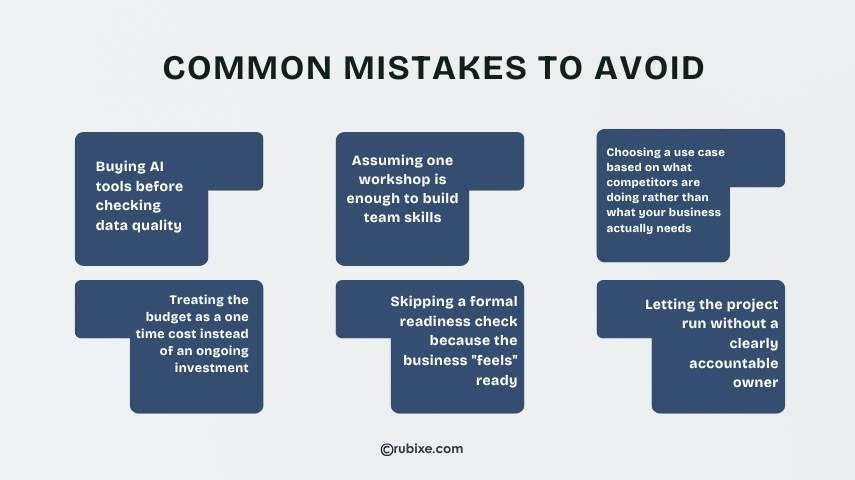
Common Mistakes to Avoid
-
Buying AI tools before checking data quality
-
Assuming one workshop is enough to build team skills
-
Choosing a use case based on what competitors are doing rather than what your business actually needs
-
Treating the budget as a one-time cost instead of an ongoing investment
-
Skipping a formal readiness check because the business "feels" ready
-
Letting the project run without a clearly accountable owner
Where This Fits Into a Larger AI Strategy
This checklist is a starting point, not a full audit. For a deeper look at how to evaluate your data specifically, see our related post on AI readiness assessment mistakes. If your business scored Not Ready in two or more areas above, that is usually the signal to bring in a structured AI Readiness Assessment rather than proceeding on assumptions and hoping the gaps close themselves during development.
FAQs
-
What is AI readiness?
AI readiness is a business's ability to successfully adopt AI, based on data quality, team skills, a defined use case, leadership support, and budget realism.
-
How do I know if my business is ready for AI?
Score your business against the five areas in this checklist. If two or more come back Not Ready, a formal readiness assessment is recommended before starting development.
-
What is an AI readiness audit?
An AI readiness audit is a structured evaluation of your data, systems, team, and processes to identify gaps before an AI project begins.
-
How long does it take to become AI ready?
This depends on the size of the gaps found, particularly in data quality and team skills. Some businesses close gaps in weeks, others need a few months of preparation.
-
Do small businesses need an AI readiness check, too?
Yes. Smaller teams often have simpler data environments, which can make readiness gaps easier to fix, but the same five areas still apply regardless of company size.
Final Takeaway
AI readiness is not about having the newest tools. It is about having clean data, a capable team, a clear use case, committed leadership, and a realistic budget before you start building. Businesses that check readiness first tend to avoid the stalled pilots that McKinsey and IBM both point to as the most common outcome of rushed AI adoption. A short, honest self-assessment now can save months of wasted effort later.
Book a Free AI Consultation
If your checklist scores raised more questions than answers, our team can run a structured AI Readiness Assessment for your business and show you exactly where the gaps are. Book a Free AI Consultation with our AI experts.
Reviewed By: Senior AI Consultant, Technical Review Team