






AI Services for Business: A Complete Guide to Types, Providers, and Adoption
Explore AI services for businesses, including types, real-world applications, costs, leading providers, and how to choose the right AI partner.
Most companies run AI now. Far fewer get value from it. The gap sits between a working demo and a system your teams use every day, on live data, without babysitting.
MIT Project NANDA's 2025 study of enterprise AI found that around 95% of generative AI pilots produced no return on the profit-and-loss statement. Only about 5% delivered real value. The report is preliminary and not peer-reviewed, so treat the exact figure with care, but the direction matches what most leaders see.
What are AI services?
AI services are the skills, tools, and support a business uses to plan, build, deploy, and run artificial intelligence. They stretch from ready-made models you call through an API to full engagements where a partner owns strategy, data work, model building, and daily operations. Most companies use a mix of both.
At the light end, AI services mean pre-trained models for a single job: reading text, tagging images, scoring a lead. At the heavy end, they mean a specialist team that takes on your whole AI program, from the first business case to the model that runs your supply chain. The middle is where most enterprise work sits: strategy, custom builds, integration into existing systems, and someone accountable when a model drifts.
The common threads are data, models, and people. AI services turn machine learning, language, vision, generative, and agentic systems into something a business function can use.
AI services vs AI as a service (AIaaS)
AI as a service means cloud-hosted AI you rent and run yourself, such as a vision or language API from AWS, Azure, or Google Cloud. Partner-delivered AI services mean a specialist team plans, builds, and runs AI around your data and workflows. AIaaS gives you the parts. A services partner gives you a working outcome.
|
|
AI as a service (AIaaS) |
AI services (partner-delivered) |
|
What you get |
Cloud APIs and prebuilt models |
Strategy, custom builds, integration, operations |
|
Who runs it |
Your own engineers |
A specialist team, with or beside you |
|
Best for |
A defined task with in-house AI skills |
A business outcome across data and workflows |
|
Main risk |
Parts that never add up to a result |
Picking the wrong partner |
Plenty of engagements use both. A services partner will often build on top of cloud AIaaS, then own the strategy, data, integration, and governance around it. The label matters less than who is accountable for the result.
Why AI services matter for businesses
AI services matter because building AI in-house is slow and risky for most teams. A good partner shortens the path from idea to a running system, brings people who have shipped AI before, and keeps the project moving past the pilot, where most efforts stall.
“AI is the new electricity,” said Andrew Ng at Stanford Graduate School of Business, 2017
The main types of AI services
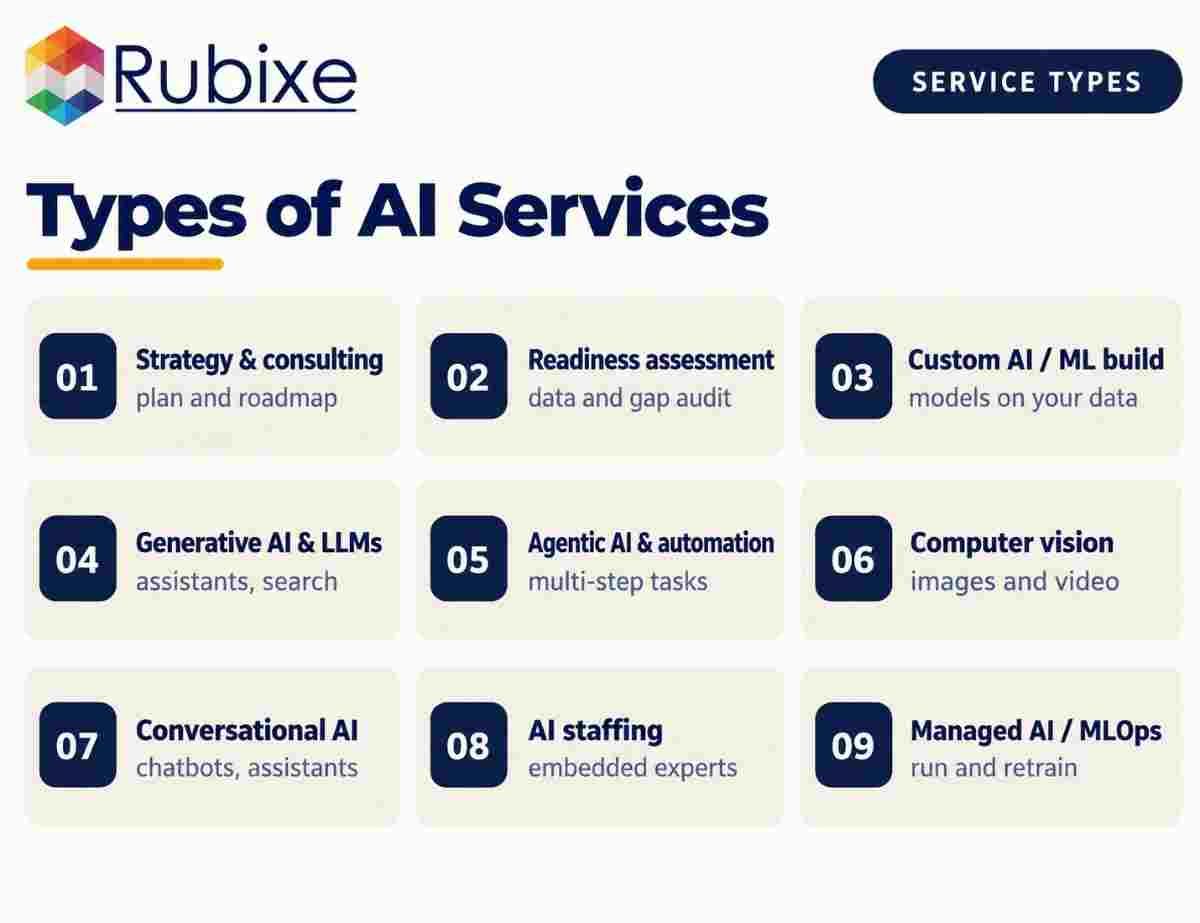
The main types of AI services are strategy and consulting, readiness assessment, custom AI/ML development, generative and agentic AI, computer vision, conversational AI, integration, staffing, and managed operations. Most programs combine several, starting with strategy and ending with an operations layer.
AI strategy and consulting:
Advisory work that finds where AI is worth doing and where it is not. Good AI consulting gives you a written roadmap including use cases ranked, data plan, timeline, and expected return. It should tell you what to do, instead of handing you a menu. Most engagements start here.
AI readiness assessment:
A short diagnostic of your data, systems, and workflows before you build anything. An AI readiness audit flags the gaps that would break a project later and turns them into an ordered fix list, usually inside 30 days.
Custom AI and machine learning development:
Building models trained on your own data for jobs off-the-shelf tools cannot do: demand forecasting, credit scoring, quality inspection, fraud detection. This AI and ML consulting work is where a services team earns its keep.
Generative AI and LLM services:
Assistants, content generation, document search, and knowledge tools built on large language models. The work is less about the model and more about grounding it in your data and putting guardrails around what it can say.
Agentic AI and automation:
Systems that plan and carry out multi-step tasks with limited human input: routing a claim, closing a ticket, running a back-office process end to end. Agentic AI services sit here, and so do process automation and RPA that cut manual load across operations.
Computer vision:
Reading images and video for tasks like defect detection on a line, identity checks, medical imaging support, or crop monitoring.
Conversational AI and chatbots:
Support bots and internal assistants that answer questions and take actions. Quality depends far more on the data behind them than on the chat window in front of them.
AI staffing and talent:
Pre-vetted AI engineers, ML scientists, and data leaders embedded into your team when you want to keep the work in-house but lack the people. AI staffing fills the gap full-time, on contract, or build-operate-transfer.
Managed AI services and MLOps:
Running the system after launch: monitoring, retraining, security, and governance. Models decay as the world changes. Someone has to watch them.
AI services vs traditional software development
Traditional software follows fixed rules a developer writes. AI services learn patterns from data and give probabilities, not certainties. Traditional code is tested once and behaves the same way. AI systems shift as data shifts, so they need monitoring and retraining after launch.
|
Dimension |
Traditional software |
AI services |
|
How it works |
Fixed rules written by hand |
Learns patterns from data |
|
Output |
The same result every time |
A prediction with a confidence level |
|
Depends on |
Clear requirements |
Data quality and volume |
|
Testing |
Pass or fail against rules |
Accuracy checked against live cases |
|
After launch |
Stable until code changes |
Drifts over time; needs retraining |
|
Best for |
Well-defined, stable problems |
Judgment under uncertainty, at scale |
Key AI technologies used in business
You do not need to build any of these to buy AI services well. Knowing what each one does helps you judge whether a provider is proposing the right tool.
|
Technology |
What it does |
Common business use |
|
Machine learning |
Learns from data to predict or classify |
Forecasting, fraud detection, recommendations |
|
Deep learning |
Layered neural networks for complex patterns |
Image and speech recognition |
|
Natural language processing |
Reads and writes human language |
Chatbots, document search, sentiment |
|
Computer vision |
Reads images and video |
Quality inspection, identity checks |
|
Generative AI / LLMs |
Creates text, code, and images |
Assistants, drafting, knowledge tools |
|
Agentic AI |
Plans and runs multi-step tasks |
Process automation, back-office ops |
|
RPA |
Automates rule-based digital tasks |
Data entry, reconciliation, routing |
|
MLOps |
Runs and maintains models in production |
Monitoring, retraining, governance |
AI services by business function
The fastest wins come from one function with clear data and a clear owner. Common starting points:
-
Sales and marketing: lead scoring, next-best-action, content and campaign support.
-
Customer service: support assistants, ticket routing, self-serve answers.
-
Operations and supply chain: demand forecasting, inventory planning, predictive maintenance.
-
Finance: fraud detection, credit and risk scoring, invoice and reconciliation automation.
-
HR and recruitment: resume screening, workforce planning, internal knowledge assistants.
-
Security: AI-driven threat detection, anomaly spotting, and automated response.
AI services by industry
|
Industry |
Where AI earns its place |
|
Financial services (BFSI) |
Fraud detection, credit decisions, compliance, trading signals |
|
Drug discovery support, clinical data, pharmacovigilance |
|
|
Quality inspection, predictive maintenance, equipment effectiveness |
|
|
Retail and e-commerce |
Demand forecasting, pricing, merchandising |
|
Energy and utilities |
Grid load, forecasting, sustainability tracking |
|
Telecom |
Churn prediction, network operations, customer ops |
|
Education |
Adaptive learning, admissions, back-office automation |
|
Agriculture |
Pest detection, yield prediction, supply chain |
How to choose an AI services provider
Choose an AI services provider on data and governance depth, industry experience, and a clear path from pilot to production, not on demo polish. Ask who owns the code and the models, how the work moves into your systems, and what happens after launch. Walk away from vague pricing and claims without references.
Gartner's own read on why projects get canceled is a useful lens here. Its analysts point at management, not models.
“Most agentic AI projects right now are... mostly driven by hype and are often misapplied,” said Anushree Verma, Senior Director Analyst, Gartner, 2025
Use this checklist when you shortlist AI services providers:
-
Data first: do they assess and fix your data before they promise a model?
-
Path to production: can they show how a pilot becomes a running system, not another slide?
-
Industry proof: have they shipped AI in your sector, with people you can talk to?
-
Ownership: do you keep the IP, the code, and the models?
-
Governance: do security, audit trails, and responsible-AI checks ship with the work?
-
Delivery model: can they consult, build, staff, or run it, so the engagement fits how you want to work?
Red flags:
-
A polished demo with no plan for live data.
-
No data-readiness step before the build.
-
Pricing they will not put in writing.
-
Claims and ratings with no client references behind them.
-
No answer for what happens after go-live.
The AI services implementation process
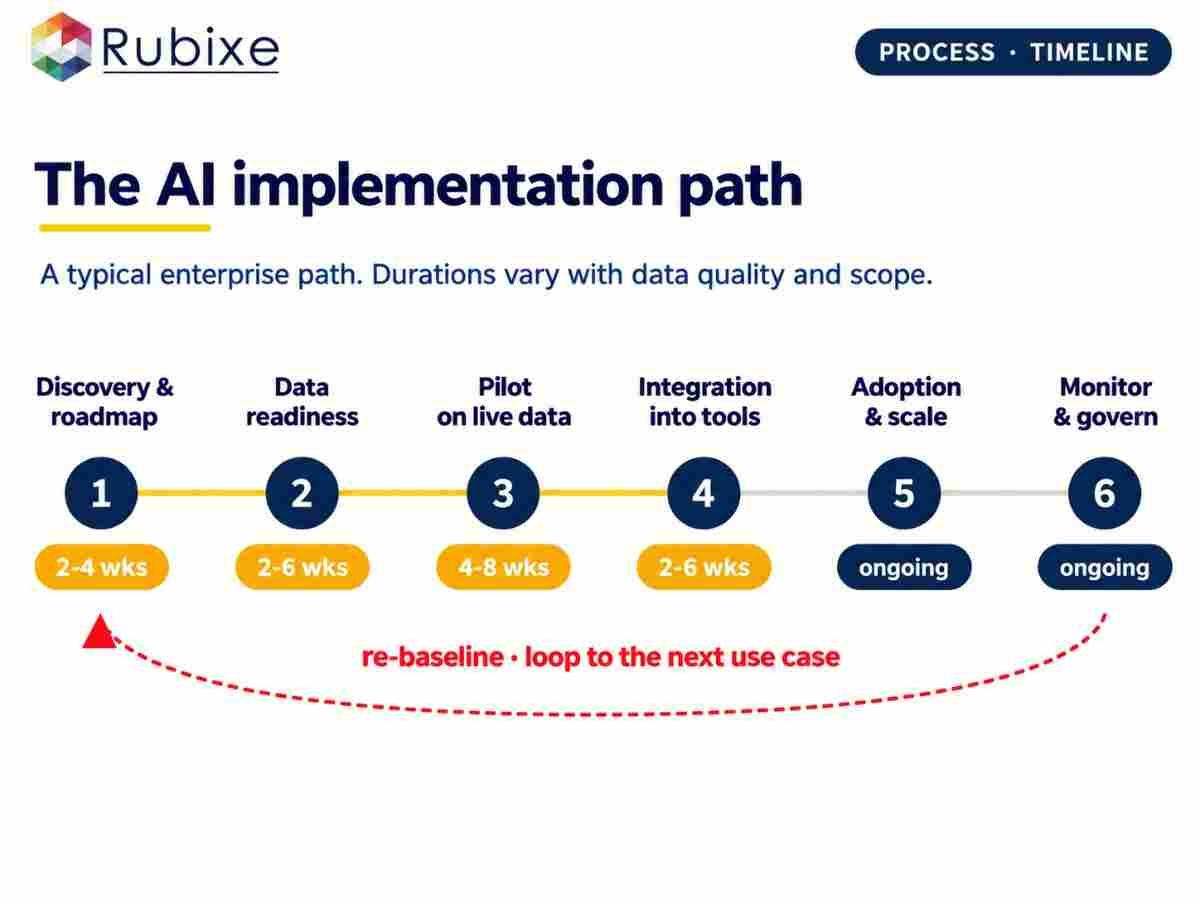
A realistic enterprise timeline, stage by stage. Durations vary with data quality and scope, so treat these as shape, not promises.
-
Discovery and roadmap (2 to 4 weeks): use cases ranked, data plan, timeline, expected return.
-
Data readiness (2 to 6 weeks): fix gaps, set up clean data flow for the first use case.
-
Pilot (4 to 8 weeks): build and prove one visible use case on live data.
-
Integration (2 to 6 weeks): wire the output into the tools people already use.
-
Adoption and scale (ongoing): roll out, train users, track return, pick the next use case.
-
Monitoring and governance (ongoing): watch for drift, retrain, keep the audit trail.
Challenges, limits, and when AI is the wrong tool
-
Honest limits save budgets: The failure data backs each of these up. Weigh them before you start:
-
Data quality: poor or scattered data is the most common reason projects fail. No model fixes bad data.
-
Change management: staff have to trust and use the system. That takes training and a clear owner.
-
Model drift: accuracy fades as the world changes. Budget for monitoring and retraining.
-
Generative AI errors: LLMs can state wrong things with confidence. Grounding and review matter.
-
Governance and compliance: regulated work needs audit trails, explainability, and controls from day one.
-
Cost at scale: a cheap pilot can get expensive in production. Price the full path, not the demo.
The pattern behind the numbers is consistent. The near-95% pilot stall rate in MIT's study and Gartner's 40%-plus agentic cancellation forecast both trace back to weak data, unclear value, and thin governance, not to model quality.
When AI is the wrong tool
Skip AI when the problem is well-defined and stable, when a simple rule already works, when you have too little data to learn from, or when no one owns the outcome. A plain script beats a model that no team will maintain.
What AI services cost
AI services cost depends on scope, data quality, integration depth, and how much you run in-house. Pricing usually follows one of four models: fixed-scope project, monthly staff augmentation, a managed-service retainer, or an outcome-priced pilot. Poor data and heavy compliance push costs up the most.
|
Engagement model |
How it is priced |
Fits when |
|
Fixed-scope project |
One price for a defined build |
The use case and data are clear |
|
Staff augmentation |
Monthly rate per person |
You lead the work and need skills |
|
Managed service/retainer |
Ongoing monthly fee |
You want the system run for you |
|
Outcome-priced pilot |
Tied to an agreed result |
You want to prove value before scaling |
Cost drivers to price in: how much data cleanup the project needs, how deep the integration goes, how much compliance and audit work the sector demands, and whether you keep running the system yourself or hand it over. Ask any provider to price the full path to production, not the pilot alone.
Why businesses work with Rubixe
Rubixe is a Bengaluru-headquartered AI consulting and services firm, with delivery and advisory teams across India, the Middle East, North America, and Europe. The focus is adoption: getting AI past the pilot and into daily work, then keeping it there.
What that looks like in practice:
-
A four-step method: consulting, data readiness, pilots, then adoption and ROI, looping back to the next use case.
-
In-house team: An in-house team of AI engineers, ML scientists, and domain consultants, so the work does not get handed to subcontractors.
-
Sector-specific: Industry-tuned playbooks across BFSI, life sciences, retail, manufacturing, telecom, energy, education, and agriculture.
-
Governance built in: responsible AI, security, and audit trails ship with the engagement.
-
Ownership stays with you: you keep the IP, code, and models.
Start with a free AI readiness conversation. You leave with a use-case shortlist, a data-readiness read, and an indicative timeline.
Explore our AI Solutions and book a free consultation with our AI experts to map your first AI win.
Frequently asked questions
What are AI services in simple terms?
AI services are the help a business gets to plan, build, and run artificial intelligence. That can be a single ready-made model through an API, or a full team that owns strategy, data, building, and operations.
What is the difference between AIaaS and AI services?
AI as a service (AIaaS) is cloud AI you rent and run yourself. Partner-delivered AI services means a team plans, builds, and runs AI around your data and workflows. AIaaS gives you parts. A services partner gives you an outcome.
How much do AI services cost?
Cost depends on scope, data quality, integration depth, and how much you keep in-house. Pricing usually follows a fixed-scope project, monthly staffing, a managed retainer, or an outcome-priced pilot. Weak data and heavy compliance raise the cost most.
How long does AI take to implement?
A first pilot often runs live within a few weeks to a couple of months once the use case and data are clear. Full adoption across teams takes longer and continues as an ongoing program.
Why do most AI pilots fail?
MIT's 2025 research found around 95% of enterprise generative AI pilots produced no P&L return. The causes are messy data, no clear owner, weak change management, and no plan for production, not the model itself.
Which industries use AI services?
Financial services, life sciences, manufacturing, retail, energy, telecom, education, and agriculture all run AI in production. The winning use case changes by sector, which is why industry experience matters when you pick a partner.
How do I choose an AI services company?
Judge them on data and governance depth, industry proof, ownership terms, and a clear path to production. Ask what happens after launch. Avoid vague pricing and claims with no references.