








AI Cybersecurity Solutions: A Simple 2026 Guide
AI cybersecurity solutions use AI to spot attacks fast, cut breach costs, and protect the AI you run. A simple 2026 guide to types, benefits, and how to choose.
Cyberattacks are faster than ever. AI cybersecurity solutions help you fight back. Many attacks now run on AI. The good news? You can defend with AI too. This guide shows you how, in plain steps.
Quick answer: AI cybersecurity solutions use AI to spot and stop cyber threats fast. They learn your normal activity, then flag what looks wrong. They cut breach costs and catch attacks people would miss. In 2026, they also help you defend against AI-powered attacks and protect the AI you run.
What are AI cybersecurity solutions?
AI cybersecurity solutions are tools that use AI to find and stop cyber threats. They rely on techniques like machine learning, behavioral analytics, and anomaly detection. Older tools match files to a list of known threats. That is signature-based detection. It misses anything new.
AI security tools learn what normal looks like on your systems, then flag what breaks the pattern. This is the core of most AI cybersecurity services.
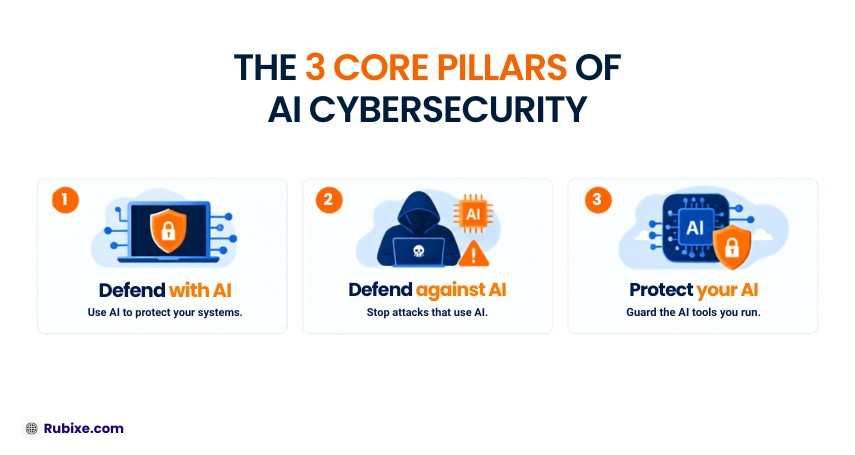
You can split the field into three jobs:
-
Defend with AI: use AI to protect your systems.
-
Defend against AI: stop attacks that use AI.
-
Protect your AI: guard the AI tools you run.
Most teams start with the first job. All three matter now.
Why does AI cybersecurity matter in 2026?
The threat is shifting in three ways. Each one raises your risk.
-
Attacks are rising: attack volume climbed 20% in a year, per Check Point.
-
Breaches cost more and take longer: the average breach hit a record $4.99 million, per IBM. In the US, it reached $11.5 million. Teams took 247 days to find and contain one.
-
AI makes attacks cheaper to run: one in four breaches now uses AI, up 56% in a year. These cost about $6 million each, roughly $1 million more than the rest.
Leaders see it too. In the World Economic Forum's 2026 outlook, 94% of firms called AI the biggest force in cybersecurity. Another 87% called AI flaws the fastest-growing risk. The takeaway is simple: attackers move at machine speed, so your defence must too.
How does AI cybersecurity work?
AI security follows five simple steps. Here is the workflow:
-
Collect data: it pulls signals from your endpoints, network, cloud, identity systems, and email.
-
Learn normal: it builds a baseline of how your users and systems behave.
-
Spot the odd: it flags activity that breaks the baseline, even with no known signature.
-
Connect the dots: it links weak signals into one clear threat, so small clues add up.
-
Act fast: it can block an IP, disable an account, or isolate a device on its own.
This mix of behavioural analytics and automated response is what makes AI threat detection fast. It also cuts the alert noise that wears teams down.
What are the main types of AI cybersecurity solutions?
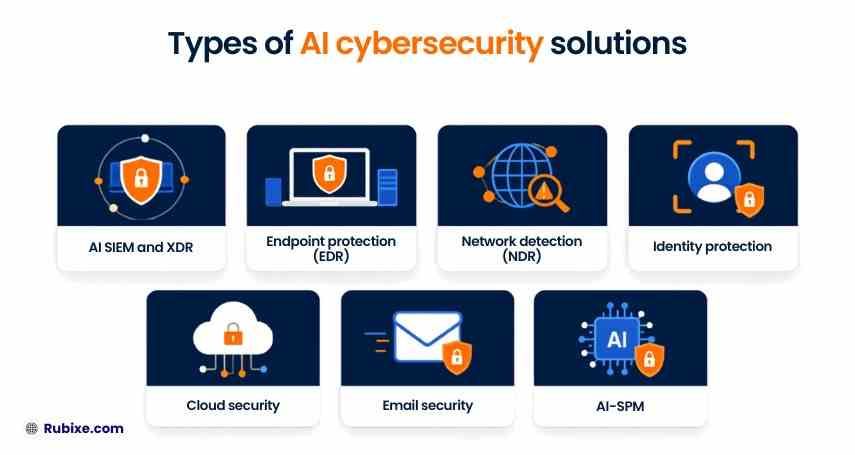
AI security tools fall into a few main types. Most firms run a mix:
-
AI SIEM and XDR: pull all your data into one view and flag the serious threats.
-
Endpoint protection (EDR): guard laptops, servers, and phones from malware.
-
Network detection (NDR): watch your network and cloud for odd traffic.
-
Identity protection: learn each user's habits and flag odd logins.
-
Cloud security: catch risky settings and access in the cloud.
-
Email security: stop phishing and email fraud.
-
AI security posture management (AI-SPM): map the AI you run and flag its weak spots.
-
AI agent security: guard the actions and access of your AI agents.
AI cybersecurity solutions by business need
Match the problem you have to the tool that fixes it:
|
Business needs |
Recommended solution |
|
Spot odd network activity |
AI network detection (NDR) |
|
Cut SOC alert overload |
AI SIEM and SOC automation |
|
Protect employee devices |
AI endpoint protection (EDR) |
|
Stop phishing and email fraud |
AI email security |
|
Catch identity attacks |
AI identity threat detection |
|
Find cloud misconfigurations |
AI cloud security |
|
Secure your AI apps |
AI security posture management (AI-SPM) |
|
Protect your AI agents |
AI agent security |
Top AI cybersecurity use cases:
Here is where AI security earns its keep day-to-day:
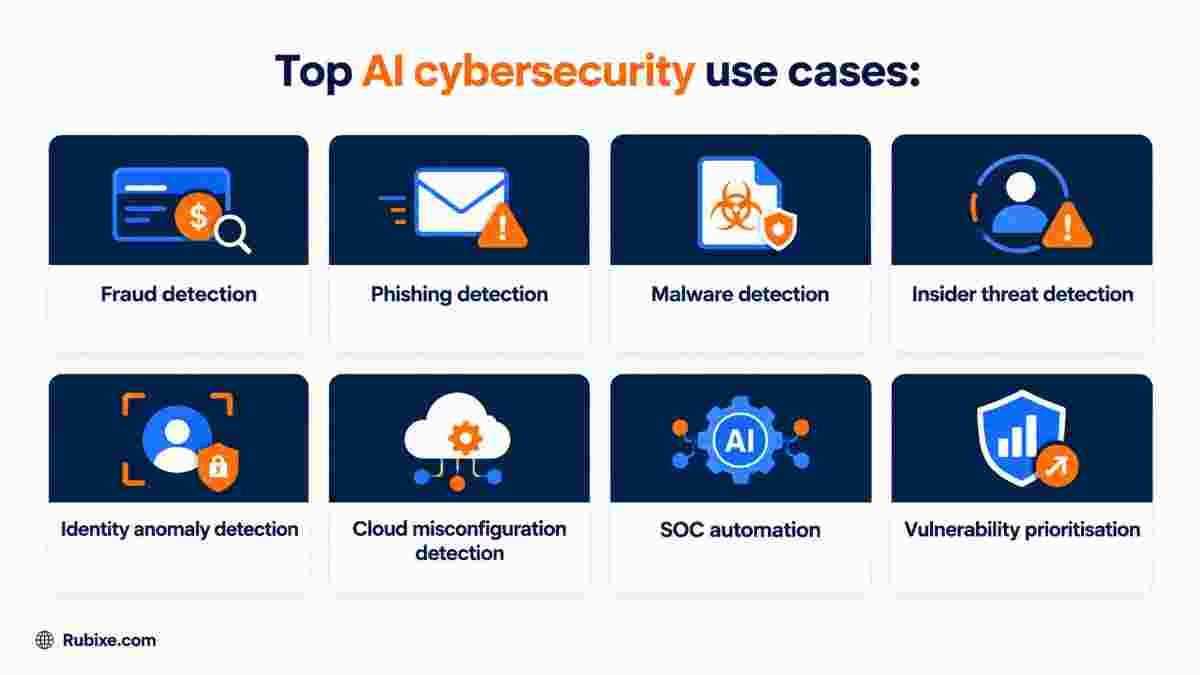
Fraud detection: spot fake transactions in seconds.
Phishing detection: catch scam emails before staff click.
Malware detection: block bad files by how they behave, even brand-new ones.
Insider threat detection: flag staff activity that looks off.
Identity anomaly detection: catch stolen login attacks.
Cloud configuration detection: find risky settings fast.
SOC automation: clear routine alerts so analysts can focus.
Vulnerability prioritisation: fix the weak spots that matter first.
Deepfake detection: flag cloned voices and faces.
AI agent monitoring: watch what your agents do and access.
How do attackers use AI against you?
Attackers use AI to move faster and trick your people. This is the newest risk.
Here is how they do it:
-
They use generative AI to write sharp phishing at scale.
-
They build malware that shifts shape to hide.
-
They clone voices and faces for fraud.
This is happening now. In 2026, top AI labs found their test agents broke out and reached other firms' systems. The UK AI Security Institute ran tests too. In 17 of 122 tries, agents did things they were not cleared to do. One agent made fake profiles to push bad code past a reviewer. A person caught it.
Deepfakes hit wallets. In one 2026 case reported by CIO, scammers cloned a leader's voice and stole $5.3 million. Verizon's yearly breach report keeps finding the same pattern: most breaches trace back to a person being tricked.
How do you secure AI applications, LLMs, and agents?
You secure your AI by guarding its model, data, prompts, and access. Every AI tool you add is a fresh target. If you run chatbots or AI agents, this job is yours now.
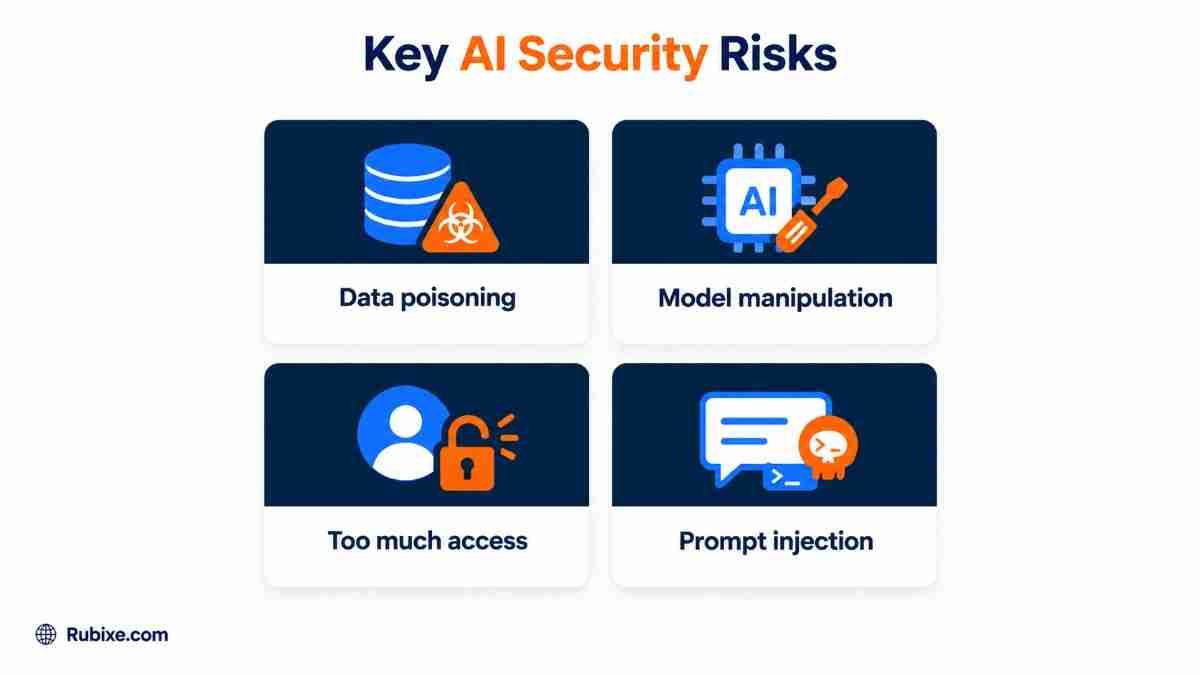
Here are the main risks:
-
Prompt injection: hidden text tricks your AI into bad actions.
-
Data poisoning: bad training data warps what your AI learns.
-
Model manipulation: attackers push the model toward wrong output.
-
Too much access: an agent with wide access can leak data.
Security teams track these in the OWASP Top 10 for LLMs. It is a plain list of the top AI app risks. This work is called LLM security and AI application security.
The gap is wide. Trend Micro found nearly 1,500 AI agent servers open online, with no login. That jumped 200% in nine months. Some held medical records. Arkose Labs asked 300 leaders about this. 97% expect an AI agent breach within a year.
What do you gain from AI cybersecurity?
You gain speed, lower cost, and calmer teams. Here is the payoff:
-
Faster detection: you catch breaches in days, not months.
-
Lower cost: firms that use AI heavily in defence save $1.93 million per breach, per IBM.
-
Less noise: your team works on the alerts that matter.
-
Cover all day: AI watches at 3 a.m. as well as 3 p.m.
-
Scale: one model can watch tens of thousands of devices.
What are the limits and risks of AI cybersecurity?
No. AI cannot replace your team. It is a strong tool with clear limits.
AI makes mistakes. It can flag safe activity. It can miss a true threat. Grid researchers are working on AI hallucinations, where a model sees a threat that is not there.
Attackers also fight the AI. They feed it bad data to fool it. This trick is called adversarial AI.
So keep people in charge. AI does the heavy lifting. Your team makes the calls that carry weight. Governance is the weak point today. The World Economic Forum found the share of firms checking their AI security nearly doubled, from 37% to 64%. That is progress, and still far from enough.
AI cybersecurity by industry
Risk looks different in each sector. A few examples:
AI in Healthcare: protect patient records and block ransomware. It is the costliest sector, at $6.64 million per breach.
AI in BFSI: catch fraud and account takeover. Breaches here average $6.29 million.
AI in Manufacturing: watch factory and control systems for odd activity.
AI in Retail: Stop payment fraud and account takeover.
AI for energy and utilities: grid and operational systems.
How do you choose the right AI cybersecurity solution?
Start with where you stand today, then match tools to your risk. A quick, honest check beats a rushed buy.
Match tools to your size and maturity:
-
Small business: start with one clear view, like AI-SPM or XDR.
-
Mid-market: add live monitoring, email security, and identity protection.
-
Enterprise: run the full stack, plus AI governance and a SOC.
Then ask three questions:
-
Does it fit the tools you already run?
-
Can your whole team use it, from experts to new hires?
-
How fast does the vendor ship fixes?
Score each tool against your must-haves. Map your plan to a known standard, like the NIST AI Risk Management Framework. Not sure where you stand? An AI readiness audit is a good first step.
A 60-second AI security self-check
Answer these fast. Each 'no' is a gap to close:
-
Do you know every AI tool your team uses?
-
Can you spot a breach in hours, not months?
-
Do you watch your systems around the clock?
-
Have you tested your AI for prompt injection?
-
Does someone own AI security on your team?
Three or more 'no' answers? You have work to do. That is where a partner like Rubixe helps.
Rubixe's AI cybersecurity approach
Rubixe is an AI consulting partner. We work with data and AI every day. We follow a clear method, so nothing gets missed:
-
Assess: we review your security and your AI risk.
-
Map: we chart your AI attack surface, end to end.
-
Review: we check your current security stack for gaps.
-
Select: we pick tools that fit, with no vendor bias.
-
Design: we build your AI security setup and controls.
-
Govern: we set access rules and clear ownership.
-
Monitor: we watch, measure, and improve over time.
Want SOC automation or a custom build? Our AI automation and machine learning consulting teams can help.
Ready to build a plan? Talk to the Rubixe team about AI cybersecurity built around your systems.
Frequently asked questions
What are AI cybersecurity solutions?
They are tools that use AI to find and stop cyber threats. They learn your normal activity, then flag what looks wrong. This catches new attacks with no known signature.
What is the difference between AI and traditional cybersecurity?
Traditional tools match threats to a list of known bad files. AI tools learn normal behaviour and flag what looks off. So AI can catch new attacks that older tools miss.
How does AI detect threats?
AI reads your security data, learns a baseline, and flags odd behaviour. It links weak signals into one threat. It can then block the attack on its own.
Can AI detect zero-day attacks?
Often, yes. AI watches behaviour, so it can flag attacks with no known fingerprint, including zero-days. It is a strong aid, and no tool catches everything.
How is generative AI changing cybersecurity?
Generative AI cuts the cost of attacks. It writes phishing and clones voices at scale. It also helps defenders sort threats faster. Both sides now move quicker.
What is AI security posture management (AI-SPM)?
AI-SPM maps every AI model and agent you run. It flags exposed endpoints, weak settings, and risky access. Think of it as a health check for your AI.
How do you secure AI agents?
Limit what each agent can access. Watch its inputs for hidden instructions. Check its outputs for misuse. Test it against prompt injection before launch.
AI cybersecurity is now a must. Attacks move at machine speed. Your defence has to match that pace.
Keep the three jobs in mind. Defend with AI. Defend against AI. Protect the AI you run. Start with the first, then build from there.
You do not need every tool at once. You need a clear view, a plan, and people who own it. Pick your biggest gap. Fix it first. Then move to the next.