






What Is Predictive Analytics, and How Does It Work?
Understand what predictive analytics is and how it works, including key models, industry applications, implementation steps, benefits, challenges, and future trends.
Every business generates data, yet few use it to anticipate what will happen next. Sales fluctuate, customers churn, machines fail, and risks emerge without warning. Predictive analytics helps organizations move from reacting to anticipating. By analyzing historical data with statistical and machine learning techniques, it reveals patterns that signal future outcomes. Companies across sectors rely on predictive insights to plan inventory, personalize marketing, prevent fraud, and optimize operations. Understanding how it works is the first step toward making smarter, data-driven decisions.
What Is Predictive Analytics?
Predictive analytics is a branch of advanced analytics that uses historical data, statistical algorithms, and machine learning to forecast future events or behaviours. Instead of explaining what happened, it estimates what is likely to happen.
It draws data from multiple sources such as:
-
Transaction records
-
Customer interactions
-
Operational systems
-
Sensors and IoT devices
-
Market and economic indicators
The output may include probability scores, risk ratings, demand forecasts, or behavioural predictions.
Predictive analytics solutions typically combine:
-
Data mining
-
Statistical modeling
-
Machine learning
-
Pattern recognition
-
Data visualization
For example, an e-commerce platform can predict which users are most likely to purchase, abandon carts, or respond to promotions. A bank can identify potential loan defaults before they occur.
Types of Predictive Analytics Models and How They Work
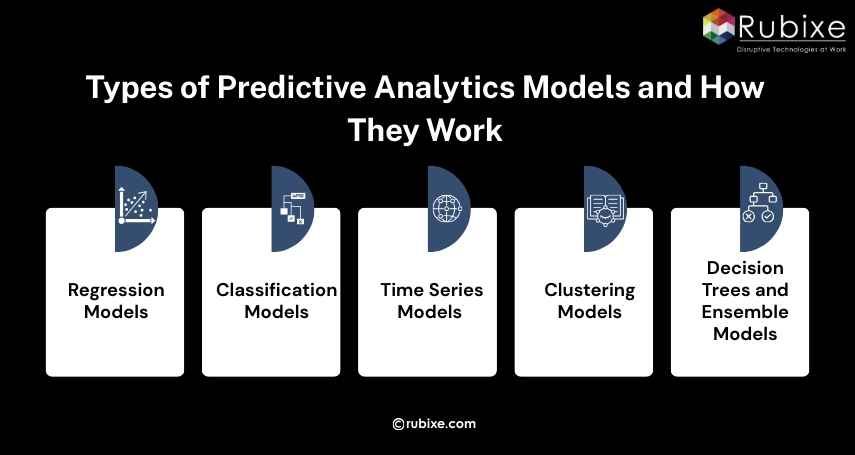
Predictive analytics uses different models depending on the type of problem, data available, and business objective. Each model identifies patterns in historical data to estimate future outcomes.
1. Regression Models
Used to predict numerical values such as revenue, demand, or pricing.
How it works:
Regression models analyze how different factors influence an outcome. For example, sales may depend on price, advertising spend, season, and market conditions. By measuring these relationships, the model estimates future values when those factors change.
Use cases:
-
Sales and revenue forecasting
-
Budget planning
-
Pricing optimization
-
Financial projections
2. Classification Models
Used when the outcome belongs to specific categories.
How it works:
Classification models learn from historical examples where outcomes are already known. They then assign new cases to categories with probability scores.
Use cases:
-
Fraud detection (fraud or legitimate)
-
Customer churn prediction (leave or stay)
-
Loan approval decisions
-
Medical risk assessment
3. Time Series Models
Used to analyze data collected over time to forecast future values.
How it works:
Time series models examine past data in chronological order to identify trends, seasonal patterns, and recurring fluctuations. By understanding how values change over days, months, or years, the model predicts future performance.
Use cases:
-
Sales forecasting based on historical trends
-
Inventory planning for seasonal demand
-
Website traffic prediction
-
Energy consumption forecasting
4. Clustering Models
Used to discover natural groupings within data without predefined labels.
How it works:
Clustering models analyse similarities among data points and group them into segments based on shared characteristics or behaviour.
Use cases:
-
Customer segmentation for targeted marketing
-
Product recommendation strategies
-
Market research analysis
-
Identifying high-value customer groups
5. Decision Trees and Ensemble Models
Used for complex predictions that depend on multiple conditions.
How it works:
Decision trees split data into branches based on rules, similar to a flowchart. Ensemble models combine many trees to improve accuracy and stability.
Use cases:
-
Credit risk scoring
-
Customer response prediction
-
Operational risk assessment
-
Demand forecasting with multiple variables
Industry Applications of Predictive Analytics
Predictive analytics has become a strategic capability across industries, helping organizations anticipate risks, optimize operations, and improve customer outcomes.
1. Healthcare
-
Predicting disease risks: Analyzes patient history, lifestyle data, and genetic information to identify individuals at higher risk of chronic conditions such as diabetes or heart disease.
-
Hospital readmission forecasting: Identifies patients who are likely to be readmitted after discharge, enabling preventive care and better follow-up planning.
-
Resource planning: Forecasts patient inflow and treatment demand to optimize staffing, equipment usage, and bed availability.
-
Personalized treatment recommendations: Uses patient-specific data to suggest tailored treatment plans, improving clinical outcomes and reducing trial-and-error approaches.
2. Retail and E-commerce
-
Demand forecasting: Predicts future product demand using historical sales, seasonality, and market trends to avoid stockouts or overstocking.
-
Inventory optimization: Ensures the right products are available at the right time by aligning supply with forecasted demand.
-
Personalized recommendations: Analyzes browsing behavior and purchase history to recommend products most relevant to each customer.
-
Price optimization: Adjusts pricing strategies dynamically based on demand patterns, competitor pricing, and customer behavior.
3. Banking and Finance
-
Credit risk evaluation: Assesses borrower profiles and financial history to estimate the likelihood of loan repayment or default.
-
Fraud detection: Detects unusual transaction patterns in real time to prevent financial fraud and minimize losses.
-
Customer lifetime value prediction: Estimates long-term profitability of customers to guide acquisition and retention strategies.
-
Algorithmic trading support: Uses historical market data and patterns to support data-driven trading decisions.
4. Manufacturing
-
Predictive maintenance: Monitors machine performance data to predict equipment failures before they occur, reducing downtime and maintenance costs.
-
Quality control forecasting: Identifies patterns that indicate potential production defects, helping maintain consistent product quality.
-
Supply chain optimization: Forecasts supply and demand fluctuations to improve procurement, logistics, and distribution efficiency.
-
Production planning: Aligns manufacturing schedules with predicted demand to improve output efficiency and reduce waste.
5. Marketing and Advertising
-
Lead scoring: Ranks prospects based on their likelihood to convert, helping sales teams prioritize high-potential leads.
-
Campaign performance forecasting: Estimates campaign results in advance using historical marketing data and audience behaviour insights.
-
Customer segmentation: Groups customers based on shared characteristics or behaviours to deliver targeted messaging.
-
Conversion prediction: Identifies users most likely to complete desired actions, such as purchases or sign-ups.
6. Telecommunications
-
Network failure prediction: Analyses system performance data to anticipate outages and maintain service reliability.
-
Customer churn prevention: Identifies subscribers at risk of switching providers, enabling proactive retention strategies.
-
Usage pattern analysis: Examines call, data, and service usage trends to design better pricing plans and service offerings.
Organizations that adopt predictive analytics solutions gain measurable improvements in operational efficiency, cost management, risk reduction, and customer satisfaction by making proactive, data-driven decisions.
How to Implement Predictive Analytics for Business Growth
Successful implementation requires more than tools. It involves strategy, data readiness, and organizational alignment.
1. Define Business Objectives
Start with a clear question, such as reducing churn by 20 percent or improving demand forecast accuracy.
Reliable predictions require high-quality
2. Assess Data Availability
Quality historical data. This may include structured and unstructured sources.
3. Prepare and Clean Data
Data preprocessing removes inconsistencies, duplicates, and missing values.
4. Select Appropriate Models
Choose models aligned with the prediction goal and data characteristics.
5. Train and Validate Models
Algorithms learn from past data and are tested using unseen datasets to measure accuracy.
6. Deploy and Monitor
Predictions are integrated into business systems and continuously monitored for performance.
7. Refine Continuously
Models require periodic retraining as market conditions and customer behaviour change.
Organizations that embed predictive insights into everyday decision-making see the greatest impact on growth and competitiveness.
Benefits of Predictive Analytics
Predictive analytics delivers measurable value across operations, marketing, finance, and strategy.
Key Benefits
-
Improved decision accuracy
-
Reduced operational risks
-
Enhanced customer experiences
-
Increased revenue opportunities
-
Optimized resource utilization
-
Faster response to market changes
According to industry research, data-driven organizations consistently outperform peers in productivity and profitability.
“Predictive analytics transforms data into actionable foresight, enabling organizations to move from reactive to proactive decision-making.”
Strategic Impact
Companies using predictive insights can:
-
Anticipate customer needs
-
Prevent losses before they occur
-
Identify growth opportunities early
-
Allocate budgets more efficiently
These advantages compound over time, creating sustainable competitive strength.
“Predictive analytics is about using data to anticipate what will happen, so organizations can make better decisions today.” - Eric Siegel, Author of "Predictive Analytics: The Power to Predict Who Will Click, Buy, Lie, or Die
Challenges and Limitations of Predictive Analysis
Despite its benefits, predictive analytics comes with practical challenges.
1. Data Quality Issues: Incomplete or biased data leads to inaccurate predictions.
2. Integration Complexity: Legacy systems may limit data access and real-time processing.
3. Skill Gaps: Specialized expertise in data science and machine learning is required to build accurate models and drive machine learning benefits in business.
4. Model Interpretability: Complex models can be difficult for stakeholders to understand.
5. Privacy and Compliance: Handling sensitive data requires strict governance and security measures.
6. Changing Conditions: Models trained on past data may become less accurate as markets evolve.
Organizations must address these challenges to realize full value from predictive analytics solutions.
Future of Predictive Analytics
Predictive analytics continues to evolve alongside artificial intelligence, big data, and cloud computing.
Emerging Trends
-
Real-time predictive insights
-
Integration with generative AI systems
-
Edge analytics for IoT devices
-
Automated machine learning (AutoML)
-
Prescriptive analytics that recommend actions
Industry studies indicate strong growth in AI adoption across both large enterprises and mid-sized businesses. As data volumes increase, predictive capabilities will become essential for operational resilience and innovation.
FAQs
1. What is the difference between predictive and descriptive analytics?
Descriptive analytics explains past events, while predictive analytics forecasts future outcomes based on patterns in historical data.
2. Do small businesses benefit from predictive analytics?
Yes. Cloud-based tools make predictive capabilities accessible to startups and mid-sized companies, especially for sales forecasting and customer insights.
3. How accurate are predictive models?
Accuracy depends on data quality, model selection, and changing conditions. Continuous monitoring improves reliability.
4. Is predictive analytics the same as AI?
Predictive analytics uses AI and machine learning techniques, but it is one component within the broader field of artificial intelligence.
5. What industries use predictive analytics the most?
Healthcare, finance, retail, manufacturing, telecommunications, and marketing are among the leading adopters.
If you want to turn raw data into accurate forecasts and strategic decisions, adopting the right predictive analytics approach is crucial. Explore how tailored AI and ML consulting services can help your organization identify opportunities early, reduce risks, and achieve sustainable growth.