












How AI is Replacing Manual Scheduling
Learn how AI Scheduling Automation replaces manual scheduling by reducing errors, improving resource allocation, and enabling real-time, data-driven planning.
You probably start your day thinking a quick meeting setup or resource alignment will take a few minutes, but it often turns into multiple messages, follow-ups, and delays that slow down actual work. What should be a simple coordination task gradually becomes a recurring operational burden.
This is where manual scheduling starts creating friction in your day-to-day workflow. As coordination complexity increases, AI begins to step in by removing repetitive effort and bringing structure to how time, people, and resources are managed.
Problem with Manual Scheduling
Manual scheduling looks simple, but in reality, it creates hidden operational friction that increases as a business grows.
1. Human Error and Inaccuracy
One of the biggest challenges in traditional scheduling is inconsistency. Even a small mistake like double booking or incorrect availability can disrupt multiple workflows. As complexity increases, errors multiply.
2. Slow Decision-Making
Every change requires communication between multiple stakeholders. This slows execution and delays important decisions. Manual systems cannot respond in real time.
3. Poor Resource Allocation
Resources such as people, time slots, and tools are often not optimized properly. This leads to underutilization or overloading of teams.
4. Reactive, Not Proactive
Manual systems only react after a problem occurs. They do not predict conflicts or optimize outcomes in advance.
This is why companies are increasingly exploring Artificial Intelligence Scheduling Automation to eliminate repetitive coordination work and reduce operational delays.
Why Traditional Scheduling Fails at Scale
As organizations grow, scheduling becomes less about coordination and more about managing complexity. What works for small teams quickly breaks down when multiple dependencies and constraints enter the picture.
At scale, manual scheduling simply cannot keep up with the speed and variability of modern operations.
Key reasons traditional scheduling fails:
-
An increasing number of employees creates overlapping availability conflicts
-
More meetings and dependencies make coordination harder to manage
-
Manual systems cannot evaluate multiple constraints simultaneously
-
Scheduling delays reduce overall productivity and execution speed
-
Teams spend more time coordinating than actually working
-
Lack of real-time optimization leads to inefficient time allocation
At this stage, AI Scheduling Automation becomes essential because it can evaluate thousands of scheduling combinations in seconds.
Without automation, teams spend more time coordinating schedules than actually doing productive work. With Artificial Intelligence Scheduling Automation, scheduling becomes a background process rather than a manual task.
This shift is critical for enterprises dealing with cross-functional teams and distributed operations.
What Is AI-Driven Scheduling?
AI-driven scheduling is a system that uses intelligence to automatically plan and manage schedules based on data, constraints, and real-time inputs.
Unlike traditional systems, it does not depend on human coordination at every step. Instead, AI Scheduling Automation processes availability, priorities, and patterns to generate optimized schedules.
For example, when a meeting request is created, the system evaluates participant availability, workload, and past behavior before suggesting the best possible time slot.
Why Should You Switch to AI Scheduling?
The shift toward automation is driven by measurable operational improvements.
Real-Time Optimization: AI Scheduling Automation continuously adjusts schedules based on live inputs, ensuring minimal disruption.
Enhanced Resource Utilization: Resources are allocated more effectively, reducing idle time and improving productivity.
Predictive Problem-Solving: Instead of reacting to conflicts, systems powered by Artificial Intelligence Scheduling Automation identify and resolve them before they occur.
Better Delivery Performance: Teams experience fewer delays, improving overall execution consistency.
Scalability for Complex Operations: As operations grow, AI Scheduling Automation adapts without requiring additional manual effort.
At this stage, businesses often begin exploring AI Workflow automation to connect scheduling with broader operational systems.
Manual vs AI Scheduling: A Direct Comparison
Understanding the difference between manual scheduling and AI Scheduling Automation makes it clear why businesses are rapidly shifting toward automation. While manual methods depend on human coordination, AI systems focus on speed, accuracy, and continuous optimization.
Below is a clear comparison of both approaches:
|
Aspect |
Manual Scheduling |
AI Scheduling Automation |
|
Speed |
Slow and dependent on communication |
Instant and real-time processing |
|
Conflict Handling |
Frequent scheduling conflicts |
Automatically detects and resolves conflicts |
|
Optimization |
Limited or manual adjustments |
Continuously optimized using algorithms |
|
Decision-Making |
Human-driven and reactive |
Data-driven and predictive |
|
Scalability |
Difficult to manage as complexity increases |
Easily scales across large teams and systems |
|
Resource Utilization |
Often inefficient or imbalanced |
Optimized allocation of time and resources |
The difference becomes more visible as business complexity increases.
Many organizations begin adopting AI Scheduling Automation when they realize that manual coordination is slowing down core operations. This comparison clearly shows why automation is not just a convenience but a necessity for scaling businesses.
How AI Scheduling Algorithms Actually Work
At the core of AI Scheduling Automation, there is a combination of technologies working together to interpret requests, analyze data, and generate optimized schedules.
Core Technologies Behind AI Scheduling
When a scheduling request is entered, natural language processing (NLP) interprets intent, participants, and timing. Machine learning then evaluates historical scheduling patterns to determine the best possible outcome.
This combination allows Scheduling Automation to move beyond rule-based systems into adaptive intelligence.
Core Algorithm Types
Modern systems use multiple optimization techniques:
-
Reinforcement learning to improve scheduling decisions over time
-
Genetic algorithms to evolve better scheduling combinations
-
Dynamic scheduling to adjust in real time
-
Multi-objective optimization to balance multiple constraints
Each of these plays a role in making AI Scheduling Automation more accurate and scalable.
System Architecture Behind Scheduling Engines
A complete AI Scheduling Automation system is built using multiple interconnected components that work together to process, predict, and optimize scheduling decisions in real time.
-
Data Processing Engine: Collects, cleans, and organizes scheduling data from multiple sources.
-
Constraint Handler: Manages rules like availability, time limits, and resource restrictions.
-
Prediction Module: Forecasts scheduling needs, demand patterns, and possible conflicts.
-
Optimization Layer: Finds the most efficient scheduling combination based on all inputs.
-
Learning Component: Continuously improves system accuracy using historical outcomes and feedback.
Together, these ensure that AI Scheduling Automation can handle complex business environments without manual intervention.
How AI Agents for Scheduling Work
AI agents take automation further by actively managing scheduling tasks without constant input.
Instead of waiting for instructions, agents powered by Agentic AI can take initiative, evaluate scheduling conditions in real time, and adjust plans automatically without manual intervention.
-
Detect scheduling conflicts
-
Suggest alternatives
-
Reschedule meetings dynamically
-
Optimize time slots automatically
This shift represents the move from automation to autonomy. In advanced systems, AI Scheduling Automation works continuously in the background, ensuring schedules remain optimized even when conditions change.
Real-World Example: AI Scheduling in Action
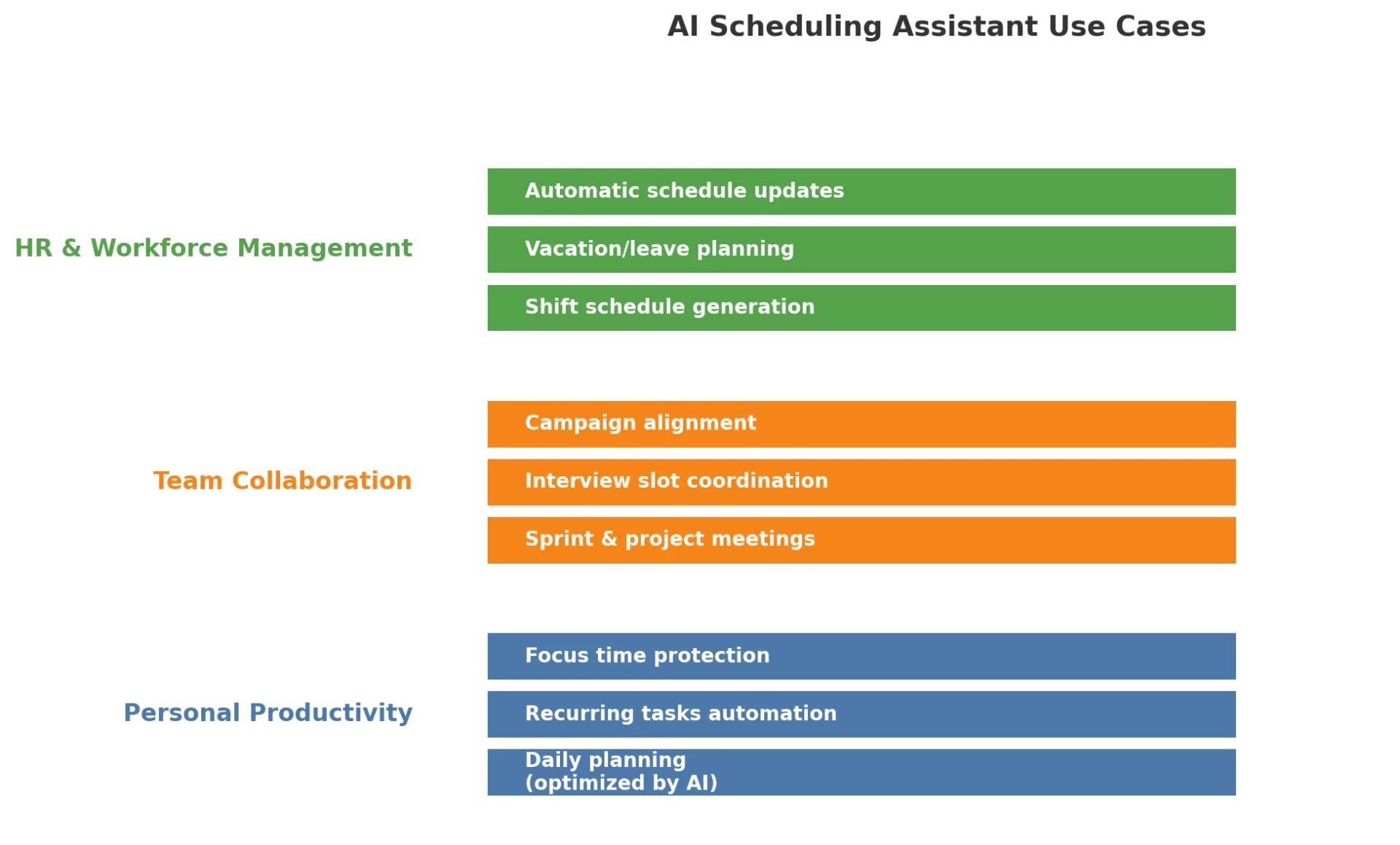
Consider a company operating across multiple time zones with distributed teams.
In a manual system, arranging a meeting can take hours of coordination. With AI Scheduling Automation, the system:
-
checks availability instantly
-
analyzes priority levels
-
resolves conflicts automatically
-
sends optimized meeting invites
This is where AI Workflow to improve productivity integrates with scheduling systems to connect communication tools, calendars, and task management platforms. The result is faster execution, fewer delays, and improved productivity across teams
Steps to Transition from Manual to AI Scheduling
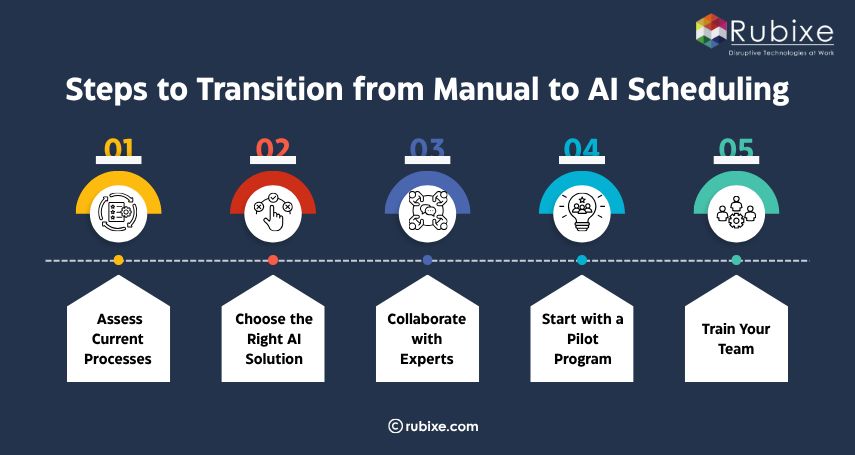
Switching from manual scheduling to automation requires a clear and structured approach. Most challenges don’t come from the technology itself, but from how the transition is planned and executed inside the organization.
A step-by-step approach helps teams introduce AI Scheduling Automation without disrupting ongoing work and ensures the system fits naturally into existing processes.
Step 1: Assess Current Processes
Start by understanding how scheduling currently happens across teams, tools, and communication channels. Look at where delays occur, where coordination becomes repetitive, and where time is being lost.
This gives a clear picture of where AI Scheduling Automation can create the most impact.
Step 2: Choose the Right AI Solution
Select an AI solution based on how your business actually operates rather than feature lists. Different organizations have different scheduling complexities, so the system should match real requirements. When the fit is right, Scheduling Automation integrates smoothly into daily workflows.
Step 3: Collaborate with Experts
Working with an AI Automation service provider helps ensure the system is set up correctly from the beginning. Experts help align technical setup with business needs and avoid unnecessary rework later. This makes the rollout of AI Scheduling Automation more stable and predictable.
Step 4: Start with a Pilot Program
Begin with a smaller rollout before expanding across the organization. This allows teams to observe how AI Scheduling Automation performs in real situations without full-scale disruption. It also helps refine workflows based on actual usage.
Step 5: Train Your Team
Teams need clarity on how the system fits into their daily work. When employees understand how AI Scheduling Automation reduces manual effort, adoption becomes much smoother. Good training ensures the system is used properly and consistently across teams.
Future of Appointment Scheduling with AI
The future of scheduling is moving toward fully autonomous systems.
Advancements in Scheduling Technology: Systems are becoming more predictive and context-aware, improving accuracy over time.
Towards Intelligent Scheduling Ecosystems: Scheduling will integrate with broader enterprise systems instead of functioning independently.
AI-Powered Autonomous Scheduling Systems: Future systems will handle scheduling decisions without human intervention.
This evolution directly contributes to enhancing the workforce with AI, where employees focus more on strategic tasks instead of coordinating work.
It also supports enhancing business with LLM Automation, where scheduling becomes part of a larger intelligent workflow ecosystem.
This discussion highlights how scheduling workflows are shifting from manual coordination to intelligent automation. The adoption of Scheduling Automation is steadily reshaping how organizations manage time, resources, and planning efficiency. The real value emerges when automation is implemented with the right structure and alignment to business operations.
Engaging with an experienced AI consulting expert can support a smoother and more effective transition.