




Agentic AI: The Future of Intelligent Automation Services
Understand how Agentic AI is shaping intelligent automation services through autonomous decision making, adaptive workflows, and scalable enterprise automation.
Are your automation systems actually reducing workload, or are they just shifting it?
Many organizations invested in automation to cut costs and improve speed. They deployed bots, integrated dashboards, and automated workflows. But over time, a pattern emerged. Bots failed when inputs changed. Exceptions piled up. Teams spent hours monitoring and correcting automated processes.
Instead of eliminating operational friction, automation sometimes created a new layer of complexity.
Agentic AI reshapes the future of intelligent automation services.
We are entering a phase where automation does not just execute instructions. It understands objectives, plans actions, adapts to change, and operates with controlled autonomy. Agentic AI represents the evolution from task automation to outcome-driven automation.
The Growth of Intelligent Automation Services
To understand the future, we need to look at the progression.
Phase 1: Rule - Based Automation
Robotic Process Automation (RPA) handled repetitive, rule-driven tasks. It followed predefined steps. If anything changed outside those rules, it stopped.
Phase 2: AI-Driven Automation
Machine learning and natural language processing were added. Systems could classify data, detect patterns, and make predictions. However, workflows still relied on predefined structures.
Phase 3: Agentic AI
Now, automation is becoming goal-oriented. Instead of executing steps, systems determine the steps needed to achieve a defined objective.
That difference is critical.
Traditional intelligent automation services focus on "How to complete this task?"
Agentic AI focuses on "How do I achieve this outcome?"
This shift introduces autonomous business processes capable of adapting to real world variability.
What Is Agentic AI?
Agentic AI refers to intelligent systems designed to act as autonomous agents within defined boundaries.
These agents:
-
Understand business objectives
-
Analyze context and data
-
Plan multi-step actions
-
Execute tasks across systems
-
Monitor outcomes
-
Adjust strategies when needed
Unlike static automation, agentic systems can re-evaluate their approach based on feedback.
For example
A traditional automation workflow processes invoices if all fields match a rule set. An agentic system analyzes anomalies, checks vendor history, compares patterns, and decides whether to approve, flag, or request clarification, all within compliance parameters.
It operates less like a script and more like a junior analyst with structured authority.
Why Current Enterprise Automation Solutions Are Struggling
Many enterprise automation solutions were built around predictable environments. But today’s business landscape is not predictable.
Consider these realities:
-
Customer expectations shift rapidly
-
Supply chains face disruptions
-
Regulatory frameworks evolve
-
Data volumes grow exponentially
-
Multi-channel interactions increase complexity
Static workflows break under dynamic conditions.
For example, In customer support, a rule-based system can categorize tickets. But if a product recall happens, ticket volume spikes. Priorities shift. Customers express frustration. Traditional automation cannot reprioritize intelligently without human intervention.
Agentic AI can:
-
Detect unusual ticket patterns
-
Reclassify urgency dynamically
-
Allocate resources
-
Draft personalized responses
-
Trigger cross-functional alerts
This adaptability is what modern intelligent automation services require.
Core Characteristics of Agentic Intelligent Automation
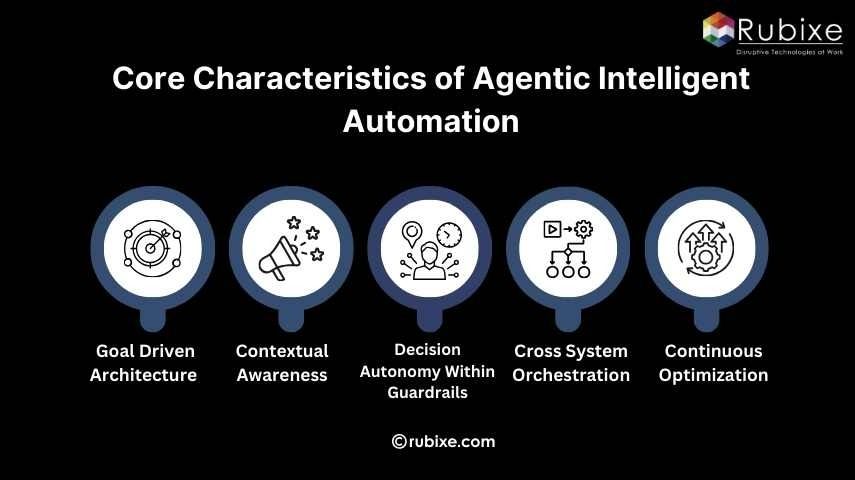
1. Goal-Driven Architecture
Instead of automating individual steps, agentic systems align with business KPIs:
-
Reduce average handling time
-
Improve fulfillment accuracy
-
Increase revenue conversion
-
Lower compliance risk
The system determines how to achieve these goals through dynamic workflows.
2. Contextual Awareness
Agentic AI analyzes structured and unstructured data:
-
Emails
-
Transaction logs
-
CRM notes
-
Market signals
-
Historical patterns
This contextual layer allows decisions that reflect real-world complexity.
3. Decision Autonomy Within Guardrails
Autonomy does not mean unrestricted control.
Organizations define:
-
Escalation thresholds
-
Financial limits
-
Compliance policies
-
Approval hierarchies
Within those boundaries, agents act independently. Every action is logged and auditable.
4. Cross-System Orchestration
Modern enterprises operate across multiple platforms. Agentic AI integrates and coordinates across:
-
ERP systems
-
CRM platforms
-
Finance tools
-
Communication software
-
Data lakes
This removes silos and enables seamless autonomous business processes.
5. Continuous Optimization
Agentic systems learn from:
-
Performance outcomes
-
Feedback loops
-
Error corrections
-
Environmental changes
Over time, accuracy and efficiency improve without constant reprogramming.
Practical Applications Across Industries
1. Customer Experience
Agentic AI can manage the entire resolution lifecycle:
-
Analyze inquiry intent
-
Retrieve order data
-
Detect delivery risks
-
Offer compensation within policy
-
Update CRM
-
Notify logistics
This reduces dependency on manual coordination and shortens resolution cycles.
2. Finance and Risk Management
In finance operations, AI-driven automation can:
-
Monitor transactions in real time
-
Identify anomalies
-
Approve low-risk payments
-
Generate compliance documentation
-
Forecast cash flow variations
Instead of reactive reviews, finance becomes proactive and continuous.
3. Supply Chain Management
Agentic AI can:
-
Predict material shortages
-
Adjust procurement strategies
-
Re-route shipments
-
Notify stakeholders automatically
In volatile markets, this agility prevents operational disruption.
4. Sales and Marketing Operations
Autonomous systems can:
-
Score leads based on behavioral data
-
Draft personalized outreach
-
Schedule follow-ups
-
Analyze pipeline risks
-
Adjust targeting strategies
Sales teams focus on relationship building rather than administrative tasks.
5. Human Resources
Agentic AI can assist with:
-
Screening resumes
-
Scheduling interviews
-
Monitoring workforce analytics
-
Predicting attrition risk
HR professionals can prioritize employee engagement instead of data sorting.
6. Quantifiable Business Impact
Organizations adopting advanced intelligent automation services report measurable outcomes such as:
-
25- 50% reduction in operational delays
-
20- 40% lower process management costs
-
30% faster decision cycles
-
Improved accuracy in high-volume workflows
-
Better cross-functional coordination
The financial value extends beyond cost reduction. It includes opportunity acceleration, faster launches, quicker responses, and improved customer satisfaction.
The Strategic Advantage of Agentic AI
The biggest real advantage over competitors lies in execution speed.
Markets shift quickly. Customer expectations change overnight. Regulatory policies evolve without warning.
Organizations that rely on manual approvals and static workflows struggle to adapt.
-
Agentic AI compresses decision cycles.
-
It reduces lag between insight and action.
-
It enables real-time operational alignment.
This shift transforms intelligent automation services from cost-saving tools into strategic growth enablers.
Building an Agentic AI Roadmap
If your organization is evaluating the future of automation, consider the following roadmap:
Step 1: Assess Decision Bottlenecks
Identify workflows where delays occur due to manual approvals or exception handling.
Step 2: Define Outcome Metrics
Align automation goals with business impact, not just process efficiency.
Step 3: Establish Governance Models
Define policy limits, escalation triggers, and compliance standards.
Step 4: Implement Controlled Pilots
Start with a contained environment to measure performance.
Step 5: Scale Intelligently
Expand to adjacent departments once measurable results are achieved.
Avoid automating inefficient workflows. Optimize first, automate second.
The Future Perspective
Automation will not disappear. It will change.
Over the next decade, intelligent automation services will shift from isolated process automation to interconnected autonomous ecosystems.
Agentic AI will:
-
Coordinate digital operations
-
Optimize enterprise workflows continuously
-
Predict operational risks
-
Support strategic decision-making
Businesses that delay adoption may face widening efficiency gaps.
The transformation is not about technology alone. It is about operational philosophy, moving from control-based management to intelligent orchestration.
The Future of Intelligent Automation
Agentic AI marks a turning point in the evolution of intelligent automation services.
Traditional automation executes.
AI-driven automation interprets.
Agentic AI decides and acts toward defined goals.
The future belongs to organizations that embrace autonomous business processes while maintaining structured governance.
If your automation systems still require constant supervision, the next step is clear: evaluate where agent-based intelligence can reduce decision friction and improve adaptability.
Intelligent automation is no longer about reducing workload. It is about building systems that think, adapt, and execute at the speed modern business demands.