










How to Choose the Right AI for Data Analytics Solution
Choose the right AI for data analytics by checking business goals, data quality, system fit, costs, and long-term use needs for better planning and result.

If your dashboards look impressive but decisions still feel delayed, the issue may not be data volume, it’s clarity.
Many organizations today collect more data than ever before, yet leaders still struggle to answer simple questions with confidence. Insights arrive late, teams debate metrics, and analytics becomes something reviewed rather than relied upon.
This is where choosing the right AI for Data Analytics solution becomes critical. The right approach shortens decision cycles, improves confidence, and aligns teams around the same reality. The wrong one quietly turns into another system, and people stop trusting.
The Business Challenges Driving Analytics Decisions
Organizations rarely invest in advanced analytics out of curiosity. The push almost always comes from operational friction that keeps repeating.
Across most businesses, the same challenges appear:
-
Fragmented data environments: Sales, finance, marketing, and operations often rely on different data sources and definitions. Even when numbers look similar, trust remains low because reconciliation is manual and inconsistent.
-
Delayed insights: Reports arrive weekly or monthly, long after the opportunity to act has passed. By the time trends are visible, outcomes are already locked in.
-
Overloaded analytics teams: Highly skilled analysts spend more time cleaning data and maintaining pipelines than analyzing outcomes or advising leadership.
-
Limited access to insights: Business teams depend heavily on centralized analytics functions, slowing responsiveness and increasing frustration.
An effective AI for Data Analytics solution addresses these problems by improving how insights are generated, validated, and delivered across the organization.
Market Forces Shaping Analytics Adoption
Analytics is no longer just a reporting layer. It’s becoming part of daily operations.
Organizations face increasing pressure to:
-
Make faster decisions with incomplete information
-
Respond to market shifts in near real time
-
Justify decisions with transparent, explainable data
As AI adoption accelerates across industries, analytics systems are expected to move beyond static dashboards. Leaders now expect systems that highlight risks, explain patterns, and support action inside workflows. Choosing the right AI for Data Analytics solution is not a technical decision alone, it’s a strategic one.
What a Modern AI Analytics Solution Must Deliver
Before comparing vendors or platforms, it’s important to define what “effective” looks like in practice.
-
Data consistency and normalization: AI should help unify data sources, align definitions, and detect anomalies automatically. This reduces time spent reconciling numbers and increases trust across teams.
-
Insight generation, not just visualization: Charts alone don’t drive action. A strong AI for Data Analytics solution identifies trends, explains drivers, and surfaces exceptions that require attention.
-
Embedded decision support: Insights are most useful when they appear where decisions are made. This reflects how AI Analytics works in real environments: data flows into analysis, analysis feeds explanation, and explanation supports action.
Evaluating Analytics Solutions Without Bias
Many analytics platforms look impressive during demonstrations. The real test is how they perform after implementation.
Evaluation should focus on fundamentals:
-
Fit with existing data reality: Few organizations have perfectly clean data. The solution must work with your current quality levels, not assume ideal conditions.
-
Transparency and explainability: Decision-makers must understand why a recommendation exists. Systems that behave like black boxes struggle to gain trust.
-
Governance and compliance readiness: Role-based access, auditability, and data lineage should be built in, not optional upgrades.
-
Usability for non-technical teams: AI for Data Analytics solution reduces dependence on specialists. Business users should be able to explore questions without constant analyst support.
-
Long-term cost considerations: Beyond licensing, consider integration effort, training needs, ongoing maintenance, and scaling costs.
Approaches Organizations Commonly Take
There is no single analytics path that fits every business. Most organizations choose one of three approaches.
1. Enhancing existing analytics stacks: Organizations with mature data warehouses often add AI layers for anomaly detection, forecasting, or natural-language querying. This works well when foundations are stable.
2. Consolidating into unified platforms: Some businesses replace fragmented tools with end-to-end platforms that handle ingestion, modeling, and insight delivery in one system.
3. Building targeted analytics use cases: Focusing on specific decisions, such as churn prediction or demand forecasting, can deliver faster returns with lower risk. Whichever approach you choose, your AI for Data Analytics solution must scale without forcing major redesigns later.
Steps for Choosing the Right AI Solution
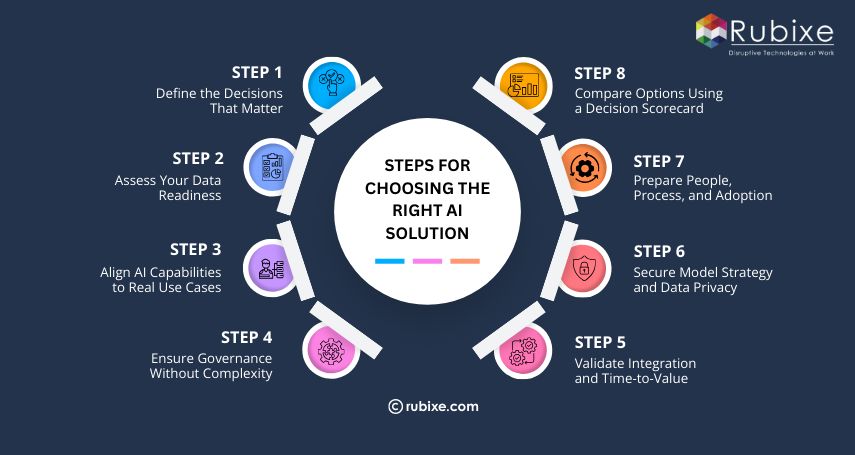
Selecting analytics AI is not about the flashiest demo or longest feature list. It’s about whether the system helps your business make better decisions faster and at scale.
Step 1: Define the Decisions That Matter
List 5–10 recurring decisions where speed and accuracy matter most, such as:
-
Which channels are driving profitable growth this month?
-
Where are customers dropping out of the funnel?
-
Which suppliers or processes are causing delays?
Define what “better” means: hours saved, forecast accuracy, fewer escalations, or higher self-serve adoption. A strong AI for Data Analytics solution is judged by its decision impact, not by its interface design.
Step 2: Assess Your Data Readiness
Assess:
-
Sources: warehouse/lake, CRM, ERP, product analytics, spreadsheets
-
Quality: duplicates, missing values, inconsistent definitions
-
Ownership: who approves metrics and access rules
-
Refresh needs: batch versus near real-time.
If teams cannot trace critical metrics, prioritize lineage, semantic modeling, and quality monitoring before expecting AI to help.
Step 3: Align AI Capabilities to Real Use Cases
Most platforms combine:
-
Augmented analysis
-
Natural-language analytics
-
Automated insights and alerts
-
Forecasting and anomaly detection
-
Generative explanations
Operations teams benefit from anomaly detection, marketing from segmentation and NLQ, and finance from governed metrics. The right AI for Data Analytics solution aligns capabilities directly to decisions.
Step 4: Ensure Governance Without Complexity
Look for:
-
A centralized semantic layer
-
Role-based access and fine-grained security
-
Clear explainability of outputs
-
Logging and monitoring of AI activity
Governance should enable trust, not slow teams down.
Step 5: Validate Integration and Time-to-Value
A practical solution integrates with:
-
Your data platform
-
Identity systems
-
Collaboration tools
Run a 2–4 week proof-of-value using real data and measure self-serve adoption, speed, accuracy, and stability. This is where AI Automation often shows immediate impact.
Step 6: Secure Model Strategy and Data Privacy
Ask:
-
Is your data used to train models by default?
-
Can processing occur in your preferred environment?
-
Are responses grounded in governed datasets?
-
How are hallucinations and leakage prevented?
Security and privacy must be non-negotiable.
Step 7: Prepare People, Process, and Adoption
Define:
-
Who owns metrics and AI configurations
-
Training for business users and analysts
-
Migration of the most-used reports first
-
Feedback loops to fix unclear answers
Most failures stem from change management, not technology.
Step 8: Compare Options Using a Decision Scorecard
Rate each option on:
-
Use-case fit
-
Governance and explainability
-
Integration effort and total cost
-
Performance at scale
-
Vendor maturity and support
This keeps the decision objective before committing to an AI for Data Analytics solution.
Benefits Experienced by Business Users
When selected thoughtfully, analytics powered by AI delivers tangible benefits.
-
Faster decision cycles: Automated detection of trends reduces delays and unnecessary meetings.
-
Improved confidence in metrics: Validation and consistent definitions reduce internal debate.
-
Higher productivity from analytics teams: Less time on preparation, more time on insight.
-
More predictable outcomes: Early risk detection improves planning and forecasting.
Over time, these benefits compound as analytics becomes part of daily operations.
Connecting Analytics to Broader Technology Strategy
Analytics should not operate in isolation. A strong AI solution for Technology aligns analytics with core systems, security standards, and long-term transformation goals.
When analytics fits naturally into the broader ecosystem, adoption becomes sustainable instead of forced.
Choosing the right AI for Data Analytics solution is not just a technology decision. It’s about choosing the right AI Tech company, one that understands how your business makes decisions, how your data really works, and where AI should support people, not complicate processes.
The right partner focuses on clarity, fit, and long-term value, not quick demos or overpromises.