

How AI Business Solutions Improve Performance Tracking
AI business solutions improve performance tracking through real-time insights, metrics, and smarter decisions to help teams measure growth and efficiency.
Why do organisations measure performance yet still feel blindsided by outcomes?
Because traditional tracking tells you what happened, not what’s unfolding right now. Spreadsheets arrive too late, dashboards feel disconnected, and KPIs often look healthy until they suddenly don’t. AI Business Solutions change this dynamic by interpreting performance in real time, predicting what’s coming next, and continuously refining insights. Instead of static metrics, leaders gain living intelligence they can trust, and that’s how performance tracking becomes a true competitive advantage.
Why Traditional Performance Tracking No Longer Keeps Up
-
Rapidly Changing Data: In modern organisations, key metrics can shift hourly rather than monthly. Relying on delayed reports means decisions are based on outdated information.
-
Distributed Teams: With teams spread across locations and time zones, visibility into performance is fragmented, making manual tracking cumbersome and error-prone.
-
Shifting Customer Behaviour: Consumer preferences and buying patterns evolve quickly. Static reports can’t capture these changes in real time, leaving businesses slow to respond.
-
Instant Market Reactions: Competitive world and market conditions can change overnight. Traditional tracking fails to provide the immediacy needed to act proactively.
-
Consequences of Outdated Insights: Decisions are reactive instead of proactive. Teams respond to symptoms rather than addressing root causes. Leaders manage problems after they occur, missing opportunities to steer growth
-
Where AI Business Solutions Help: By providing real-time visibility, predictive insights, and continuous analysis, AI closes the gap between what’s happening and what’s visible, enabling smarter, faster, and more confident decision-making.
What Makes AI Business Solutions Different?
Traditional analytics tell you what happened, but Artificial Intelligence Business Solutions show what’s happening now and what’s likely next. By combining machine learning, real-time data processing, pattern recognition, and predictive analytics, AI systems go beyond isolated metrics to connect the dots across departments, processes, and timelines. The result is performance tracking that is continuous, contextual, and truly intelligent.
The Emotional Cost of Poor Performance Visibility
-
Leader Frustration From Surprise Shortfalls: When actual results deviate unexpectedly from targets, leaders experience stress and uncertainty, making strategic decisions harder.
-
Pressure From Unclear Accountability: Without clear, trustworthy metrics, responsibility becomes ambiguous, leading to tension and slower problem-solving across teams.
-
Stress From Reactive Management: Delayed insights force leaders to react to issues after they occur, increasing workload and reducing confidence in decision-making.
-
Team Micromanagement Due to Distrust in Metrics: Teams may feel constantly monitored when metrics are inconsistent or untrusted, lowering morale and initiative.
-
Confusion From Conflicting Reports: Disconnected dashboards and reports create uncertainty about priorities, slowing down daily operations and alignment.
-
Disengagement When Goals Feel Unrealistic: Employees lose motivation when targets seem disconnected from reality or progress isn’t clearly communicated.
-
How AI Business Solutions Help: By delivering real-time, reliable, and contextual insights, AI reduces emotional friction, builds trust, aligns teams, and instills confidence at every level of the organisation.
How AI Business Solutions Transform Performance Tracking
AI-driven systems provide real-time visibility by processing data continuously rather than periodically. This enables live performance dashboards, instant alerts when metrics deviate, and early detection of inefficiencies. Instead of waiting for end-of-month reports, leaders can act immediately while outcomes are still influenceable, making decision-making faster, smarter, and more proactive.
From Metrics to Meaningful Insights
-
Identify Hidden Correlations: AI analyses complex datasets to uncover relationships and dependencies that aren’t obvious, helping leaders see connections across departments, processes, and metrics.
-
Highlight Root Causes Behind Trends: Instead of focusing on surface-level outcomes, AI pinpoints the underlying factors driving performance changes, enabling targeted interventions.
-
Explain Why Performance Is Changing, Not Just That It Is: Beyond reporting anomalies, AI provides context and reasoning behind trends, giving leaders the insight needed to make informed, proactive decisions.
-
Transform Observation Into Understanding: By turning raw metrics into meaningful intelligence, AI shifts performance tracking from reactive monitoring to strategic insight, empowering smarter actions across the organisation.
Key Areas Where AI Improves Performance Tracking
AI-powered tracking systems enhance operations and process efficiency by monitoring workflows end-to-end. They identify bottlenecks before they escalate, spot underutilised resources, and detect process deviations in real time. This proactive visibility enables teams to optimise operations continuously, addressing issues before they become problems rather than reacting after the fact.
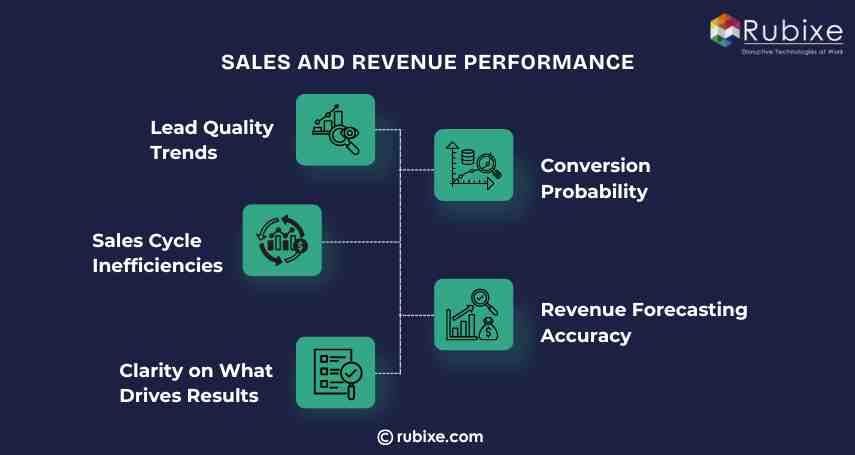
Sales and Revenue Performance
-
Lead Quality Trends: AI analyses patterns in lead sources, engagement, and behaviour to identify which leads are most likely to convert, enabling teams to focus on high-potential prospects.
-
Conversion Probability: By assessing historical and real-time data, AI predicts the likelihood of closing each deal, helping sales teams prioritise efforts and allocate resources effectively.
-
Sales Cycle Inefficiencies: AI detects bottlenecks and delays in the sales process, highlighting where improvements can shorten cycles and increase overall productivity.
-
Revenue Forecasting Accuracy: AI improves financial predictions by integrating multiple variables, giving leaders a clearer view of expected revenue and allowing for more informed planning.
-
Clarity on What Drives Results: Rather than focusing solely on final numbers, AI provides actionable insights into the factors influencing performance, enabling smarter decision-making and better outcomes.
Workforce Productivity and Engagement
Performance isn’t just about output; it’s about sustainability. AI-driven workforce analytics track productivity patterns, workload balance, skill utilisation gaps, and potential burnout risks. With these insights, managers can support their teams intelligently, making informed decisions that promote long-term efficiency and well-being rather than relying on instinct alone.
Predictive Performance Tracking: Seeing Around Corners
-
Forecast Performance Risks: AI models analyse historical trends and current data to identify potential shortfalls or challenges, enabling proactive risk management.
-
Simulate Outcomes of Strategic Decisions: Predictive analytics allow leaders to model “what-if” scenarios, evaluating the likely impact of different strategies before committing resources.
-
Recommend Corrective Actions Early: AI suggests actionable steps to address emerging issues, helping teams course-correct before problems escalate.
-
Creating True Competitive Advantage: By shifting the focus from past results to future possibilities, AI enables organisations to anticipate challenges, optimise decisions, and stay ahead of competitors.
Performance Tracking Across Silos Unified at Last
Many organisations track performance in silos: finance focuses on costs, operations on efficiency, HR on productivity, and marketing on engagement. Artificial Intelligence Business Solutions breaks down these barriers by integrating insights across functions, showing how workforce performance impacts customer satisfaction, operational delays affect revenue, and marketing effectiveness influences sales cycles. The result is a connected, holistic view of performance rather than isolated reports.
Why Data Alone Isn’t Enough
-
Teams Drown in Dashboards: With countless metrics and reports, employees spend more time navigating data than acting on it, reducing efficiency and focus.
-
Delayed or Missed Insights: Traditional reporting often surfaces information too late, causing opportunities to be overlooked and problems to escalate.
-
Decisions Based on Intuition: Without timely, accurate analysis, leaders rely on gut feeling rather than evidence, increasing the risk of missteps.
-
AI as an Intelligent Interpreter: Artificial Intelligence Business Solutions filter noise, prioritise critical signals, and deliver context-rich insights, enabling faster, more confident decisions.
-
Essential for Scaling Organisations: As businesses grow, the volume and complexity of data increase exponentially. AI ensures that decision-making keeps pace, turning data into actionable intelligence rather than overwhelming teams.
The Role of AI Readiness in Performance Tracking Success
Not every AI initiative delivers results. Performance tracking fails when data quality is poor, systems are disconnected, teams don’t trust AI outputs, or there’s no strategic alignment. That’s why AI readiness audits and thoughtful implementation are essential. Organisations like us take a holistic approach combining AI consulting, readiness assessments, automation, AI staffing, and cybersecurity to ensure performance intelligence is accurate, secure, and trusted.
The Cost of Delayed Intelligence
-
Faster Course Correction: AI provides real-time insights, enabling leaders to identify issues and implement changes immediately, rather than reacting to outdated reports.
-
Stronger Accountability: Transparent, data-driven tracking clarifies responsibilities across teams, reducing ambiguity and ensuring everyone knows their impact on outcomes.
-
Smarter Resource Allocation: AI highlights where resources are most effectively deployed, helping organisations optimise time, budget, and talent for maximum return.
-
Predictable Growth Trajectories: Continuous monitoring and predictive analytics allow businesses to anticipate trends, mitigate risks, and plan strategically, creating more reliable growth paths.
-
Competitive Advantage: Organisations that act on insights early gain a lasting edge, making it increasingly difficult for reactive competitors to keep up.
Trust, Transparency, and Explainable AI
Performance tracking should build confidence, not suspicion. Effective Artificial Intelligence Business Solutions are transparent in how insights are generated, explainable to non-technical leaders, and secure and compliant by design. When teams understand why the system flags an issue, trust grows, adoption increases, and resistance naturally fades.
Human Intelligence + Artificial Intelligence
-
Data Processing: AI can process vast volumes of information quickly and accurately, freeing leaders from time-consuming analysis and ensuring decisions are based on reliable data.
-
Pattern Recognition: By identifying trends, anomalies, and correlations that may be invisible to humans, AI provides insights that improve the quality and speed of decision-making.
-
Continuous Monitoring: AI tracks performance and operational metrics in real time, alerting leaders to issues before they escalate and supporting proactive management.
Leaders Can Then Focus On:
-
Strategy: With routine data tasks handled, leaders can dedicate more time to long-term planning and high-impact initiatives.
-
Creativity: Freed from operational noise, leaders can explore innovative solutions and new growth opportunities.
-
Relationship-Building: Time saved by AI can be invested in mentoring teams, engaging clients, and strengthening partnerships.
-
Decision-Making: AI augments judgment with evidence-backed insights, enabling smarter, faster, and more confident choices.
The Outcome: This partnership between human leadership and AI intelligence defines the future of high-performance, agile organisations.
What the Future of Performance Tracking Looks Like
Performance tracking is evolving from periodic, descriptive, and reactive approaches to continuous, predictive, and proactive ones. Future-ready AI Business Solutions will self-adjust KPIs as conditions change, provide scenario-based recommendations, integrate seamlessly across platforms, and learn alongside organisational goals. With these capabilities, performance is no longer measured after the fact it is managed in real time.
Performance is not a static scorecard it’s a living, evolving system. AI Business Solutions let organisations listen to it in real time, anticipate shifts, and respond with confidence. In a world where speed, accuracy, and clarity define success, intelligent performance tracking is no longer optional it’s foundational.