






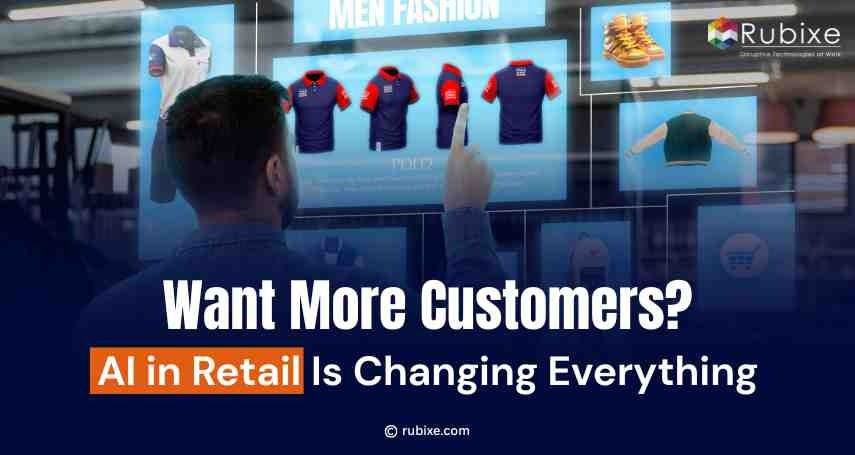
AI in Retail: 15 Trends Shaping 2026
15 AI trends in retail, from personalized shopping and demand forecasting to automation and smarter customer experiences that drive growth.
The store you walk into today or the app you open to shop works differently than it did two years ago. AI in retail has quietly crossed from pilot project to production infrastructure, and in 2026, the gap between retailers who have embraced it and those still weighing the decision is widening fast. This is not hype. It's a shift in how buying and selling fundamentally work.
Here is the honest picture: the global AI in retail market is projected to grow from $16.54 billion in 2026 to $105.88 billion by 2034, driven by a CAGR of 26.1%. Meanwhile, 89% of retailers using AI report higher revenue, and 95% report lower operating costs. Those are not incremental improvements. Those are structural advantages.
These shifts are part of a much larger transformation happening across the AI in retail industry, where technology is reshaping everything from supply chains to customer experience at scale.
Whether you run a boutique fashion label, a grocery chain, or a multi-channel e-commerce brand, this guide breaks down the 15 most important AI in retail trends that are actively reshaping how retailers compete, operate, and serve customers in 2026.
|
$16.54B Global AI in the retail market size in 2026 |
89% Retailers using AI who report increased revenue |
26.1% CAGR for AI in retail through 2034 |
The 15 AI in Retail Trends Defining 2026
1. Agentic Commerce: AI That Shops on Your Behalf
The most disruptive shift in AI in retail right now is the rise of agentic commerce, AI systems that do not just suggest products but autonomously browse, compare, and purchase on behalf of the customer.
Google's Universal Commerce Protocol (UCP), announced at NRF 2026, lays the groundwork for non-human checkout flows directly inside Gemini and AI Mode in Search. For retailers, this changes everything about how product data is structured. Shoppers are spending longer with LLMs during product discovery than with traditional search engines and sharing far more personal context while doing so.
If your product catalog is not clean, semantically rich, and machine-readable, your products become invisible to these agents.
Let’s say, a customer asks their AI assistant to "reorder my usual cleaning supplies when they run out." The agent monitors usage patterns, detects low stock, compares prices across retailers in real time, and completes the purchase autonomously. No app, no search, no browsing required.
2. Hyper-Personalization at Segment-of-One Scale
Basic product recommendations based on "people also bought" logic are yesterday's technology. In 2026, AI in retail delivers true hyper-personalization - dynamically assembled homepages, contextual offers, and even individually priced promotions, all computed in milliseconds per user.
The personalized recommendations segment holds 33% of the entire AI retail market in 2026, making it the largest application segment by revenue share.
3. Predictive Inventory Management
Dead stock and empty shelves are two of the most expensive problems in retail. AI in retail now addresses both by analyzing historical sales, weather patterns, local events, and social media signals to forecast demand at a store-by-store, SKU-by-SKU level.
Retailers deploying predictive inventory AI are seeing up to 30% reductions in operational costs alongside significant drops in overstock write-offs.
In practice, Zara's AI-powered supply chain adjusts production orders within days based on which styles are trending in each specific market, dramatically cutting end-of-season markdowns.
4. Visual Search and AI-Powered Product Discovery
Typing "blue dress with puff sleeves" is increasingly replaced by simply taking a photo. Visual search AI lets shoppers point their camera at an item on someone else, in a magazine, or on the street, and find it (or something similar) in their catalog instantly.
Platforms like Pinterest Lens and Google Lens have conditioned shoppers to expect this. Retailers who integrate visual search APIs into their mobile experience reduce friction in discovery, particularly for fashion, home décor, and beauty categories where verbal descriptions fall short.
5. Conversational Commerce Goes Mainstream
AI-powered chat and voice assistants have evolved from FAQ bots into full commerce engines. In 2026, conversational AI in retail handles product discovery, size guidance, order tracking, returns, and post-purchase support, all through a single, context-aware conversation thread.
The accessibility dimension is often overlooked: hands-free voice interactions serve mobile-first shoppers, elderly users, and visually impaired customers in ways that no static website can match. Retailers embedding these systems into owned apps and WhatsApp see measurable lifts in conversion and customer satisfaction scores.
6. Autonomous and Frictionless Checkout
The checkout line is one of the most persistent frustrations in physical retail. AI in retail is eliminating it through computer vision, sensor fusion, and machine learning that track items as customers pick them up and automatically bill them as they walk out.
Amazon's Just Walk Out technology has been licensed to third-party grocery chains, stadiums, and airports globally. In 2026, the model has matured enough that even mid-size retailers can deploy frictionless checkout solutions without building custom infrastructure.
7. AI-Driven Dynamic Pricing
Airline pricing strategies are now standard practice in retail. AI models analyze competitor pricing, inventory levels, time of day, demand signals, and customer segments in real time to adjust prices fluidly. Done well, this maximizes margin without alienating loyal buyers.
Dynamic pricing AI is especially effective in e-commerce, where price changes are instant and invisible to competitors until after the fact. The risk is that customer perception of unfairness is managed by AI systems that set guardrails to avoid dramatic swings on the same item within short windows.
8. AI-Powered Returns Management
Returns cost the retail industry billions annually, and fraudulent returns alone account for a significant slice. AI in retail now predicts which customers are likely to return items before purchase, enabling proactive sizing guidance, better product descriptions, and even tailored return policies per customer.
On the fraud side, AI returns fraud detection reduces fraudulent returns by up to 38%, creating a direct bottom-line impact without adding friction for legitimate shoppers.
9. Generative AI for Product Content at Scale
Writing 50,000 product descriptions is a task that once required an army of copywriters and weeks of work. Generative AI in retail compresses this to hours. In 2026, large retailers will use AI to generate SEO-optimized product titles, descriptions, meta tags, and even A/B test variants automatically, and at a catalog scale.
The quality bar has risen sharply. Modern generative AI outputs product content that reflects brand voice, integrates technical specifications, and reads naturally. The writer's role has shifted to AI prompt architecture and quality review rather than first-draft production. Many retailers are now adopting AI services for e-commerce to improve customer experience, automate operations, and scale personalization across their digital storefronts.
10. Computer Vision for In-Store Intelligence
Physical stores are increasingly instrumented with AI-driven computer vision cameras that monitor shelf stock levels, track foot traffic heatmaps, measure queue lengths, and detect compliance with planogram layouts, all in real time, without manual audits.
This gives store managers and HQ teams a data layer over physical retail that was previously impossible to obtain. Retailers using shelf intelligence AI catch out-of-stock conditions hours earlier, reducing lost sales from empty shelves by a measurable margin.
11. AI-Driven Loyalty Programs That Actually Work
Generic points programs are being replaced by AI loyalty systems that know exactly what motivates each customer. Instead of offering everyone the same reward structure, AI models identify whether a particular shopper responds better to early access, free shipping, surprise gifts, or charitable donations on their behalf.
This level of personalization in loyalty dramatically increases engagement and reduces the cost per point of loyalty investment, since rewards are matched to motivations rather than distributed uniformly.
12. Supply Chain Resilience Through AI
The supply chain disruptions of recent years exposed how fragile traditional procurement models are. AI in retail is rebuilding supply chain logic with real-time scenario planning, multi-supplier risk scoring, and autonomous rerouting when disruptions occur.
In 2026, 58% of retail companies are actively deploying AI across supply chain functions, with autonomous decision-making agents handling reorder triggers, supplier selection, and logistics optimization without human intervention on routine decisions.
13. Sustainable Retail Powered by AI
Consumers and regulators alike are demanding greater accountability on sustainability. AI in retail is becoming the engine behind genuine sustainability progress, not just greenwashing. AI tools now optimize delivery routing to minimize carbon output, reduce overproduction through demand accuracy, and flag supply chain partners whose practices fall below ESG thresholds.
For brands that have made sustainability a core differentiator, AI-generated sustainability reports and carbon accounting tools help substantiate claims with data, which increasingly matters to both investors and consumers aged 18–35.
14. AI as a Frontline Employee Augmentation Tool
AI in retail is not replacing store associates at scale - it is making them significantly more effective. AI-powered earpieces and mobile tools give frontline staff real-time inventory data, customer purchase history, and product expertise they could never carry in their heads alone.
For instance, an associate at a shoe store can tell a customer within seconds whether a specific size is in the back, at the nearest branch, or available for same-day delivery - pulling from systems that previously required a manager and a phone call. This kind of augmentation lifts average transaction value and customer satisfaction simultaneously.
15. AI-Powered Fraud Detection and Security
Payment fraud, account takeovers, and promotional abuse cost retailers billions. AI fraud detection models now operate in real time, analyzing thousands of behavioral signals per transaction to flag anomalies without blocking legitimate purchases, the false positive problem that plagued earlier rule-based systems.
In loyalty programs specifically, AI identifies promotional abuse patterns (e.g., return-to-buy cycling, coupon stacking) that are invisible to human reviewers but show clear statistical fingerprints in behavioral data.
Frequently Asked Questions: AI in Retail
1. What is AI in retail, and why does it matter in 2026?
AI in retail refers to the application of machine learning, computer vision, natural language processing, and automation across the entire retail value chain , from demand forecasting and inventory management to personalized customer experiences and fraud detection. In 2026, it matters because the market has matured past experimentation: retailers using AI are showing demonstrably better margins, higher revenue, and faster operational decisions than those who have not invested.
2. What is agentic commerce, and should small retailers care about it?
Agentic commerce means AI systems that autonomously complete purchases on behalf of shoppers, no human browsing or clicking required. Small retailers should care because it changes how products get discovered. If your catalog is not optimized for AI agents to read and evaluate, you could be excluded from an increasingly significant portion of online transactions by the end of 2026.
3. Which AI in retail trend has the fastest ROI for a mid-size retailer?
Predictive inventory management and AI-powered customer service automation consistently deliver the fastest, most measurable returns for mid-size retailers. Inventory AI reduces overstock and lost sales simultaneously; customer service AI cuts support costs while improving response speed. Both can show ROI within two to three quarters of proper deployment.
Where AI is taking retail next
Retail in 2026 is being shaped by faster decisions, connected data, and more focused customer engagement. Businesses are moving toward systems that help them respond quickly, plan better, and stay aligned with changing demand.
At Rubixe, we help retail and e-commerce businesses design, implement, and scale AI solutions that create real competitive advantage, not just proofs of concept.
Our focus is on bringing AI into everyday retail operations in a way that supports consistent performance and better decision-making. By combining data, machine learning, and automation, we help retailers build systems that are more structured, responsive, and efficient.
Rubixe’s AI capabilities help retailers:
-
Understand customer behavior and identify buying patterns
-
Improve inventory planning and reduce stock gaps
-
Deliver tailored product recommendations across digital platforms
-
Automate repetitive operational tasks
-
Detect trends early and adjust strategies with confidence
To learn more about how Rubixe can help you tap into the full potential of AI, schedule a free demo with our team.