


What is AI orchestration?
AI orchestration connects multiple AI tools and workflows into one system to automate processes and improve business efficiency.
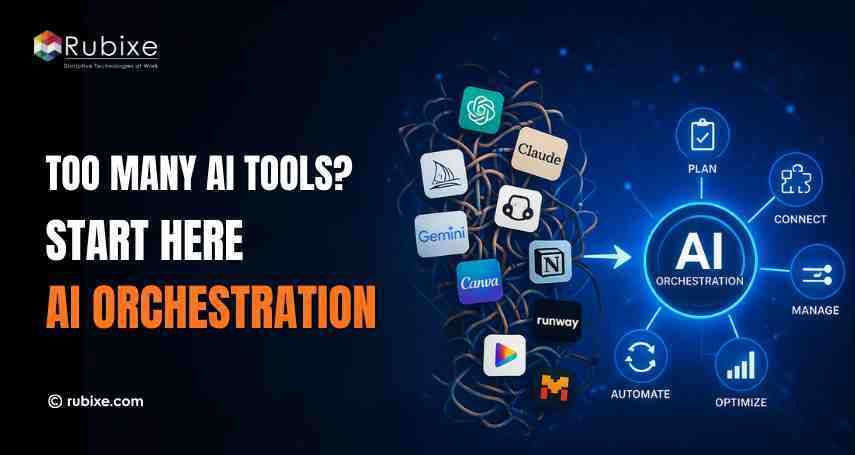
Most companies are not struggling with AI tools… they are struggling to make those tools talk to each other.”
Teams use multiple AI platforms, dashboards, and automation tools - but instead of saving time, they end up switching between systems all day.
This is exactly where AI orchestration becomes important.
It connects all AI tools into one unified system so businesses don’t just use AI - they actually make AI work together.
Why It Matters Now
AI adoption is accelerating across enterprises, but most initiatives fail to generate measurable results.
A recent MIT study found that 95% of enterprise AI pilots fail to deliver business outcomes, highlighting a critical challenge for organizations trying to scale AI effectively.
This is where AI orchestration becomes essential. By connecting AI systems, automating workflows, and managing governance, orchestration ensures that AI investments move from isolated pilots to impactful, enterprise-wide solutions.
Key reasons why it is critical today:
-
Eliminates silos: Integrates multiple AI tools across departments to ensure smooth, connected workflows.
-
Improves operational agility: Enables real-time decision-making by linking predictive insights to automated actions.
-
Enhances compliance and governance: Tracks AI-driven decisions, ensuring transparency and accountability across processes.
-
Optimizes resource utilization: Reduces duplication of effort and accelerates task execution for higher efficiency.
-
Supports strategic growth: Aligns AI initiatives with business objectives, maximizing ROI and long-term impact.
By implementing Artificial Intelligence orchestration, organizations can streamline processes, mitigate risks, and fully leverage AI adoption to drive measurable business outcomes.
How Does AI Orchestration Work?
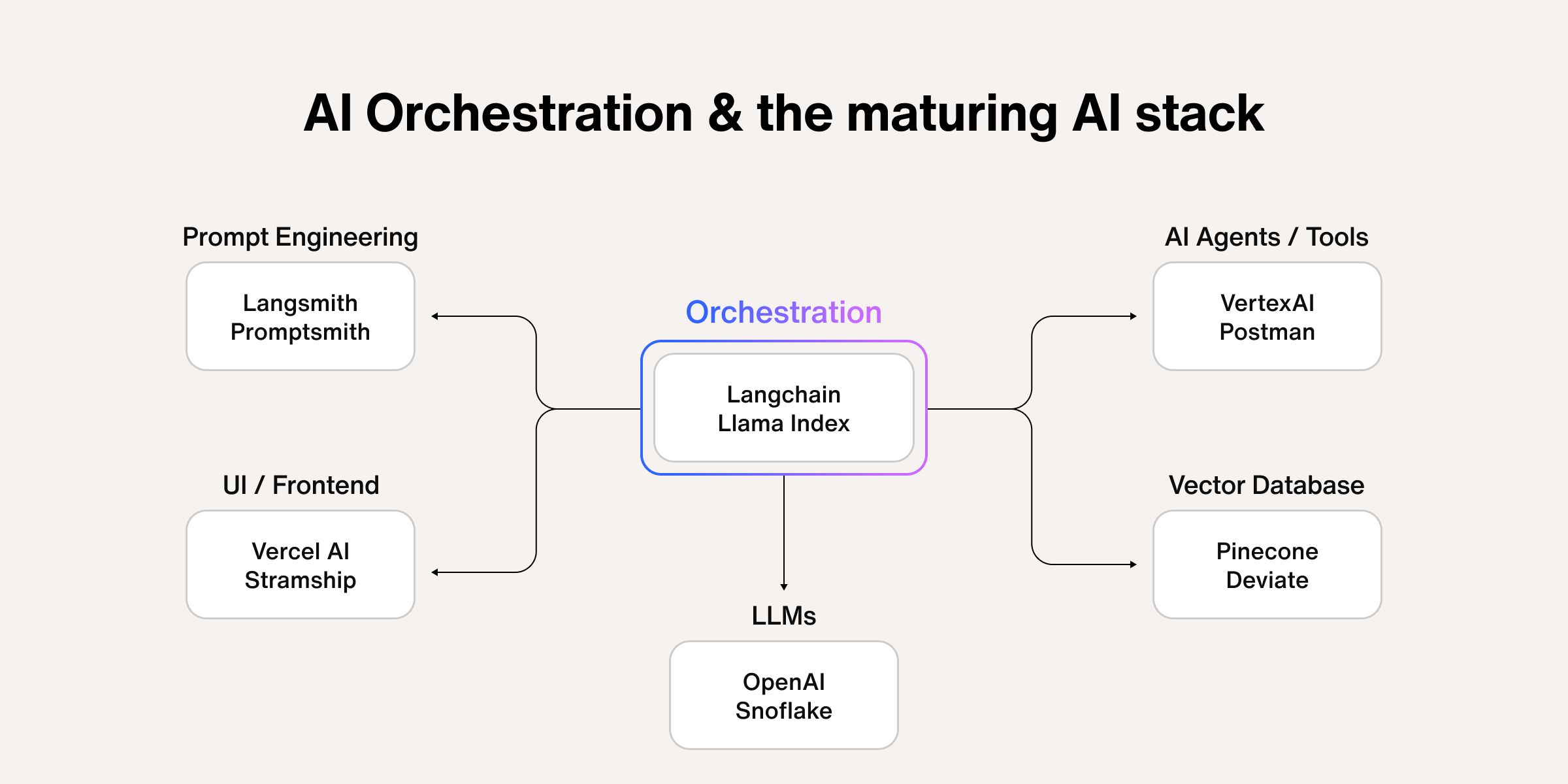
Source: Sendbird.com
At its core, Artificial Intelligence orchestration coordinates multiple AI models, automation scripts, and data workflows into a unified system that executes tasks efficiently and accurately.
This approach ensures insights are actionable, decisions are timely, and resources are allocated optimally. Key components of Artificial Intelligence orchestration include integration, automation, management, and governance.
AI Integration:
Integration enables AI models and enterprise systems to communicate seamlessly. APIs, pipelines, and shared data platforms allow predictive insights to flow directly into operational workflows.
Example: A predictive sales model can automatically trigger marketing campaigns or stock replenishment, creating a responsive supply chain.
Effective AI integration ensures that each system contributes to a unified workflow, reducing redundancy and improving the quality of decision-making.
AI Automation
Automation focuses on executing repetitive or rule-based tasks across multiple systems. By automating routine activities, companies can free up human resources for strategic work.
Example: Financial organizations can automate invoice approvals using AI-driven scoring, streamlining workflows and reducing errors.
Leveraging AI workflow automation in this context ensures tasks move smoothly between systems, creating end-to-end efficiency and minimizing delays.
AI Management
Management includes monitoring models, retraining algorithms, and evaluating performance continuously. Artificial Intelligence orchestration frameworks track system outputs, flag anomalies, and adjust workflows dynamically.
Example: Customer service platforms can adapt automated ticket routing based on changing patterns, ensuring high-priority issues are resolved promptly.
This centralized oversight is crucial for AI Automation, as it ensures consistency and reliability in the outputs generated by interconnected systems.
Governance
Governance frameworks within AI orchestration provide oversight, compliance, and transparency. They track AI decisions, monitor fairness, and enforce policies across workflows.
Example: HR systems using AI can ensure unbiased candidate screening, with complete logs available for audits.
Proper AI Governance safeguards organizations against operational risks and regulatory breaches, while supporting ethical AI adoption.
What Sets AI Orchestration Apart from Other AI Technologies?
While other AI technologies may focus on individual models, task automation, or MLOps, Artificial Intelligence orchestration integrates these elements into a coordinated system, capable of driving end-to-end intelligent workflows.
1.AI Orchestration vs Workflow Orchestration
Workflow orchestration executes sequences of tasks, but Artificial Intelligence orchestration ensures that each step is informed by predictive insights and adaptive models.
Example: In logistics, workflow orchestration schedules deliveries, while AI orchestration dynamically adjusts routes based on real-time traffic data.
2.AI Orchestration vs AI Agents
AI agents operate independently to complete specific tasks. AI orchestration coordinates multiple agents to collaborate efficiently and maintain alignment with enterprise objectives.
Example: Agentic AI may manage individual marketing campaigns, while orchestration ensures that campaigns are synchronized across channels and optimized for ROI.
3.AI Orchestration vs MLOps
MLOps manages model deployment and monitoring. Artificial Intelligence orchestration extends beyond models, integrating automation, predictive analytics, and decision-making to execute complete business processes.
Example: MLOps deploys a fraud detection model, while orchestration ensures that flagged transactions trigger automated investigations and reporting workflows.
Benefits of AI Orchestration
AI orchestration drives tangible advantages across scalability, efficiency, collaboration, and compliance.
Greater Scalability
Coordinating multiple AI models and automated workflows allows organizations to scale operations without increasing manual resources.
Increased Efficiency
By automating task handoffs between AI systems, operations are faster, errors are minimized, and employees focus on higher-value work.
Example: Retailers using AI integration to connect inventory, marketing, and customer insights can adjust promotions and stock levels in real time.
Better Collaboration
Orchestrated AI promotes collaboration across teams by providing a unified interface for interacting with models, tools, and workflows.
Example: Cross-functional teams can view predictive insights and automatically adjust production schedules, marketing plans, and resource allocation.
Improved Performance
Centralized monitoring enhances accuracy and consistency across systems. Insights from multiple models can be combined to make smarter, data-driven decisions.
Example: Financial services can integrate predictive risk models with automated approval workflows for faster and more reliable loan processing using AI tools.
More Reliable Governance and Compliance
Audit trails, policy enforcement, and real-time monitoring ensure that AI-driven processes adhere to regulations and internal standards.
Example: Enterprises can track algorithmic decisions across departments, ensuring transparency and accountability.
How to Implement AI Orchestration
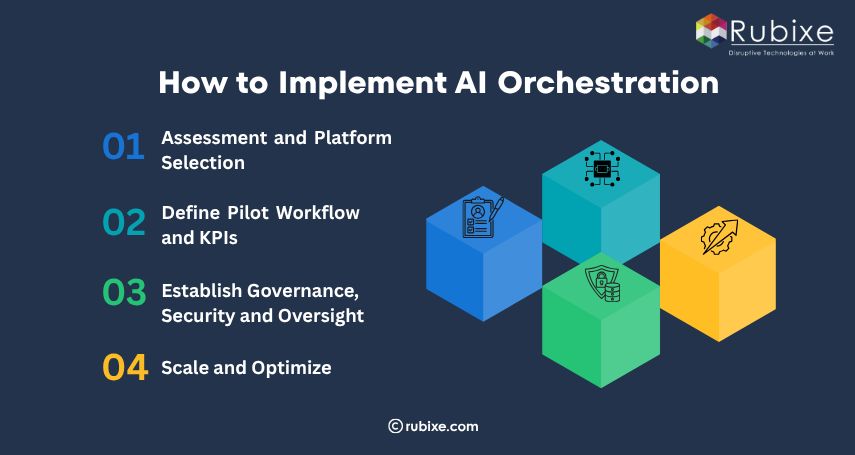
Implementation of AI orchestration requires careful planning, clear KPIs, and robust governance.
1. Assessment and Platform Selection
Evaluate business needs and determine which AI models, systems, and automation tools require orchestration. Choose a platform that supports integration, monitoring, and scalability.
2. Define Pilot Workflow and KPIs
Select a workflow that represents broader business processes and establish KPIs to measure performance improvements, error reduction, and resource efficiency.
3. Establish Governance, Security, and Oversight
Define policies, ethical guidelines, and compliance standards. Use monitoring tools to track AI performance, decisions, and anomalies across workflows.
4. Scale and Optimize
Expand orchestration to additional processes, optimize based on lessons learned from the pilot, and continuously refine the orchestration framework.
Example: Scaling AI orchestration from HR onboarding workflows to finance, supply chain, and marketing operations ensures enterprise-wide benefits.
What to Look for in an AI Orchestration Platform
Selecting the right platform is essential for achieving seamless AI orchestration. A strong platform ensures systems work together efficiently, tasks are automated, and insights are actionable.
Key considerations include:
1. Robust AI integration: The platform should connect with your existing AI tools, data pipelines, and applications. Strong AI integration ensures that insights from different AI models can be combined and executed in a unified workflow, reducing silos and boosting operational efficiency.
2. Support for AI workflow automation: Automates repetitive tasks and links AI outputs to downstream processes, enabling faster decision-making and consistent outcomes.
3. Real-time monitoring and model performance tracking: Provides visibility into AI models’ accuracy and effectiveness, allowing teams to identify issues quickly and optimize performance.
4. Transparent AI governance and compliance features: Tracks decision-making processes, ensuring adherence to regulations, internal policies, and ethical standards.
5. Ease of collaboration across teams: Facilitates communication between data scientists, engineers, and business stakeholders to streamline the deployment and scaling of AI solutions.
A platform that balances integration, automation, and oversight empowers organizations to fully leverage Artificial Intelligence orchestration for both efficiency and innovation.
The Future of AI Orchestration
The next phase of Artificial Intelligence orchestration will involve tighter integration with autonomous AI systems, cloud-native platforms, and real-time analytics. Enterprises will increasingly rely on orchestration to unify initiatives, optimize performance, and maintain regulatory compliance.
-
Integration with Agentic AI to enable independent decision-making across systems
-
Advanced AI tools providing predictive insights across workflows
-
Seamless AI workflow automation connecting departments for end-to-end efficiency
Forward-thinking organizations leveraging AI orchestration today are positioning themselves to scale operations, improve decision-making, and maintain a sustainable competitive edge.
Struggling to manage multiple AI tools and make them work together effectively? Wasting time on managing disconnected AI workflows instead of driving results?
Connect with AI consulting experts to streamline your AI systems, unify insights, and unlock the full potential of your automation strategy.