


















What Is AI Governance and Why Does It Matter?
Learn how AI governance helps your business manage risks, ensure ethical AI use, and align AI initiatives with goals and compliance standards.

You may be exploring artificial intelligence to improve efficiency, automate processes, or gain deeper insights from data. But without clear rules, policies, and accountability, AI initiatives can quickly create risks from compliance issues to ethical concerns.
Many organizations overlook Artificial Intelligence governance at the start, only realizing its importance after costly mistakes occur.
Implementing a structured AI governance framework ensures your AI projects align with business objectives, remain compliant with regulations, and deliver long-term value.
What is AI Governance?
AI governance refers to the policies, processes, and structures that organizations use to manage, monitor, and guide the development and deployment of AI systems. It provides a framework for ensuring AI is used responsibly, ethically, and safely while supporting business goals.
Why Is AI Governance Important?
AI governance is critical because ungoverned AI systems can create serious business, legal, and ethical challenges. Without proper policies and oversight, companies may face:
-
Compliance violations with global AI regulations
-
Biased or unethical AI outcomes
-
Operational failures from poorly monitored AI models
-
Reputation damage from AI misuse
Investing in Artificial Intelligence governance explains why AI adoption matters, ensuring that AI initiatives align with organizational objectives and stakeholder expectations.
Key Concepts in AI Governance
Before implementing AI governance in your organization, it’s important to understand the foundational concepts that guide responsible AI use. These concepts help businesses identify risks, establish ethical standards, and ensure accountability, forming the backbone of any effective governance framework.
AI Risk Management
AI risk management involves identifying, assessing, and mitigating potential risks associated with AI systems, including operational, legal, and reputational risks. Conducting an AI readiness assessment before implementation helps organizations understand potential vulnerabilities and address them proactively.
Ethical AI
Ethical AI ensures that AI systems operate fairly, without bias, and respect user rights. Ethics policies help guide development teams and decision-makers in building AI solutions that align with societal and organizational values.
Transparency and Accountability
AI systems must be explainable and auditable. Transparency allows stakeholders to understand how decisions are made, while accountability assigns responsibility for AI outcomes.
Critical Components of Responsible AI Governance
Before diving into the specific components, it’s important to understand that effective AI governance relies on a combination of well-defined policies, structured processes, clear accountability, and ongoing oversight. These elements work together to ensure that AI initiatives are ethical, compliant, and aligned with your business objectives.
-
Policies: Clearly defined rules guiding AI development, deployment, and usage. Policies include ethical guidelines, data management standards, and operational procedures to ensure compliance and responsible use.
-
Processes: Standardized procedures for designing, testing, and monitoring AI systems. Well-defined processes allow teams to consistently evaluate AI performance, manage risk, and address errors quickly.
-
Roles and Responsibilities: Assignment of accountability across teams data scientists, business leaders, compliance officers, and IT specialists. Defining responsibilities ensures that everyone knows their role in maintaining ethical and compliant AI operations.
-
Compliance and Audit Mechanisms: Systems for continuous monitoring, regulatory compliance, and internal audits to ensure responsible AI operations. Organizations that integrate audits with AI adoption services can proactively identify gaps before they escalate.
Principles and Standards of Responsible AI Governance
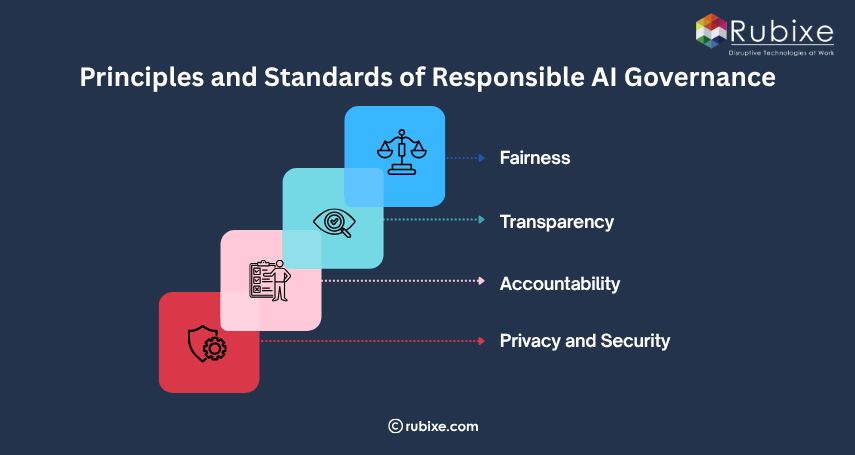
Effective Artificial Intelligence governance is guided by core principles and standards that ensure AI systems are ethical, transparent, and secure. These guidelines help organizations maintain trust, accountability, and compliance across all AI initiatives.
Fairness
Ensuring AI systems do not discriminate or introduce bias into decision-making processes. Fairness is critical in industries like finance, healthcare, and hiring, where biased AI decisions can result in legal consequences and reputational harm.
Transparency
Providing clear insights into how AI models function, the data they use, and the decisions they produce. Transparency improves trust among stakeholders and supports regulatory compliance, particularly in data-sensitive sectors.
Accountability
Establishing responsibility for AI outcomes and assigning oversight to relevant stakeholders. This ensures that errors or unexpected behavior can be traced and corrected efficiently.
Privacy and Security
Protecting sensitive data and maintaining robust cybersecurity measures to secure AI systems. Organizations integrating AI Cybersecurity solutions reduce exposure to threats while maintaining trust with customers and partners.
Levels of AI Governance
Artificial Intelligence governance can exist at different levels within an organization, depending on how formalized policies, processes, and oversight are. Understanding these levels helps businesses identify where they currently stand and what steps are needed to mature their AI governance framework.
-
Informal Governance: Ad hoc guidelines and loosely defined policies for small-scale AI initiatives. Informal governance often exists in early-stage AI projects where few processes are defined.
-
Ad Hoc Governance: Partially structured frameworks applied inconsistently across departments. This level introduces some standards but lacks enterprise-wide enforcement.
-
Formal Governance: Fully structured, enterprise-wide frameworks with defined policies, standards, monitoring, and reporting mechanisms. Formal governance ensures consistent AI practices, risk mitigation, and regulatory compliance.
How Organizations Are Deploying AI Governance
Before implementing, organizations must understand that a successful deployment that aligns with business objectives, ensures compliance, and embeds accountability across teams
-
Assess Current AI Initiatives: Understand which AI systems are in use and their associated risks. This step helps identify gaps and prioritize areas that need governance first.
-
Define Governance Policies: Set clear rules for AI development, testing, and deployment. Include guidelines on data management, ethical considerations, and compliance standards to ensure consistency.
-
Assign Roles and Responsibilities: Ensure accountability across teams. Clearly define ownership for AI performance, ethical compliance, and operational monitoring to prevent overlaps or gaps.
-
Monitor and Audit: Continuously track AI performance, compliance, and ethical considerations. Establish feedback loops to refine policies and processes based on real-world results.
Best Practices: Practical implementation steps
-
Assess Current AI Initiatives: Understand which AI systems are in use and their associated risks. This step helps identify gaps and prioritize areas that need governance first. Include a review of past AI projects to learn from previous successes and challenges.
-
Define Governance Policies: Set clear rules for AI development, testing, and deployment. Include guidelines on data management, ethical considerations, and compliance standards to ensure consistency. Policies should also outline escalation procedures for promptly handling AI-related issues.
-
Assign Roles and Responsibilities: Ensure accountability across teams. Clearly define ownership for AI performance, ethical compliance, and operational monitoring to prevent overlaps or gaps. Establish cross-functional committees to review and support AI governance decisions.
-
Monitor and Audit: Continuously track AI performance, compliance, and ethical considerations. Establish feedback loops to refine policies and processes based on real-world results. Regular audits should include both automated system checks and human oversight for comprehensive evaluation.
Partnering with an AI Development company or consulting specialists can accelerate deployment, provide technical expertise, and ensure the framework is robust, scalable, and adaptable to future AI needs.
Business Benefits of AI Governance
Implementing Artificial Intelligence governance delivers measurable advantages:
Operational efficiency: AI initiatives run smoothly with reduced errors and oversight.
Risk reduction: Compliance, security, and ethical risks are proactively managed.
Enhanced decision-making: AI insights are reliable and aligned with business objectives.
Reputation and trust: Transparent and accountable AI operations increase stakeholder confidence.
Regulatory readiness: Organizations can respond effectively to current and emerging AI regulations.
Faster innovation cycles: Structured governance enables quicker AI deployment across departments.
Cost savings: Prevents financial loss from errors, biases, and regulatory fines.
Using AI in digital transformation initiatives ensures that AI adoption delivers strategic business impact rather than just technology experimentation.
The Future of AI Governance and Potential Regulatory Changes
Artificial Intelligence governance is evolving alongside emerging technologies and global regulations. Organizations should anticipate:
-
EU AI Act and global frameworks requiring accountability and risk management
-
Increased scrutiny on ethical AI and data privacy
-
Integration of AI governance with enterprise-wide AI adoption services for scalable compliance
-
AI governance is becoming a competitive differentiator, where companies demonstrating robust oversight are trusted more by customers, partners, and investors
Businesses that proactively implement governance frameworks today are better positioned to leverage AI responsibly and stay ahead of regulatory changes.
Your AI initiatives can only deliver value if they are implemented responsibly. A structured AI governance framework ensures compliance, ethical use, and alignment with business goals.
Partner with experienced AI Service providers to deploy robust governance frameworks and scale your AI initiatives confidently.