











What is AI Adoption? Why does it matter?
AI adoption explains why it matters and how businesses implement AI, automation, machine learning, AI strategy, AI integration, and digital transformation.
The shift is easy to miss if you’re not close to day-to-day work.
Inside teams, small improvements are adding up. Customer queries are resolved faster without expanding support. Forecasts improve without extra reporting effort. People spend less time preparing information and more time acting on it.
From the outside, it looks subtle. Inside operations, it changes how work moves.
What’s driving this is not hype. It’s pressure. Businesses are expected to move faster, deliver consistent results, and do so without adding more processes. Delays stand out. Inconsistency stands out. Teams feel it when systems can’t keep up. This is the environment in which AI Adoption is taking shape.
What Is AI Adoption?
AI Adoption refers to the structured process of embedding artificial intelligence into existing business systems, workflows, and decision-making processes to improve efficiency, accuracy, and scalability.
Rather than introducing entirely new tools, adoption focuses on strengthening areas where friction already exists within operations, analytics, customer interactions, and internal coordination. When implemented correctly, AI becomes part of everyday execution, not an additional layer teams must consciously interact with.
Organizations guided by a clear AI Adoption Strategy for business move beyond isolated pilots and begin embedding intelligence into how work actually gets done.
Why AI Adoption Matters Now
Business conditions have shifted in ways that are subtle but significant. The pressure is not coming from one direction it’s building across operations, leadership expectations, and customer experience.
Organizations are being asked to move faster, operate with tighter margins, and deliver consistent outcomes without increasing complexity.
-
Shorter decision timelines: Teams are expected to act quickly, often with incomplete information. AI-enabled systems process data continuously, helping surface relevant patterns and risks while decisions are still being shaped.
-
Reduced margin for error: Smaller mistakes can have an outsized impact when margins are tight. Intelligent systems support more reliable execution by identifying anomalies and inconsistencies early.
-
Rising expectations for responsiveness and reliability: Customers and internal stakeholders expect timely, predictable outcomes. Manual workflows struggle to keep pace as volume and complexity increase.
-
Limits of static reporting: Periodic reports often arrive too late to influence outcomes. AI surfaces insights in real time, enabling action instead of post-event analysis.
This shift explains why AI Adoption has moved from experimental initiatives into core operational environments.
The Core Challenges Businesses Face Without AI
Processes that slow down as the business grows
As organizations expand, tasks that once felt manageable begin to strain teams. Manual handoffs increase, review cycles lengthen, and small errors compound into larger delays.
AI helps reduce this strain by handling repetitive actions consistently, allowing teams to focus on judgment-driven work that requires experience and context.
Data volume without usable insight
Many businesses collect large volumes of data but struggle to convert it into timely understanding. Reports arrive late, dashboards conflict, and decisions depend on partial visibility.
With intelligent systems in place, patterns surface continuously. Leaders gain earlier visibility into trends, risks, and performance shifts instead of relying on delayed summaries.
Systems that don’t work together
Departments often depend on tools that operate independently. Information moves slowly across teams, if at all.
AI can connect these systems logically, allowing workflows to respond to shared signals. This becomes far more effective when aligned with a practical AI Adoption Framework that defines how intelligence flows across processes.
How AI Adoption Happens in Practice
-
Identifying operational friction
Successful adoption starts by locating points where work slows down, repeats unnecessarily, or breaks under scale. These moments indicate where intelligence can reduce friction without redesigning entire systems.
-
Embedding AI into existing workflows
AI delivers value when it appears inside tools teams already use, such as CRM platforms, analytics systems, or internal dashboards. This reduces resistance and accelerates everyday use.
-
Establishing ownership and accountability
Clear ownership ensures outputs are reviewed, corrected, and trusted. Without defined responsibility, AI initiatives often stall after early success.
-
Iteration through feedback
Adoption improves through continuous feedback. Teams need simple ways to flag issues, correct outputs, and refine system behavior over time.
When these steps are overlooked, organizations often encounter preventable AI Adoption Challenges.
Role of Structure in Sustainable AI Adoption
Structure prevents confusion and inconsistency as AI becomes part of everyday operations. Without clear boundaries and feedback loops, even well-designed systems lose trust and relevance over time.
-
Governance and clarity: Teams need clear guidelines around access, review, and escalation. Knowing when AI outputs can be acted on directly and when human judgment is required reduces hesitation and builds confidence across roles.
-
Workflow alignment: AI must live where decisions are made. When outputs appear inside familiar systems rather than separate dashboards, adoption feels like part of routine work instead of an additional step.
-
Continuous improvement mechanisms: No system performs perfectly at launch. Structured feedback ensures AI evolves alongside business needs, preventing drift and maintaining long-term usefulness.
Common Stages of AI Adoption
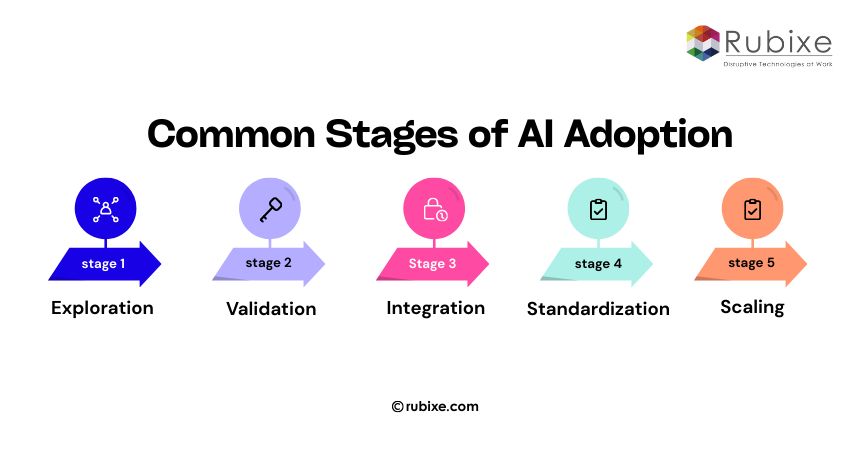
Most organizations progress through similar phases, even if they don’t label them formally.
-
Exploration: Teams test tools and ideas independently to understand potential value and limitations.
-
Validation: Early use cases are measured against real data and business outcomes.
-
Integration: AI is embedded into systems and workflows people depend on daily.
-
Standardization: Governance, ownership, and review cycles are defined to ensure consistency.
-
Scaling: Capabilities expand across teams with shared standards and reliability.
Understanding these stages helps leaders assess where they are in the AI Adoption journey and what steps to follow.
Benefits Businesses Experience from Effective Adoption
When implemented thoughtfully, impact appears across the organization.
-
Faster decision cycles: Relevant insights surface earlier, reducing back-and-forth and delay.
-
Lower manual effort: Routine tasks become more consistent, freeing teams to focus on higher-value work.
-
Operational consistency: Decisions are guided by shared signals rather than individual interpretation.
-
Stronger use of existing systems: AI enhances current investments instead of replacing them.
-
Improved decision confidence: Leaders act with greater certainty when insights are timely and reliable.
These benefits compound as AI becomes embedded into daily operations rather than treated as an optional layer.
AI Adoption Across Business Functions
- Operations and supply chain: AI helps anticipate demand shifts, identify bottlenecks, and reduce downtime by surfacing risks early.
- Sales and marketing: Intelligent models prioritize leads, support personalized outreach, and improve retention without increasing manual effort.
- Finance and analytics: Forecast accuracy improves, anomalies surface earlier, and reporting becomes more consistent.
- Human resources and workforce planning: AI improves hiring, workforce planning, and attrition analysis by reducing manual screening and enabling more informed staffing decisions.
- Customer support and service operations: AI speeds up issue resolution by prioritizing tickets, detecting sentiment, and supporting consistent customer responses at scale.
Across functions, adoption works best when supported by an experienced AI Service provider who understands system-level integration.
Leadership’s Role in Adoption Success
AI initiatives struggle when treated as isolated technical projects.
Successful adoption requires:
-
Clear business objectives tied to outcomes
-
Executive sponsorship
-
Cross-functional collaboration
-
Defined success metrics
When leadership positions AI as decision support rather than replacement, adoption becomes smoother. Collaboration with an AI Consulting Company often helps align strategy, execution, and governance.
Measuring the Impact of AI Adoption
Success should be evaluated through outcomes, not technical sophistication.
Key indicators include:
-
Time saved per workflow
-
Cost reduction across processes
-
Improvements in forecast accuracy
-
Gains in customer satisfaction
These signals help refine the AI Adoption Strategy for business over time, keeping initiatives aligned with operational priorities.
AI Adoption is shaping how organizations run their core operations. The difference lies in whether it is approached with intention or left to evolve on its own.
Clarity around where intelligence adds value is what turns AI from an experiment into a dependable capability often starting with the right AI consulting company to guide that journey.