





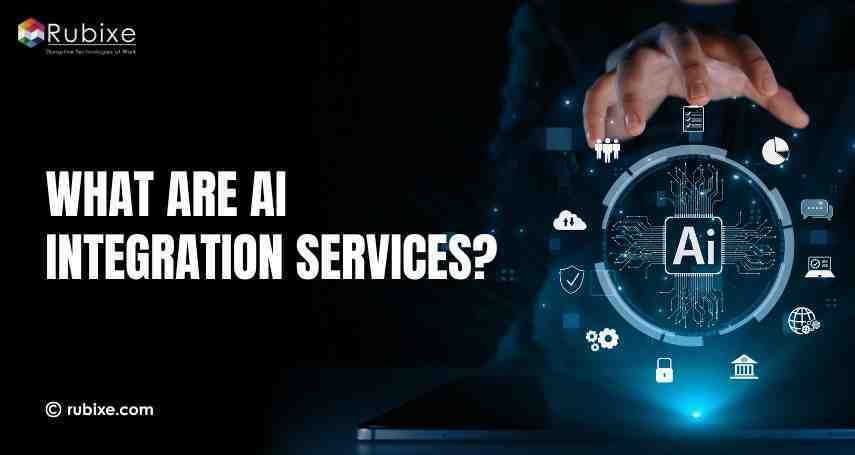
What are AI Integration services?
AI integration services help businesses connect AI with systems, improve data flow, automate processes, and support better decisions across operations.
You can usually tell when a business is doing AI but not really benefiting from it. The tools exist. A few teams are experimenting.
Someone even built a pilot that looks great in a demo. Yet the day-to-day work stays the same. Decisions still feel delayed. Data still lives in too many places. And the AI output sits in a separate dashboard that nobody checks when it matters.
That gap is exactly what AI integration services are designed to close.
They’re not about adding more AI. They’re about connecting AI to the systems, data, and workflows your business already relies on so AI becomes usable, reliable, and measurable.
What Are AI Integration Services?
AI integration services focus on connecting AI capabilities to the systems and workflows a business already uses. Instead of running AI as a separate tool or experiment, integration embeds it directly into operational environments such as CRM platforms, finance systems, support tools, and internal applications.
In simple terms, AI integration services turn AI from something teams reference into something they work with consistently, securely, and at scale.
Why AI Feels Disconnected From Daily Work
Most AI initiatives slow down for practical reasons that surface only after experimentation begins.
-
Fragmented business systems: Organizations rely on many platforms, sales tools, finance systems, support software, and analytics dashboards. When AI operates separately from these systems, teams must manually move insights into action.
-
Inconsistent data context: Different teams often use different definitions for the same metrics. Without shared context, AI outputs feel unreliable, even when technically correct.
-
Pilot success that doesn’t translate: Early pilots often work with limited data and controlled scenarios. Once exposed to real usage, issues around scale, access, and governance appear.
-
Late-stage risk concerns: Security, compliance, and audit requirements are often addressed after experimentation. At that point, progress slows while controls are retrofitted.
These challenges explain why organizations look toward AI integration services as a second, more serious phase of AI adoption.
Why AI Integration Has Become a Priority
The market conversation around AI has changed. Leaders are no longer asking whether AI is possible. They’re asking whether it improves outcomes.
Three forces are driving this shift:
-
Growing operational complexity: As organizations scale, manual coordination becomes harder. Integrated AI supports faster decisions without adding process overhead.
-
Tool overload: Most businesses already manage a crowded technology stack. Integration ensures AI simplifies workflows rather than becoming another standalone tool.
-
Pressure to demonstrate value: Budgets increasingly demand measurable results. Integration is where AI connects to operational metrics, making its impact visible.
Because of these forces, AI integration services are now seen as essential infrastructure rather than an optional enhancement.
What AI Integration Services Include
At a practical level, AI integration services focus on embedding AI into an organization’s existing environment so it operates reliably and consistently.
Core integration scope
Typical integration work includes:
-
Connecting AI to structured and unstructured data sources
-
Embedding AI outputs into operational applications
-
Designing workflow triggers and review checkpoints
-
Implementing access controls and audit trails
-
Monitoring performance and usage over time
The emphasis is on stability and usability, not experimentation.
Where AI Integration Delivers the Most Value
Integration tends to create the strongest impact in workflows that are repetitive, decision-heavy, and sensitive to delays.
Customer support and service operations:
Integrated AI can:
-
Pull customer context automatically
-
Summarize conversations for faster handoffs
-
Route requests based on urgency and intent
-
Trigger follow-up actions without manual tracking
These improvements shorten response times while preserving accountability.
Sales and revenue workflows:
Sales teams benefit when AI is embedded directly into their tools:
-
Automatic enrichment of lead records
-
Visibility into deal risks and stalled stages
-
Drafted follow-ups aligned with approved messaging
-
Conversation insights synced into systems
This is often where organizations first implement AI in your Business, because outcomes are visible and measurable.
Finance and back-office processes
Finance teams rely on structure and traceability. Integrated AI supports:
-
Data extraction from documents
-
Validation and exception routing
-
Matching and reconciliation tasks
-
Audit-ready activity logs
Operations and internal monitoring
Operational teams gain value when AI can:
-
Detect anomalies early
-
Highlight bottlenecks
-
Trigger escalation workflows
-
Reduce manual oversight
In these cases, AI Services function as an intelligence layer supporting existing processes.
Key Components That Make Integration Sustainable
A production-ready approach requires more than connectivity alone.
1. Data integration and consistency
Reliable AI outputs depend on consistent definitions, quality checks, and clear ownership of data sources.
2. Application and API connectivity
AI must read from and write to systems teams already use, rather than creating separate destinations for insights.
3. Workflow orchestration and oversight
Integration defines:
-
When can AI act automatically?
-
When is human review required?
-
How are exceptions escalated?
This keeps accountability clear.
4. Monitoring and continuous improvement
Data and behavior change over time. Integration services include monitoring routines to maintain performance and relevance.
These components distinguish long-term implementations from short-lived pilots and are central to AI integration services that scale.
Benefits Businesses Experience From Integration
When executed thoughtfully, AI integration services deliver benefits that teams feel in their daily work.
-
Faster execution with fewer handoffs
-
Greater trust in AI outputs due to shared context
-
Reduced manual workload across teams
-
Improved customer experience through timely actions
-
Built-in governance and traceability
-
Easier expansion of new AI use cases
Over time, these benefits compound as integration patterns mature and adoption grows.
How to Assess Integration Readiness
Before committing resources, it’s important to evaluate readiness realistically.
Readiness questions
Ask:
-
Which workflows would benefit first from integration?
-
Where does the required data live, and who owns it?
-
What security and compliance constraints apply?
-
When should AI outputs be reviewed by humans?
-
Who owns performance after deployment?
Clear answers reduce rework and prevent stalled initiatives.
A Practical, Phased Approach to AI Integration
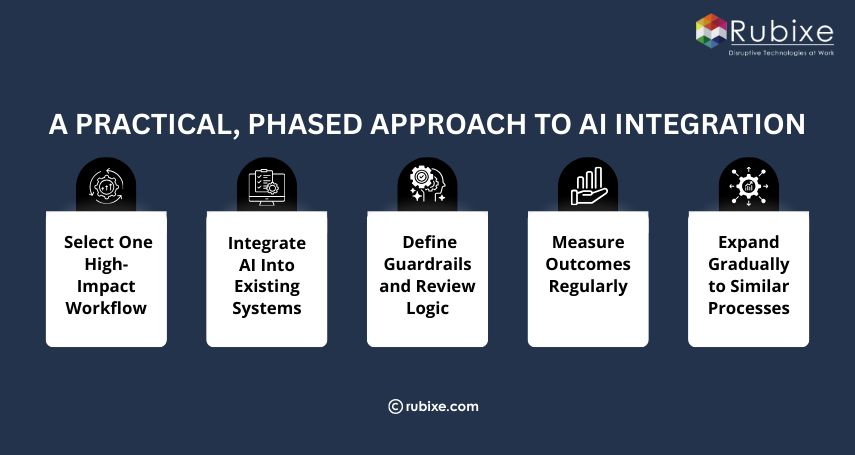 AI integration works best when it happens step by step. Trying to connect everything at once usually creates confusion and slows teams down. A phased approach keeps things clear, controlled, and easier to manage.
1. Select One High-Impact Workflow
Start with a process that clearly causes delays, rework, or frustration. When the problem is visible, it’s easier to show improvement and get team support.
2. Integrate AI Into Existing Systems
Add AI into the tools people already use every day. This avoids switching between platforms and helps AI outputs influence real work, not just reports.
3. Define Guardrails and Review Logic
Decide when AI can act on its own and when a person should review the result. Clear rules keep responsibility with teams while still saving time.
4. Measure Outcomes Regularly
Track simple metrics like time saved, fewer errors, and how often teams use the solution. These signals show whether integration is actually helping.
5. Expand Gradually to Similar Processes
Once the first workflow runs smoothly, apply the same setup to related areas. Using the same pattern makes expansion faster and safer.
This phased approach helps organizations implement AI in their business without disrupting daily operations or overwhelming teams.
Why Partner Selection Matters
Integration challenges usually stem from complexity rather than model capability.
A capable AI consulting company supports:
-
Use-case prioritization tied to real decisions
-
Governance aligned with operational reality
-
Reliable system integration
-
Clear ownership beyond initial rollout
This guidance helps prevent AI initiatives from becoming disconnected efforts.
AI becomes valuable when it participates in real work, not when it produces isolated outputs. That participation depends on integration into systems, data, and workflows people already trust.
AI integration services turn AI from experimentation into a dependable capability. They connect insight to action, support governance, and enable scale.
Organizations that invest in integration early build AI foundations that grow with the business instead of fragmenting it.