









How Generative AI is Used in Digital Transformation
Generative AI in digital transformation: explore use cases, benefits, risks, and strategies to drive innovation, efficiency, and smarter business decisions.
Generative AI (GenAI) is accelerating digital transformation, with adoption moving from early experimentation to real business implementation. As of early 2026, 88% of organizations are using AI in at least one function, and 70% are investing in AI-driven initiatives as part of their digital transformation efforts.
This is where generative AI is shifting the equation. Instead of only analysing data, it creates, content, code, insights, designs, and even decision support. That capability is accelerating digital transformation from a long-term roadmap into a continuous, adaptive process.
Let’s break down how generative AI fits into digital transformation strategies, where it delivers real business value, and what leaders should consider before adopting it at scale.
Understanding the Role of Generative AI in Digital Transformation
Digital transformation has moved beyond system upgrades. It now focuses on how organizations operate, make decisions, and deliver value at scale. In this shift, generative AI is playing a more direct and functional role.
Earlier, AI was primarily used for analysis - forecasting demand, identifying patterns, and supporting decision-making. With the integration of generative AI in digital transformation, the focus has expanded from analysis to creation and execution.
Generative AI can produce content, generate code, summarize complex data, and assist in decision workflows. This allows businesses to move faster across functions without increasing manual effort.
For example:
-
Marketing teams can generate campaign content aligned with brand guidelines
-
Development teams can build and test code more efficiently
-
Business teams can convert large datasets into clear, actionable insights
According to Gartner reports, over 30% of enterprise applications will include generative AI features by 2026, compared to less than 5% in 2023. This signals a clear shift, AI is embedded in digital transformation, rather than being treated as a separate capability.
Generative AI in digital transformation is no longer limited to specific use cases. It is becoming a core layer within business operations, supporting execution, improving consistency, and enabling organizations to respond faster to changing demands.
Use Cases of Generative AI in Digital Transformation
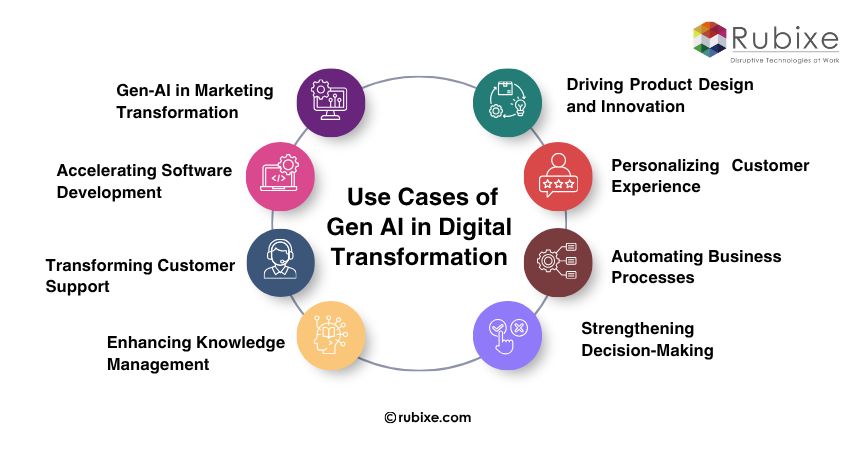
The real value of generative AI in digital transformation comes from how it is applied across business functions. Instead of isolated use, organisations are embedding generative AI into everyday workflows to improve speed, reduce manual effort, and drive better outcomes.
1. Generative AI in Marketing Transformation
In the context of digital transformation, marketing teams are using generative AI to create blogs, ad copies, email campaigns, and social media content at scale.
This reduces turnaround time and ensures consistency across channels, especially for brands managing continuous content demand.
Transformation impact: Faster campaign execution and consistent brand communication.
2. Accelerating Software Development
Generative AI in digital transformation is significantly improving software development processes. It assists developers in generating code, writing test cases, and maintaining documentation.
This reduces repetitive effort and allows teams to focus on building and optimizing core features.
Transformation impact: Shorter development cycles and improved engineering productivity. Based on internal studies, GitHub reported that developers using generative AI coding assistants’ complete tasks up to 55% faster.
3. Transforming Customer Support
Customer support is a key area where generative AI is actively used in digital transformation initiatives. AI-driven systems can understand context and generate accurate, human-like responses.
This ensures faster resolution while maintaining quality across interactions.
Transformation impact: Scalable support operations with improved response time.
4. Enhancing Knowledge Management
Organizations are integrating generative AI in digital transformation to simplify internal knowledge access. Employees can retrieve information using natural language queries instead of manual searches.
This improves how teams access and use organizational knowledge.
Transformation impact: Faster information access and improved decision-making.
5. Driving Product Design and Innovation
In product development, generative AI supports the creation of prototypes, simulations, and design variations based on user data.
This enables faster experimentation and better alignment with user expectations as part of broader digital transformation efforts.
Transformation impact: Faster innovation cycles and reduced development risk.
6. Personalizing Customer Experience
Personalization is a major focus in digital transformation, and generative AI enables businesses to deliver tailored experiences at scale.
It generates personalized recommendations, content, and communication based on user behaviour and preferences.
Transformation impact: Higher customer engagement and improved retention.
7. Automating Business Processes
Organizations are applying generative AI in digital transformation to automate routine workflows such as reporting, documentation, and internal communications.
This reduces manual workload across departments like HR, finance, and operations.
Transformation impact: Streamlined processes and improved operational efficiency.
8. Strengthening Decision-Making
One of the most valuable uses of generative AI in digital transformation is in decision support. It converts complex data into clear summaries and actionable insights.
This helps leadership teams make faster and more informed decisions.
Transformation impact: Faster, data-driven decision-making across the organization.
Benefits of Generative AI in Digital Transformation
The impact of generative AI becomes more visible when looking at measurable business outcomes. The benefits of digital transformation are amplified when AI is applied correctly.
-
Faster Decision-Making: Generative AI converts large volumes of data into clear summaries and recommendations. Leaders can act with better clarity and less delay.
-
Improved Operational Efficiency: Automation reduces repetitive work across departments, marketing, HR, finance, and IT. Teams can focus on higher-value tasks.
-
Cost Optimization: By reducing manual effort and improving process efficiency, organizations can control operational costs while scaling output.
-
Enhanced Customer Experience: AI enables personalized interactions across touchpoints, websites, apps, and support systems. This leads to higher engagement and retention.
-
Scalable Innovation: Companies can experiment with new ideas without heavy resource investment. AI-generated prototypes and simulations reduce the cost of testing.
According to recent surveys, AI could contribute up to $15.7 trillion to the global economy by 2030, with a significant portion driven by productivity gains and consumer demand.
Navigating the Risks of Generative AI While Driving Transformation
While the opportunities are strong, adopting generative AI without a structured approach can create risks.
-
Data Privacy and Security: AI systems rely on large datasets. Without proper governance, sensitive information can be exposed or misused.
-
Accuracy and Reliability: Generative AI can produce incorrect or misleading outputs. Businesses need validation layers to ensure accuracy.
-
Bias in AI Models: If training data contains bias, the outputs will reflect it. This can affect decision-making and customer interactions.
-
Integration Challenges: Embedding AI into existing systems requires technical alignment. Without proper planning, it can lead to inefficiencies instead of improvements.
-
Regulatory Compliance: Governments are introducing stricter AI regulations. Organizations must stay aligned with compliance requirements.
To manage these risks, companies often get into digital transformation consulting to design structured AI adoption frameworks. This ensures alignment with business goals while maintaining control over data and processes.
Building a Strong Foundation for Generative AI Adoption
Before implementing generative AI, organizations need a clear foundation.
-
Define Business Objectives: AI adoption should start with a clear problem statement, what needs to improve and why.
-
Strengthen Data Infrastructure: High-quality data is critical. Without it, AI outputs will lack reliability.
-
Choose the Right Technology Stack: Different use cases require different tools. Selecting the right platforms ensures scalability and performance.
-
Upskill Teams: Employees need to understand how to work with AI systems. Training programs improve adoption and reduce resistance.
-
Partner with the Right Experts: Selecting the right partner plays a key role. When choosing generative AI companies, businesses should evaluate domain expertise, implementation experience, and long-term support capabilities.
Embracing a Generative AI-Driven Future
Generative AI is shaping how organizations approach transformation. It is moving from experimental projects to core business functions.
Companies that adopt early are gaining an advantage in speed, efficiency, and innovation. Those that delay may struggle to keep up with evolving market expectations. Organizations that integrate AI into their operations are twice as likely to achieve high financial performance compared to those that do not.
The focus now is shifting from adoption to optimization, how effectively AI is used across business functions.
This is where working with the right implementation partner becomes critical. Rubixe works closely with organizations to bring structure to this phase, helping businesses move beyond initial adoption and implement generative AI in a way that aligns with real operational goals. From identifying the right use cases to building scalable AI services and solutions, the approach stays focused on delivering long-term value within a well-defined digital transformation strategy.
Final Words
Generative AI is redefining how digital transformation is executed. It brings the ability to create, automate, and optimize at a level that was not possible with traditional technologies.
From marketing and development to customer experience and decision-making, its impact is visible across the organisation. The key lies in applying it with clear intent, strong data practices, and the right strategic approach.
Businesses that align generative AI with their transformation goals will move faster, operate smarter, and stay competitive in an environment that continues to evolve.