









What is Digital Transformation Consulting?
Digital transformation consulting helps businesses modernize processes, adopt the right technologies, and drive measurable growth through expert strategy and execution.
You’ve invested in technology, upgraded systems, and digitized processes. Yet growth feels slow, teams remain disconnected, and results don’t match expectations. This is where Digital Transformation consulting becomes critical.
Organizations often adopt new platforms with the hope that performance will automatically improve. However, transformation is not simply about technology implementation. It requires structured planning, alignment across departments, and a clear understanding of business objectives. Without direction, digital initiatives lose momentum and fail to deliver measurable value.
They provide the clarity, roadmap, and execution framework required to turn digital ambition into sustainable results.
Understanding Digital Transformation Consulting
Digital Transformation consulting is a strategic advisory service that helps organizations plan, implement, and optimize digital initiatives aligned with business goals. It focuses on connecting technology investments with operational efficiency, customer experience, and long-term growth.
Rather than offering isolated technology solutions, consultants evaluate the entire organization, including processes, systems, leadership alignment, and workforce readiness.
What It Actually Involves
Digital Transformation consulting typically includes:
-
Assessing current digital maturity
-
Identifying operational gaps
-
Defining transformation priorities
-
Designing implementation roadmaps
-
Supporting change management
The goal is to ensure digital initiatives create measurable business impact instead of fragmented improvements.
Why Organizations Seek It:
Most companies recognize the need to evolve. However, internal teams often face:
-
Legacy infrastructure limitations
-
Resistance to process change
-
Lack of cross-functional alignment
-
Unclear ROI from digital investments
It provides structured guidance that reduces risk and improves decision-making confidence.
Why Digital Initiatives Often Fail
Many transformation efforts begin with strong enthusiasm but struggle during execution. Technology upgrades alone do not guarantee improved outcomes.
In fact, digital transformation fails without AI when organizations ignore the intelligence layer required to extract value from data and automation systems.
Common Reasons for Failure
1. Lack of a clear transformation strategy: Without a defined roadmap, digital efforts become scattered initiatives that lack measurable goals and business alignment.
2. Siloed departmental execution: When teams implement digital tools independently, systems fail to integrate, creating fragmented workflows and inconsistent outcomes.
3. Inadequate leadership alignment: If leadership teams are not unified in vision and priorities, transformation initiatives lose direction and internal support.
4. Poor data governance: Unstructured, inconsistent, or inaccessible data prevents organizations from generating reliable insights and making informed decisions.
5. Limited focus on long-term scalability: Implementing short-term solutions without considering future growth leads to systems that cannot adapt to evolving business demands.
Digital Transformation consulting addresses these issues systematically, ensuring that transformation efforts remain coordinated and outcome-driven.
Core Components of Digital Transformation Consulting
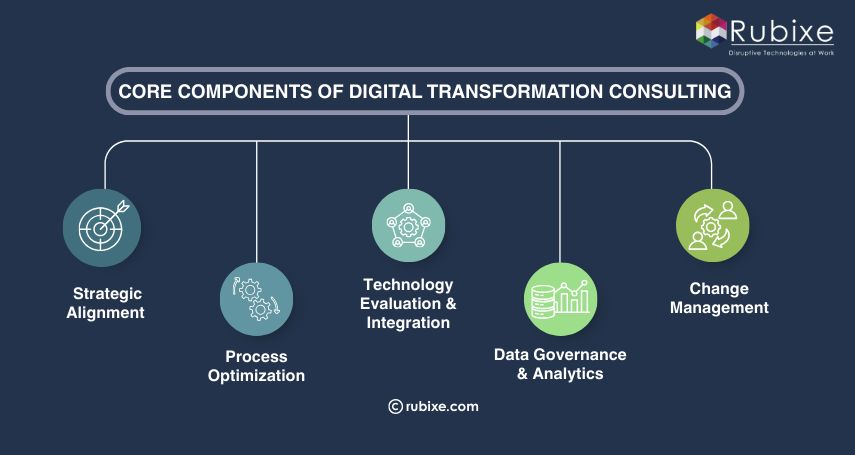
A structured consulting approach focuses on multiple dimensions of change.
Strategic Alignment:
Consultants begin by understanding business objectives. Digital tools must support measurable goals such as revenue growth, cost optimization, or customer satisfaction improvement.
Without strategic alignment, digital investments become isolated experiments rather than coordinated initiatives.
Process Optimization:
Before introducing new systems, consultants analyze existing workflows. Eliminating inefficiencies and redesigning processes ensures technology enhances performance rather than complicating operations.
Technology Evaluation and Integration:
Digital Transformation consulting helps organizations select appropriate platforms based on scalability, compatibility, and long-term adaptability. Integration planning ensures smooth system communication across departments.
Data Governance and Analytics:
Data plays a central role in transformation. Consultants define governance frameworks, ensuring data accuracy, security, and accessibility for decision-making.
Change Management:
Transformation requires people's adoption. Consultants support leadership communication, training programs, and structured implementation phases to ensure smooth transitions.
The Role of AI in Digital Transformation Consulting
Artificial Intelligence increasingly influences modern consulting strategies. The Role of AI in digital transformation has shifted from an optional enhancement to a strategic necessity.
AI introduces learning capabilities, predictive insights, and intelligent automation that amplify digital investments.
Why AI Strengthens Transformation
AI contributes to:
-
Real-time data interpretation
-
Automated decision pathways
-
Personalized customer engagement
-
Predictive operational planning
Without integrating AI, digital systems remain reactive rather than adaptive. This is why many consultants emphasize AI Consulting in Digital Transformation as part of a comprehensive roadmap.
Digital Transformation consulting today involves guiding organizations in combining digital systems with intelligent capabilities that enhance speed, accuracy, and scalability.
Key Benefits of Digital Transformation Consulting
When executed properly, consulting delivers structured advantages.
-
Improved Decision-Making: Data-backed insights replace assumptions. Leaders gain visibility into operational performance and strategic opportunities.
-
Enhanced Operational Efficiency: Streamlined workflows reduce redundancies and manual processes, increasing productivity.
-
Greater Organizational Agility: Companies adapt faster to market shifts and internal demands through flexible digital systems.
-
Sustainable Growth: Structured implementation reduces disruption while building scalable infrastructure.
-
Stronger Customer Experience Alignment: Digital strategies align systems, processes, and communication channels to create consistent and personalized customer interactions.
-
Better Cross-Department Collaboration: Integrated platforms improve information sharing across teams, reducing miscommunication and operational silos.
-
Improved Risk Management and Compliance: Clear governance frameworks enhance data security, regulatory compliance, and operational transparency.
How Digital Transformation Consulting Works in Practice
Although each organization’s journey differs, consulting engagements typically follow a structured path.
Phase 1: Assessment and Discovery
This foundational phase evaluates the organization’s current digital maturity, operational workflows, leadership alignment, data readiness, and existing technology infrastructure. Consultants identify inefficiencies, integration gaps, and risk areas while aligning transformation objectives with business priorities.
Outcome: A comprehensive diagnostic report that defines transformation gaps, opportunities, quick wins, and strategic focus areas.
Phase 2: Strategy and Roadmap Development
Based on assessment insights, a structured transformation blueprint is created. This phase defines long-term vision, prioritizes high-impact initiatives, outlines technology architecture, integrates intelligence-driven capabilities where required, and establishes measurable KPIs.
Outcome: A detailed, phased AI adoption roadmap with clear milestones, timelines, responsibilities, and success metrics aligned with business goals.
Phase 3: Implementation and Execution
This phase converts strategy into action through controlled system deployment, integration across departments, workforce enablement, and active performance monitoring. Execution is typically phased to reduce disruption and support smooth organizational adoption.
Outcome: Successful rollout of digital initiatives with measurable operational improvements and performance validation.
Phase 4: Optimization and Continuous Improvement
Transformation continues beyond deployment. Performance data is analyzed regularly to refine workflows, improve system efficiency, strengthen governance, and scale digital capabilities according to evolving business demands.
Outcome: A sustainable, scalable digital ecosystem that continuously adapts to market and operational changes.
Integrating AI Services Within Consulting Strategy
Modern transformation strategies increasingly incorporate AI Services to enhance digital capabilities.
AI Services can support:
-
Intelligent automation
-
Predictive analytics
-
Data-driven forecasting
-
Smart workflow optimization
Consultants evaluate where AI delivers meaningful value rather than introducing unnecessary complexity. This integration reinforces why Digital Transformation consulting now overlaps with strategic AI advisory services.
Challenges to Prepare For
Even with expert guidance, transformation involves complexity. Digital initiatives impact systems, people, and long-established processes, which naturally introduces friction during execution.
-
Resistance to Change: Employees and mid-level management may hesitate to adopt new systems or workflows, slowing down implementation and reducing early momentum.
-
Budget Constraints: Limited financial planning or unclear ROI projections can delay transformation phases or restrict scalability.
-
Data Migration Challenges: Transferring data from legacy systems to modern platforms often involves inconsistencies, duplication, and security risks.
-
Integration Limitations: Existing tools may not seamlessly connect with new technologies, creating operational bottlenecks.
-
Skill Gaps: Internal teams may lack the technical expertise required to manage advanced digital systems effectively.
They address these risks proactively by designing phased execution plans, aligning leadership, and setting measurable milestones to reduce uncertainty.
The Future of Digital Transformation Consulting
As technology evolves, consulting strategies continue to adapt. Intelligence-driven systems, automation frameworks, and scalable digital architectures are becoming central priorities.
Organizations increasingly recognize that sustainable transformation requires:
-
Continuous system optimization
-
Strong data governance frameworks
-
AI-driven decision support
-
Cross-functional collaboration
-
Ongoing strategic oversight
The future of Digital Transformation consulting lies in helping businesses build ecosystems that learn, adapt, and evolve rather than simply digitize existing operations.
Choosing the Right Consulting Approach
Not all consulting models produce equal results. Organizations should evaluate potential partners carefully.
What to Look For
-
Industry knowledge
-
Clear methodology
-
Focus on measurable outcomes
-
Experience in AI integration
-
Transparent execution frameworks
Working with a specialized AI Consulting company can strengthen transformation efforts when intelligence-driven solutions are required. The right consulting partner emphasizes collaboration, structured planning, and long-term sustainability rather than short-term technology deployment.
Ready to move forward?
If your digital efforts feel fragmented or slow, the next step may not be more tools. It may be the right strategic direction. Digital Transformation consulting helps you connect technology, people, and processes in a way that supports measurable growth.
Start by evaluating where your organization stands today. With the right roadmap and expertise, transformation becomes structured, scalable, and aligned with your long-term goals.