









Hidden AI Implementation Challenges Businesses Ignore
The hidden challenges of AI implementation services reveal risks in data, infrastructure, and adoption that can delay or derail business outcomes.
AI implementation services often fail due to poor data quality, weak integration planning, low user adoption, and unclear ROI measurement. While many AI projects look successful during deployment, hidden operational challenges frequently reduce long-term business impact.
Every month, I speak to business leaders who signed a contract with an AI implementation partner three quarters ago.
On paper, everything looks successful.
The system is technically live.
The vendor has moved on to their next client.
But inside the organisation, the reality is very different.
The team is still doing half of their work manually.
Why?
-
The AI outputs can't be trusted
-
Nobody knows how to use the tool correctly
-
The data feeding the model is inconsistent or incomplete
This is the pattern nobody advertises when they sell you AI implementation services.
This is also a common issue with poorly executed AI implementation services for businesses, where the focus is on deployment, not actual business outcomes.
In most cases, the issue is not the AI system itself, but the operational gaps surrounding implementation, adoption, and integration.
And that gap is where most AI investments quietly lose value.
Why AI Implementation Services Fail
I have spent over two decades watching enterprise technology projects go wrong across industries.
AI is not special.
It fails for the same structural reasons IT projects have always failed:
-
Unclear or shifting business goals
-
Poor data foundations
-
Weak change management
-
Vendors focused on delivery, not outcomes
But AI introduces one additional risk.
Speed.
The speed at which a working demo turns into an expensive failure is much higher.
A proof of concept can look impressive in a controlled environment.
But scaling that same solution into real operations exposes every hidden weakness.
This is why many enterprise AI implementation services struggle to deliver measurable and sustainable outcomes.
Challenge 1: Data Issues in AI Implementation Services
When a client tells us their AI implementation solution is underperforming, we don’t start by questioning the model.
We start with the data.
In one retail distribution company I worked with, an AI demand-forecasting tool was producing recommendations that were off by 35%.
The system looked fine. The model was functioning correctly.
The issue was deeper.
Three separate warehouse systems were feeding data into the model using different date formats.
The AI treated them as a single timeline, silently corrupting the output.
There were no alerts. No system errors. Just inaccurate decisions.
This is not a rare scenario.
According to Gartner, at least 30% of generative AI projects will be abandoned after proof of concept due to poor data quality.
That means:
-
Months of effort invested
-
Significant budgets spent
-
No meaningful business impact
This is one of the biggest risks in AI implementation solutions.
What this means for you:
Before signing any AI implementation contract, ensure your vendor evaluates:
-
Data quality
-
Data consistency
-
Data accessibility
If they skip this step, they are not solving your problem - they are accelerating it.
Challenge 2: Change Management in AI Implementation
A logistics firm I consulted for deployed a route optimisation AI across its operations team.
Technically, the system worked.
Operationally, it failed.
The team ignored it.
Why?
Because:
-
Drivers trusted their 15 years of experience over algorithmic suggestions
-
No one explained how or why the AI made decisions
-
There was no training on when to trust or override the system
The result?
The tool remained unused for four months.
The vendor moved on.
The business saw no return.
Eventually, the company had to invest again, this time in adoption and training.
Many AI implementation services for enterprises fail at this exact stage.
The reality is simple:
Change management is not a soft skill or optional add-on.
It is half of the implementation effort.
Without user trust and adoption, even the best AI system becomes irrelevant.
Challenge 3: AI Proof of Concept Challenges
There is a predictable cycle in AI projects that I have seen across multiple industries.
-
A vendor builds a compelling proof of concept
-
Stakeholders get excited by the results
-
Budget is approved, and contracts are signed
-
The solution moves toward real deployment
Then reality hits.
And reality includes:
-
Messy, unstructured data
-
Legacy systems that don’t integrate easily
-
Compliance and regulatory constraints
-
Resistance from end users
At this stage, the original scope begins to expand.
-
Timelines stretch.
-
Budgets increase.
-
Confidence drops.
McKinsey & Company reports that nearly two-thirds of organisations are still stuck in the experimentation or pilot phase of AI.
Not because AI technology is ineffective.
But because scaling AI into production is far more complex than initial demonstrations suggest.
This is where most enterprise AI implementation services break down.
What this means for you:
Do not rely on early success stories.
Instead, ask for:
-
Client references 12 months after deployment
-
Evidence of long-term usage
-
Proof of measurable business impact
That is where real success or failure becomes visible.
Top 5 AI Implementation Challenges
|
Challenge |
What It Looks Like |
What It Actually Costs |
|
Data Readiness |
Unclean, siloed, inconsistent data |
Inaccurate outputs, delays |
|
Change Management |
Lack of training and buy-in |
Low adoption, no ROI |
|
Scope Creep |
Expanding requirements mid-project |
Budget overruns |
|
Integration Gaps |
AI disconnected from core systems |
Manual work, inefficiency |
|
ROI Measurement |
No defined success metrics |
No proof of value |
Challenge 4: Integration Challenges in AI Implementation
Most AI implementation services are sold as standalone solutions.
In reality, AI rarely operates in isolation.
It must integrate with:
-
CRM systems
-
ERP platforms
-
Operational workflows
-
Reporting dashboards
Each integration introduces complexity.
Each connection is a potential failure point.
In one financial services firm, an AI credit-risk tool was successfully deployed.
However:
-
It was not integrated with the decision-making system
-
Analysts had to manually transfer results
This added friction instead of reducing it.
That is not a transformation.
That is inefficiency disguised as innovation.
Strong AI integration services are critical to ensure seamless workflows.
Proper AI implementation solutions always map:
-
System dependencies
-
Data flows
-
Integration points
before development begins.
Challenge 5: Measuring ROI in AI Implementation
One of the most overlooked aspects of AI projects is measurement.
Most organisations rush into implementation without defining a baseline.
If you do not know:
-
Current processing time
-
Error rates
-
Operational costs
You cannot measure improvement.
According to McKinsey & Company:
-
Only 39% of organisations report a measurable financial impact from AI
-
61% cannot demonstrate ROI
This is not a failure of AI.
It is a failure of the AI implementation strategy.
Without clear metrics, success becomes subjective and difficult to defend.
What you should do:
-
Define 3 - 5 measurable KPIs before implementation
-
Capture baseline performance
-
Track progress at 30, 90, and 180 days
This is how you build a business case for scaling AI solutions for businesses.
Successful AI Implementation vs Failed Projects
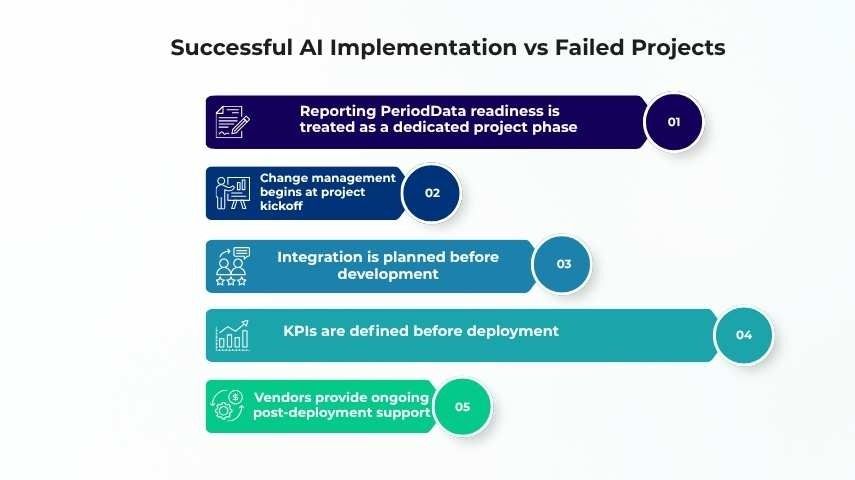
Across industries, successful AI implementations follow a consistent pattern.
-
Data readiness is treated as a dedicated project phase
-
Change management begins at project kickoff
-
Integration is planned before development
-
KPIs are defined before deployment
-
Vendors provide ongoing post-deployment support
These are not advanced strategies.
They are disciplined execution practices.
Successful AI implementation services focus on outcomes, not just delivery.
What Businesses Should Prioritize Before AI Deployment
Businesses planning AI implementation should focus on operational readiness before technology deployment. Data quality, workflow integration, employee adoption, and measurable KPIs are often more important than the AI model itself.
Key areas to prioritize:
- Data readiness and consistency
- Integration planning
- Employee training and adoption
- Scalable implementation strategy
- Long-term ROI measurement
Organizations that prepare these foundations early are more likely to achieve sustainable AI performance and measurable business outcomes.
FAQs
1. Why do many AI implementation projects fail?
Many AI projects fail because businesses focus mainly on deployment while ignoring data quality, system integration, employee adoption, and measurable business goals. Without proper planning, AI systems often struggle to deliver long-term operational value.
2. What are the biggest challenges in AI implementation services?
The most common challenges include poor-quality data, lack of integration with existing systems, low employee adoption, unclear ROI measurement, and expanding project scope during implementation.
3. How important is data quality in AI implementation?
Data quality is critical for AI performance. Inconsistent, incomplete, or outdated data can lead to inaccurate predictions, unreliable outputs, and poor business decisions.
4. Why does change management matter in AI implementation?
Employees must understand how AI systems work and how to use them effectively. Without training, trust, and adoption planning, even technically successful AI systems may fail operationally.
5. What is the role of integration in AI implementation?
AI systems must connect with CRMs, ERP platforms, workflows, dashboards, and operational tools. Poor integration creates manual work, delays, and fragmented decision-making.
Before Choosing AI Implementation Services
Before signing any contract, ask your vendor for three client references.
But do not ask for recent projects.
Ask for clients who are at least 12 months post-deployment.
Then ask two simple questions:
-
What did the vendor get wrong?
-
What would you do differently?
These answers will reveal far more than any sales presentation.
At Rubixe, we focus on the phases that are most often underestimated:
-
Integration architecture
-
Adoption planning
-
ROI measurement
Because these are the areas where most AI projects fail.
Successful AI implementation depends less on the technology itself and more on the systems, processes, and people surrounding deployment. Businesses that focus on data readiness, integration planning, adoption strategy, and measurable outcomes are more likely to achieve long-term value from AI investments.
Organizations that approach AI implementation strategically reduce operational risk, improve scalability, and avoid the costly failures that affect many enterprise AI projects.