









Role of AI in Digital Transformation
Understand how AI Digital Transformation supports smarter operations, data-driven decisions, and better customer experiences across modern businesses.
You invest in digital tools expecting faster work and clearer decisions. Yet teams still handle manual tasks, data sits in different systems, and real progress feels slow within many AI Digital Transformation initiatives.
This gap is common. Technology is present, though its impact feels limited.
Digital transformation delivers results when systems move beyond storing information and begin supporting decisions. Artificial Intelligence makes that shift possible by turning data into insights, automating repetitive tasks, and improving operational efficiency.
AI strengthens digital transformation by helping you build smarter, more responsive systems that drive efficiency and growth through AI Digital Transformation strategies.
Understanding Digital Transformation
Digital transformation refers to the integration of digital technologies into core business operations, customer engagement, and decision-making processes. The objective is to improve performance, agility, and long-term competitiveness.
Organizations pursue digital transformation to:
-
Modernize legacy systems
-
Improve operational efficiency
-
Enhance customer experience
-
Enable data-driven decision-making
-
Create scalable business models
Technology alone does not deliver transformation. Success depends on combining an AI Digital consulting strategy, processes, people, and intelligent technologies such as AI. AI becomes the enabling layer that converts digital systems into adaptive and learning ecosystems, forming the foundation of successful AI Digital Transformation.
Why AI Drives Digital Transformation
Traditional automation follows fixed rules. AI adds learning, pattern recognition, and predictive intelligence.
AI systems analyze large volumes of data, identify trends, and generate insights that support faster and more accurate decisions. This helps organizations move from reactive operations toward proactive planning. This transition is a key outcome of AI Digital Transformation efforts.
Why AI plays a key role:
-
Processes structured and unstructured data efficiently
-
Learns and improves through machine learning models
-
Enables real-time analytics and forecasting
-
Automates complex tasks beyond repetitive workflows
-
Supports personalized customer experiences at scale
AI helps organizations turn digital investments into practical business outcomes rather than into standalone technology implementations.
Core Roles of AI in Digital Transformation
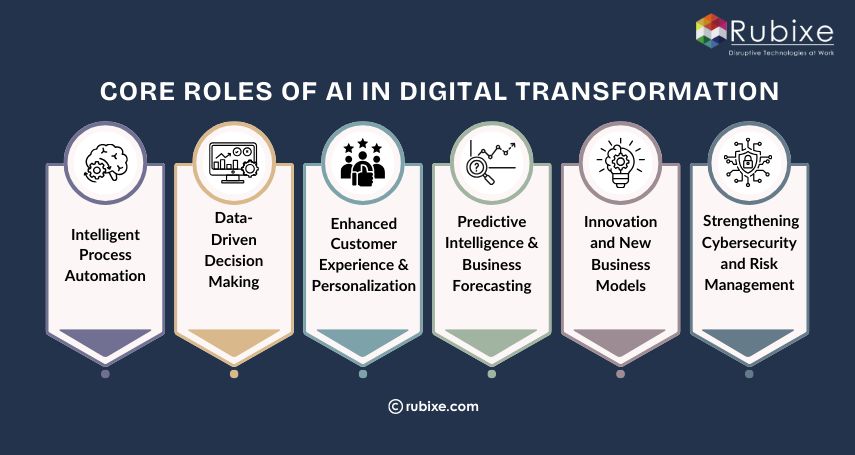
AI supports digital transformation in practical ways across everyday business operations. From improving workflows to enabling smarter decisions and customer experiences, its impact appears across multiple functions.
Understanding these roles helps clarify where AI creates real operational value. These capabilities define how AI Digital Transformation delivers measurable business impact.
1. Intelligent Process Automation
Intelligent Process Automation is one of the earliest and most impactful uses of AI in digital initiatives.
AI-powered automation handles repetitive and rule-based tasks such as:
-
Data entry and document processing
-
Customer service queries
-
Invoice management
-
Workflow routing
Unlike traditional automation, AI systems manage exceptions and learn from outcomes, improving accuracy over time. Organizations adopting AI automation reduce operational errors while increasing efficiency and scalability.
A research case study demonstrated that AI-enabled automation reduced processing time by over 80% in enterprise expense workflows while improving compliance accuracy.
Business impact:
-
Faster operations
-
Reduced operational costs
-
Improved employee productivity
-
Higher process consistency
2. Data-Driven Decision Making
Modern enterprises generate massive volumes of data. AI converts this data into actionable insights. This shift represents a major advantage of AI Digital Transformation across modern enterprises.
AI analytics platforms:
-
Detect patterns invisible to manual analysis
-
Forecast demand and market trends
-
Support strategic planning
-
Identify operational risks early
Predictive analytics allows leadership teams to anticipate outcomes rather than react after problems occur. Real-time insights enable organizations to optimize pricing, supply chains, and resource allocation with greater precision.
3. Enhanced Customer Experience and Personalization
Customer expectations have evolved toward instant, personalized interactions. AI enables businesses to understand behavior, preferences, and intent across digital touchpoints.
Common applications include:
-
AI chatbots and virtual assistants
-
Personalized product recommendations
-
Sentiment analysis
-
Intelligent customer support routing
AI-driven personalization improves engagement and customer satisfaction while increasing retention rates. Digital transformation initiatives increasingly prioritize customer experience, with personalization serving as a major competitive differentiator.
4. Predictive Intelligence and Business Forecasting
AI models analyze historical and real-time data to predict future outcomes through Predictive analysis, a capability central to AI Digital Transformation initiatives.
Applications include:
-
Sales forecasting
-
Predictive maintenance
-
Demand planning
-
Risk assessment
Manufacturing organizations use AI to predict equipment failures before downtime occurs, reducing maintenance costs and improving operational continuity. Predictive intelligence allows organizations to plan resources efficiently and reduce uncertainty in decision-making.
5. Innovation and New Business Models
AI enables companies to create entirely new products and services.
Examples include:
-
AI-powered recommendation platforms
-
Intelligent financial advisory systems
-
Smart healthcare diagnostics
-
Automated software migration tools
Enterprises deploying AI during system modernization projects have reduced migration timelines significantly while improving implementation quality. Innovation becomes faster because AI accelerates experimentation and analysis.
6. Strengthening Cybersecurity and Risk Management
Digital transformation increases data exposure and cybersecurity risks. AI strengthens security by continuously monitoring systems for anomalies.
AI security capabilities include:
-
Threat detection through behavioral analysis
-
Fraud prevention
-
Real-time risk alerts
-
Automated incident response
AI identifies abnormal patterns faster than manual monitoring, improving organizational resilience.
Industry Applications of AI in Digital Transformation
The following examples show how AI Digital Transformation applies across sectors.
Healthcare
AI automates documentation, analyzes medical data, and improves diagnostic workflows. Healthcare organizations using AI automation have saved thousands of employee hours monthly while improving accuracy levels above 99%.
Finance
Financial institutions use AI for fraud detection, risk modeling, and personalized financial services, improving trust and decision speed.
Retail and E-commerce
AI analyzes purchasing behavior to deliver personalized recommendations, optimize pricing strategies, and forecast demand.
Manufacturing
Predictive maintenance and intelligent quality control reduce downtime and improve production efficiency.
Government and Public Services
AI adoption supports digital governance initiatives by improving operational efficiency and citizen service delivery.
Key Benefits from AI-Driven Digital Transformation
Organizations adopting AI Digital Transformation experience both operational and strategic improvements.
-
Operational Efficiency: Automation reduces manual workloads and accelerates processes.
-
Better Strategic Decisions: AI insights support leadership with accurate forecasting and data-backed planning.
-
Scalability: Organizations handle increased workloads without proportional resource expansion.
-
Improved Customer Engagement: Personalized interactions strengthen brand loyalty.
-
Faster Innovation Cycles: AI accelerates research, testing, and deployment of new solutions.
Challenges Organizations Face During AI Adoption
Despite strong potential, many digital transformation initiatives struggle due to execution gaps, reinforcing why AI adoption matters in structured transformation programs.
Common challenges include:
-
Lack of a clear AI strategy
-
Poor data quality or fragmented systems
-
Skills shortage within teams
-
Integration with legacy infrastructure
-
Governance and ethical concerns
Studies show many organizations commit to transformation but struggle with large-scale implementation due to strategic misalignment.
Best Practices for Implementing AI in Digital Transformation
Successful AI adoption depends on clear planning and practical execution supported by AI Consulting in Digital transformation approaches. Organizations achieve better outcomes when implementation focuses on business value, data readiness, and gradual adoption.
-
Start with Business Objectives: AI initiatives should solve clear business problems. Defining measurable goals helps ensure technology adoption delivers practical outcomes.
-
Build Strong Data Foundations: AI depends on reliable data. Well-structured and accessible data improves model accuracy and decision quality.
-
Adopt a Phased Approach: Starting with small pilot projects allows organizations to test impact, reduce risk, and scale gradually based on results.
-
Combine Human Expertise with AI: Human oversight supports better interpretation of AI outputs and ensures responsible decision-making.
-
Invest in Workforce Enablement: Training teams to work alongside AI tools helps organizations fully utilize technology and sustain long-term transformation.
The Future of AI in Digital Transformation
AI adoption continues to grow as technologies become more accessible and easier to integrate into business operations. Organizations are moving toward intelligent systems that continuously improve performance and decision-making. This evolution reflects the growing maturity of AI Digital Transformation worldwide.
Key developments shaping the future include:
-
Hyper-automation across enterprise workflows
-
AI-driven decision intelligence platforms
-
Industry-specific AI solutions tailored to business needs
-
Real-time adaptive systems that respond to operational changes
Organizations that adopt AI with a clear strategy are expected to achieve stronger operational maturity and sustained competitive growth.
How Businesses Can Move Forward
Digital transformation succeeds when technology adoption connects directly to business outcomes. AI enables organizations to unlock value from existing digital investments by improving intelligence, efficiency, and customer relevance.
Businesses should focus on:
-
Identifying high-impact use cases
-
Aligning AI initiatives with growth objectives
-
Building scalable digital infrastructure
-
Partnering with an experienced AI Consulting Company
A structured approach ensures sustainable transformation rather than isolated automation projects.
Ready for digital transformation?
You already have the data and digital tools. The next step is making them work smarter for your business. Connect with the team at Rubixe to discover practical AI solutions built around real business needs.