









What is cognitive automation? A Complete Guide
Learn how organizations use cognitive automation across operations, customer service, and strategic workflows to improve efficiency, accuracy, and decision-making.
You’ve invested in tools to speed up work, but are things really improving?
When your processes aren’t optimized, faster work only leads to repeated mistakes. Cognitive automation goes beyond simple automation to help your team work smarter, reduce errors, and make better decisions consistently.
Understanding how it works and the technologies behind it is essential before deciding where and how to implement it.
What is Cognitive Automation?
Cognitive automation goes beyond traditional rule-based automation by integrating artificial intelligence to handle complex, decision-driven tasks. Unlike standard automation that follows static instructions, It can interpret information, recognize patterns, and take actions based on insights.
This approach leverages machine learning, natural language processing, and predictive analytics to make operations smarter. Organizations implementing cognitive automation experience improvements in productivity, accuracy, and business agility.
How Does Cognitive Automation Work?
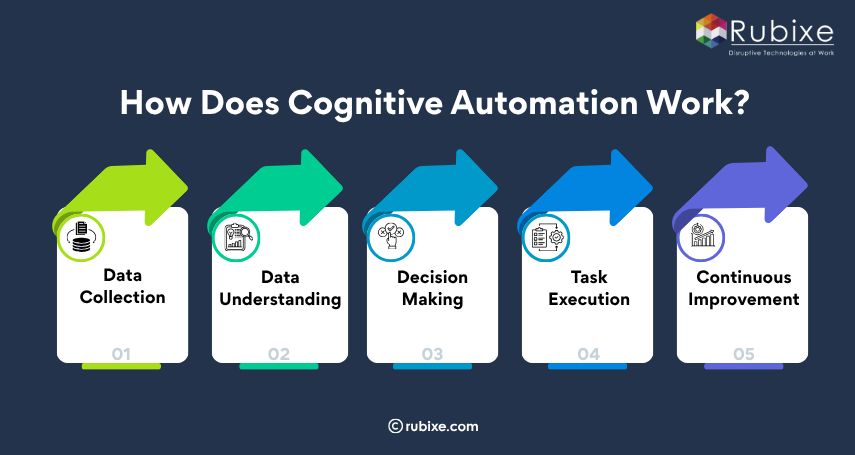
To understand cognitive automation, it helps to see how intelligence is layered on top of automation. At its core, it combines data processing, decision-making, and continuous learning.
Data Collection
This is the foundation of cognitive automation. Information is gathered from structured databases, unstructured documents, emails, forms, and system logs. Unlike manual processes, where data might be fragmented or overlooked, cognitive systems collect data in real time, ensuring completeness.
Data Understanding
Once data is collected, cognitive systems use Natural Language Processing (NLP) and Machine Learning (ML) to interpret and extract meaningful insights. The AI does not just read data it understands context, relationships, and patterns. This step ensures that raw data is transformed into actionable intelligence.
Decision Making
With insights in hand, the system can make informed decisions based on predefined rules, predictive analytics in decision-making, or historical trends. It simulates human reasoning by evaluating multiple options and predicting outcomes.
Task Execution
After decisions are made, automation executes the necessary actions. This could include sending notifications, approving transactions, updating records, or triggering workflows.
Continuous Improvement
After decisions are made, automation executes the necessary actions. This could include sending notifications, approving transactions, updating records, or triggering workflows.
This workflow ensures tasks are executed efficiently while freeing employees to focus on strategic initiatives.
Core Technologies Behind Cognitive Automation
Cognitive automation relies on multiple technologies working together to create intelligent workflows.
-
Natural Language Processing (NLP): Interprets human language in emails, chats, and documents to extract meaning. This allows systems to understand context, sentiment, and intent, making interactions more human-like and actionable.
-
Machine Learning (ML): Learns from historical data to enhance future predictions and recommendations. Over time, ML models improve accuracy and adapt to changing business patterns without constant reprogramming.
-
Computer Vision: Analyzes images or videos for recognition tasks. It can identify objects, detect anomalies, and automate visual inspections in industries like manufacturing and healthcare.
-
Robotic Process Automation (RPA): RPA executes repetitive tasks while integrating cognitive insights. RPA ensures consistency, reduces errors, and frees employees to focus on more strategic, decision-driven work.
By combining these technologies, businesses can handle complex tasks that traditionally required human judgment.
What are Examples of Cognitive Automation?
Cognitive automation is already transforming real-world business processes.
-
Virtual Assistants: Handle queries, schedule meetings, and provide real-time support.
-
Product Categorization: Automatically classifies items based on attributes and customer behavior.
-
IT Service Management (ITSM): Resolves tickets, prioritizes incidents, and predicts system outages.
-
Accounts Payable: Automates invoice processing, verification, and approvals.
-
Customer Service: AI-powered systems respond quickly, reducing wait times and improving accuracy.
-
Employee Onboarding: Streamlines document collection, training, and compliance tasks.
-
CRM Systems: Enhance customer engagement through data analysis and insights.
-
Recommendation Engines: Suggest products or services based on data-driven patterns.
-
Regulatory Compliance: Monitors operations for adherence to legal and industry standards.
These examples illustrate how automation enhances efficiency and decision-making across multiple processes.
What are the Uses of Cognitive Automation?
Cognitive automation finds applications in operations, customer engagement, and strategic decision-making. It helps organizations work smarter, reduce errors, and respond faster to changing business needs.
Operational Efficiency: Automates complex workflows to reduce manual effort. This not only speeds up processes but also ensures consistency and accuracy across operations.
Decision Support: Provides insights for informed business decisions. Analyzing patterns and trends, it helps leaders anticipate challenges and act proactively.
Customer Experience: Enables faster, more accurate interactions. Personalized responses and real-time assistance improve satisfaction and loyalty.
Employee Productivity: Frees teams from repetitive tasks to focus on strategic work. Teams can dedicate more time to innovation, problem-solving, and higher-value activities.
Organizations implement cognitive automation as part of broader AI Automation service provider offerings to achieve measurable efficiency and productivity gains. It also integrates seamlessly with enterprise systems to deliver end-to-end intelligence across departments.
What are the Challenges of Cognitive Automation?
Despite its advantages, cognitive automation requires careful planning and implementation.
-
High Initial Investment: AI infrastructure and training require financial commitment.
-
Integration Complexity: Systems must connect seamlessly with existing workflows.
-
Data Quality Issues: Poor or inconsistent data reduces the accuracy of insights.
-
Employee Resistance: Teams may be hesitant to adopt new technology without proper guidance.
Establishing an AI COE (Center of Excellence) can help mitigate these challenges, providing governance, standardization, and oversight.
What are the Benefits of Cognitive Automation?
Organizations that integrate cognitive solutions enjoy multiple advantages across operations, decision-making, and growth:
-
Faster Operations: Tasks are completed quickly with minimal delays. This allows teams to focus on strategic priorities rather than routine work.
-
Reduced Errors: Intelligent verification and automated checks reduce human mistakes. Consistent accuracy builds trust in business processes and outputs.
-
Cost Savings: Less manual effort lowers operational costs. Organizations can optimize resource allocation and avoid unnecessary expenses.
-
Improved Decision-Making: Data-driven insights guide better business outcomes. Decisions become more predictable, reliable, and aligned with business goals.
-
Scalability: Systems handle higher volumes without additional resources. Businesses can expand operations efficiently without adding complexity.
-
Enhanced Customer Experience: Faster and more accurate responses improve satisfaction. Customers benefit from personalized and timely interactions.
Adopting cognitive automation is a practical way to realize the benefits of digital transformation, streamlining operations while maintaining quality, compliance, and business agility
How Does Cognitive Automation Apply to Different Industries?
Cognitive automation delivers measurable benefits across multiple sectors:
Manufacturing: Streamlines the supply chain, enables predictive maintenance, and supports quality checks.
Retail: Enables personalized recommendations and automated inventory management.
Healthcare: Improves patient record analysis, operational efficiency, and scheduling.
Banking & Finance: Enhances fraud detection, risk management, and compliance.
Logistics: Optimizes routing, tracking, and real-time decision-making.
Adoption of cognitive automation in these industries ensures that processes are both faster and smarter, creating tangible business value.
How to Implement Cognitive Automation in Your Organization
Implementing cognitive automation requires a structured approach:
-
Assess Current Processes: Identify bottlenecks and repetitive tasks.
-
Conduct an AI Readiness Audit: Evaluate data quality and technology readiness using an AI readiness audit.
-
Start with Pilot Projects: Focus on high-impact tasks before scaling.
-
Select Appropriate Tools and Vendors: Partner with an AI Development company for scalable deployment.
-
Train Teams and Establish Governance: Define clear roles and responsibilities within the organization (AI COE).
-
Scale Across Departments: Expand successful pilot projects to other processes.
-
Measure Impact and Refine Workflows: Continuously track results and improve performance.
Implementing cognitive automation effectively ensures both efficiency and strategic alignment.
Choosing the Right AI Automation Service Provider
Selecting the right partner is critical for successful deployment:
-
Evaluate vendor experience and previous implementations.
-
Ensure AI tools match your business needs.
-
Confirm scalability and ongoing support.
-
Look for practical workflow integration and end-to-end deployment experience.
Working with an AI Automation service provider ensures that cognitive automation delivers measurable business outcomes from day one.
Cognitive automation is more than technology, it’s a way to rethink how work gets done. By combining AI intelligence with automation, businesses can streamline workflows, reduce errors, enhance decision-making, and scale operations efficiently.
Partner with AI Development experts to implement cognitive automation and start transforming your business processes today for smarter, faster, and more reliable operations.