

















AI in Agriculture: Smart Farming Delivers Higher Returns
AI in agriculture enables smart farming with data-driven insights, improving crop yields, reducing costs, and delivering higher returns for modern farmers.
Farming has always been a high-stakes business. Weather, pests, soil depletion, and labor shortages. Every season brings a new set of risks.
What’s changing now is that farmers don’t have to face those risks blind anymore.
AI use cases in agriculture have moved from research papers into real fields, real harvests, and real balance sheets.
Farms using AI-driven tools are consistently reporting:
-
15 - 20% higher yields
-
Up to 25% lower input costs
According to the Agriculture Statistics report of NCHStats, the global AI in agriculture market valued at $2.1 billion in 2024 is on course to reach $8.2 billion by 2030, growing at a 25% CAGR.
Let’s break down how smart farming works, where it delivers returns, and what it means for any farm or agri-business thinking seriously about the future.
What is Smart Farming
Smart farming is a data-driven approach to agriculture that uses connected technologies such as IoT sensors, remote sensing (satellite or drone imagery), and advanced analytics to optimize farm operations and decision-making.
It enables precise management of inputs like water, fertilizers, and crop protection by continuously monitoring field conditions and translating that data into timely, actionable insights.
Rather than relying on generalized practices or manual observation alone, smart farming allows farmers to make location-specific, evidence-based decisions across the entire production cycle.
Result:
-
Improved resource efficiency
-
Higher yield consistency
-
Reduced operational risk
All while retaining full human control over on-ground execution.
6 High-Impact AI Use Cases in Agriculture
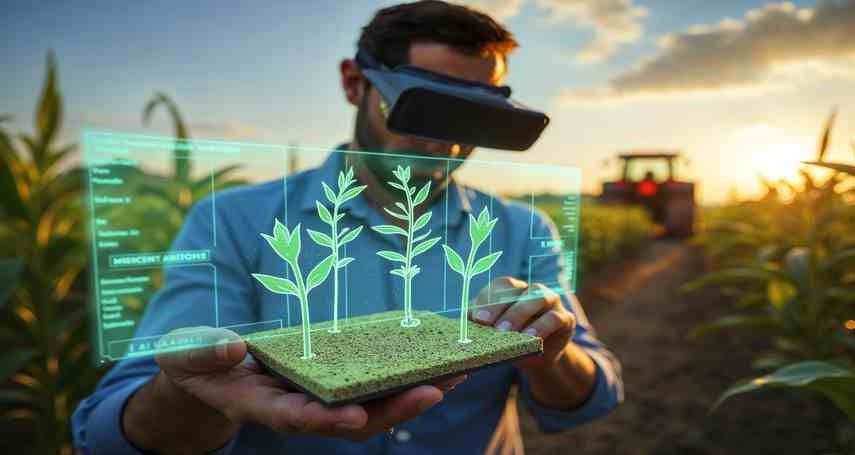
1. Crop Health Monitoring with Computer Vision
Traditional crop scouting means walking the field, eyeballing plant health, and hoping you catch a problem early enough.
At scale, thousands of acres, it’s close to impossible.
AI Solution:
Computer vision for smart agriculture solves this by letting drones scan entire fields in hours and flag issues at a granular level.
A neural network trained on crop imagery can detect apple scab with 95% accuracy.
Similar systems catch yellow rust in wheat before it spreads to neighboring rows.
Impact:
The economics are stark.
Early disease detection means:
-
Targeted, local treatment
-
Not blanket pesticide spraying
This reduces:
-
Chemical costs
-
Crop loss
2. Predictive Analytics for Yield and Risk Management
Weather forecasting once told farmers it might rain. Today’s AI systems go much further.
What AI does:
Platforms powered by predictive analytics use cases can ingest:
-
Decades of weather patterns
-
Real-time soil sensor data
-
Satellite imagery
They use this to model crop outcomes months in advance.
For example, Syngenta's generative AI tools, built as continuous agronomic advisors, forecast yield variability with up to 95% accuracy, even six months before harvest.
Why this matters:
This matters enormously for:
-
Supply chain planning
-
Crop insurance decisions
-
Market positioning
A farmer who knows in May that their corn yield will be 12% lower than projected has options.
A farmer who finds out in September does not.
Beyond weather:
Predictive models also handle:
-
Pest migration patterns
-
Disease outbreak probabilities
-
Optimal harvest windows
Impact:
AI forecasting improves decision-making well before critical farming stages.
3. Precision Irrigation - Less Water, More Growth
 Water is one of agriculture’s most limited and mismanaged resources.
Too much irrigation washes away nutrients.
Too little reduces crop health and yield.
Managing this balance manually, especially across large fields, is inefficient and often inaccurate.
AI Solution:
AI-powered precision irrigation uses:
-
Soil sensors
-
Weather data
-
Crop condition insights
To deliver the exact amount of water needed, when and where required.
Impact:
-
30 - 40% lower water usage
-
Maintained or improved yields
In India, platforms designed for smallholder farmers extend these benefits further using local-language recommendations.
4. AI-Powered Fertilizer Optimisation
Blanket fertilizer application is expensive and wasteful.
A field is not uniform:
-
Soil composition varies
-
Nitrogen levels differ
-
Moisture levels change
Treating all areas the same creates both financial and environmental problems.
AI Solution:
AI-powered fertilizer optimisation combines soil sensor data, satellite imagery, and crop models to create variable-rate application maps.
Equipment using Variable Rate Technology (VRT) applies fertilizer only where needed.
Impact:
-
Reduced fertilizer waste
-
Lower input costs
Even a 15% reduction can recover technology costs within 1 - 2 seasons.
5. AI Pest Control - From Reactive to Proactive
Traditional pest management is reactive.
By the time the infestation is visible, damage is already done.
AI Solution:
AI pest control flips this equation using smart traps:
-
Attract pests using pheromones
-
Capture images
-
Use AI to identify species and population density
Farmers receive alerts before economic damage occurs.
Advanced systems:
Some businesses deploy robots that:
-
Identify individual weeds
-
Apply micro-doses of herbicide
Impact:
-
Up to 95% reduction in herbicide use
-
Improved weed control
-
Protection of beneficial insects
This aligns with integrated pest management practices.
6. Autonomous Machinery and Field Operations
Labor shortages are a structural challenge in agriculture.
Seasonal workers are:
-
Harder to find
-
More expensive
AI Solution:
Autonomous machinery integrates:
-
AI
-
Computer vision
-
Robotics
To enable real-time decision-making.
Machines adjust:
-
Planting depth
-
Spray patterns
-
Harvest parameters
Impact:
-
24/7 operation
-
Consistent precision
-
Reduced dependency on labor
The autonomous agricultural machinery market is projected to reach $128.42 billion by 2034.
The Integration Challenge and How Forward-Thinking Farms Are Solving It
 While these AI use cases deliver strong ROI, implementation is where most farms struggle.
Key challenges:
-
High initial costs
-
Data infrastructure gaps
-
Learning curve for teams
McKinsey's Global Farmer Insights survey shows adoption is growing slowly, with a 3-percentage-point increase since 2022.
What successful farms do:
-
Start with one high-value use case
-
Demonstrate ROI
-
Expand systematically
What makes the difference:
Implementation expertise, not just technology.
Partnering with an experienced AI development partner who understands both the technology and agriculture's operational constraints accelerates this process considerably.
Why the Next Five Years Are the Critical Window
The AI in agriculture market is growing fast. The farms that build capability now will have operational data, trained models specific to their soil and crop types, and team fluency with AI tools that competitors starting later will lack.
The technology is also maturing rapidly. Edge AI hardware is getting cheaper. Connectivity is improving in rural areas.
Software platforms are becoming more interoperable, and sensors, drones, ERP systems, and agronomic models are increasingly talking to each other within integrated farm management platforms.
For any farm or agri-business serious about staying competitive, the question is no longer whether AI belongs in agriculture. It's about which AI use cases to prioritize and how to get the implementation right.
Key Takeaways
-
AI increases yields by 15 - 20%
-
Input costs drop by up to 25%
-
Irrigation efficiency improves by 30 - 40%
-
Yield forecasting reaches up to 95% accuracy
-
Fertilizer optimisation reduces waste and cost
-
Early adoption creates long-term competitive advantage
Smart farming is not a future concept; it's operating profitably on farms today. AI use cases in agriculture are delivering measurable results across irrigation, crop monitoring, pest management, fertilizer optimisation, yield forecasting, and autonomous field operations.
The market numbers reflect genuine adoption, not speculation.
Farms that act now build two things competitors cannot easily replicate: operational data tailored to their specific conditions, and team expertise with AI-driven systems. Both compound in value over time.
The technology is proven. The returns are documented. The window for building a first-mover advantage in smart farming is open, but it won't stay open indefinitely.
Rubixe helps agriculture businesses and agri-tech companies design and deploy AI systems that solve real operational problems. If you're evaluating where to start or how to scale an existing pilot, explore how Rubixe approaches AI development in agriculture, no sales pitch, just a practical conversation about your operation.
FAQs
1. What are the most proven AI use cases in agriculture today?
Crop disease detection, AI-powered irrigation, yield forecasting, and automated pest or weed control are the most proven use cases. These have consistent, real-world ROI across commercial farms in developed agricultural markets.
2. How much does implementing AI in agriculture cost?
Costs vary by farm size and use case. Entry-level tools like irrigation systems or drone monitoring are relatively affordable, while full automation requires higher investment, but most farms recover costs within one to three seasons.
3. Can small and mid-sized farms benefit from AI, or is it only for large operations?
AI is accessible to both. Large farms invest in advanced machinery, while smaller farms benefit from low-cost, software-driven tools like mobile apps, satellite data, and smart irrigation.
4. What data does AI in agriculture require, and how is it collected?
AI systems typically use soil data, weather inputs, satellite or drone imagery, and historical farm records. Modern platforms integrate these into one system, with minimal manual input after setup.
5. How do I know which AI use case to start with on my farm?
Start with your highest cost or yield challenge. Choose irrigation, automation, or disease detection based on where you’re losing the most value, and scale from there.