AI Solutions for Enterprise Recruitment
AI solutions for enterprise recruitment streamline hiring, improve candidate matching, reduce manual effort, and support data-driven hiring decisions.
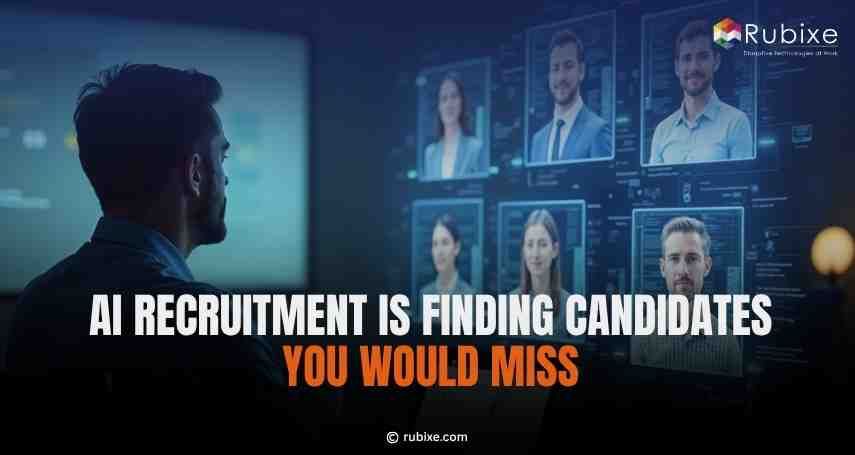
Enterprises today receive thousands of applications for a single role, yet identifying the right candidate quickly remains a challenge. As roles become more specialized and hiring demands increase, delays in screening and inconsistent evaluation begin to impact business outcomes. This growing gap is reflected in the market itself - the AI recruitment market is projected to reach $890 million by 2028, growing at a steady CAGR of 7.2%.
Traditional recruitment methods struggle to keep pace with this scale. Manual screening, delayed responses, and fragmented processes often slow down hiring cycles and affect the quality of hires. At the enterprise level, these inefficiencies directly impact productivity, team performance, and overall growth. This is where AI recruitment solutions are gaining importance, bringing structure, speed, and more reliable decision-making into the hiring process.
Why AI in Recruitment is Crucial
Enterprise hiring has shifted from volume-based processing to precision-based selection. Traditional recruitment methods struggle when applications run into thousands per role.
AI recruitment solutions address key gaps:
-
Volume Handling Without Quality Loss: High application volumes often slow down screening and lead to missed talent; AI processes and shortlist candidates quickly without compromising relevance.
-
Reducing Bias in Early Screening: AI evaluates candidates based on defined criteria like skills and experience, helping bring more consistency and reduce subjective bias in the initial stages.
-
Faster Hiring Cycles: By automating screening and early interactions, AI helps teams move candidates faster through the pipeline and close positions without delays.
-
Better Candidate Experience: Timely responses and structured communication improve engagement, making the hiring process smoother and more reliable for candidates.
This shift is already visible in practice - around 67% of HR professionals report that AI has improved efficiency across their recruitment processes.
Benefits of Integrating AI in Enterprise Recruitment
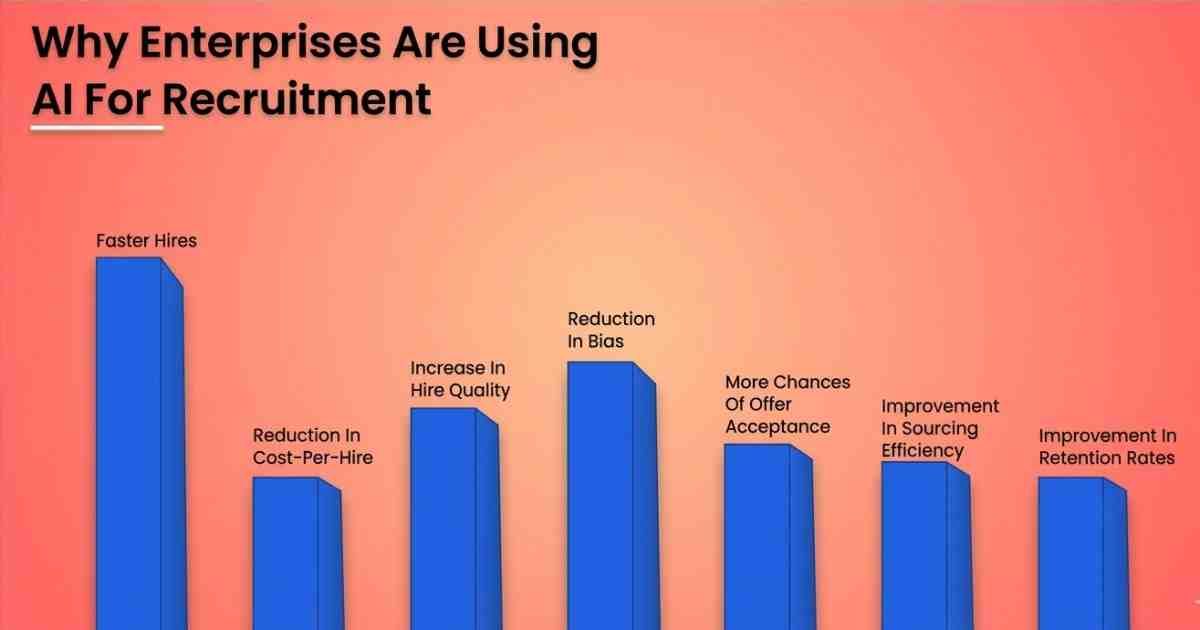 Implementing AI recruitment solutions creates measurable improvements across the hiring funnel. These improvements show up across different stages of the hiring process:
-
Cost Reduction in Hiring Operations: Organizations report 20 - 40% lower cost per hire when AI automates screening and scheduling processes. AI reduces process inefficiencies, avoids repeated hiring efforts, and improves the quality of shortlists. This results in better resource utilization and fewer cost-heavy hiring cycles.
-
Scalable Hiring Processes: AI enables recruitment teams to handle multiple roles, geographies, and departments without increasing team size.
-
Data-Driven Hiring Decisions: AI systems analyze past hiring data, candidate success patterns, and performance indicators to improve future hiring decisions.
-
Consistency Across Hiring Teams: Large organizations often struggle with inconsistent evaluation standards. AI standardizes screening and evaluation criteria across teams.
-
Improved Screening Accuracy: Using Artificial Intelligence models for AI resume screening, enterprises can match candidates based on skills, experience depth, and role relevance. This improves shortlist quality significantly.
Key Use Cases of AI Recruitment Solutions
AI is not applied in one stage - it runs across the entire hiring workflow.
-
Candidate Sourcing and Matching: AI tools scan internal and external platforms to identify suitable candidates based on role requirements.
-
Screening and Shortlisting: Systems using AI recruitment automation filter resumes and rank candidates based on predefined parameters.
-
Interview Scheduling and Coordination: Automation reduces back-and-forth communication and ensures faster scheduling.
-
Candidate Engagement: Chatbots and automated workflows keep candidates informed throughout the hiring process.
-
Predictive Hiring Insights: AI models analyze hiring patterns to predict candidate success and retention.
Steps to Implement AI in Enterprise Recruitment
Adopting AI recruitment solutions works only when it follows a clear, structured approach. Each step should solve a specific hiring problem, not just introduce new tools.
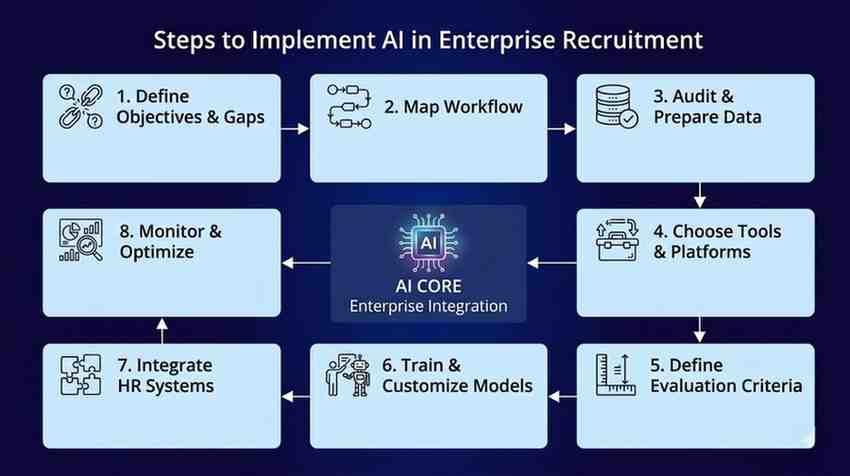 1. Define Hiring Objectives and Gaps: Start by identifying where your current process is breaking - whether it’s high application volume, slow screening, inconsistent shortlisting, or candidate drop-offs. A clear problem definition ensures AI is applied where it actually creates impact.
2. Map the Current Recruitment Workflow: Document every stage of your hiring process, from sourcing to onboarding. This helps identify which steps can be automated and which require human decision-making.
3. Audit and Prepare Recruitment Data: AI systems depend on structured and reliable data. Review past hiring data, job descriptions, and candidate evaluation criteria. Clean, consistent data improves model accuracy and output quality.
4. Choose the Right AI Tools and Platforms: Select AI hiring software that aligns with your business needs. It should integrate with your existing systems, support customization, and scale across roles and departments.
5. Define Clear Evaluation Criteria: Set standardized parameters for screening and shortlisting candidates. This ensures the AI system evaluates profiles based on relevant skills, experience, and role fit.
6. Train and Customize AI Models: Train the system using role-specific and industry-relevant data. Customization improves matching accuracy and ensures the output aligns with your hiring expectations.
7. Integrate with Existing HR Systems: Connect AI tools with your ATS, HRMS, and communication platforms. This ensures a seamless workflow without disrupting current operations.
8. Monitor Performance and Optimize Continuously: Track key metrics such as shortlist quality, time-to-hire, and candidate experience. Regular monitoring helps refine the system and improve outcomes over time.
Challenges in AI Enterprise Recruitment
While AI recruitment solutions offer clear advantages, enterprises often face practical challenges during implementation and scaling.
-
Data Quality Issues: Inconsistent, outdated, or unstructured recruitment data can lead to inaccurate screening and poor candidate matching.
-
Bias in AI Models: AI systems can reflect biases present in historical hiring data, affecting fairness in candidate evaluation and shortlisting.
-
Integration Complexity: Enterprises often operate with multiple HR systems, making it difficult to align AI tools with existing workflows and platforms.
-
Resistance from Hiring Teams: Recruitment teams may hesitate to adopt AI due to lack of clarity, trust issues, or fear of reduced control in decision-making.
-
Overdependence on Automation: Excessive reliance on AI can limit human judgment, especially in roles that require contextual understanding and cultural fit.
To overcome these challenges and reduce implementation risks, choosing the right AI recruitment partner becomes critical for long-term success.
Choosing the Right AI Partner
Many enterprises face challenges in AI adoption, not because of the technology, but due to poor alignment between tools and hiring workflows. Selecting the right partner plays a major role in how well your AI staffing and recruitment solutions actually work in real hiring scenarios. To make the right choice, look for these key factors:
-
Industry Experience: Look for teams that have worked on enterprise recruitment challenges across industries.
-
Customization Capability: Every enterprise has unique hiring needs. Avoid one-size-fits-all solutions.
-
Technical Expertise: A strong understanding of AI models, data systems, and integration frameworks is essential.
-
Proven Track Record: Evaluate case studies, implementation success, and measurable outcomes.
-
Long-Term Support: AI systems require ongoing updates, optimization, and scaling support.
Move Ahead with Rubixe
Implementing AI recruitment solutions without a structured approach often leads to limited results. The real impact comes from aligning AI with your hiring workflows, data systems, and business goals.
Rubixe works with enterprises to design and implement recruitment systems that deliver measurable outcomes. From identifying the right use cases to building scalable AI-driven hiring frameworks, the focus remains on practical execution.
If your hiring process is slowing down growth or creating inconsistencies, it’s time to move towards a system that brings clarity, speed, and accuracy into recruitment.
Schedule a free consultation with our team and start building a faster, more consistent AI-driven recruitment system.
Enterprise recruitment demands speed, accuracy, and consistency - areas where traditional methods struggle at scale. AI recruitment solutions bring structure to hiring, reduce manual effort, and improve decision-making through data.
The shift is already visible across industries. Organizations that implement AI with clear intent and the right execution model are improving hiring outcomes and reducing operational strain. The next step is to evaluate your current hiring process, identify gaps, and move towards a system that can consistently deliver the right talent at scale without slowing down your business.