











AI Consulting Frameworks: From Strategy to Deployment
AI consulting frameworks covering strategy, planning, deployment, machine learning, data analysis, automation, AI tools, implementation, workflows, and business use.
AI initiatives of companies don’t fail because of bad ideas; they fail because teams move without clarity. Companies invest in tools, run pilots, and expect results, but results stay inconsistent.
The missing piece is understanding where the organization stands and how to move forward step by step. This is where structured AI consulting frameworks come in. They define how strategy turns into execution, how use cases become systems, and how AI moves beyond experimentation into measurable outcomes.
If you are evaluating how to implement AI across your business, understanding the AI consulting framework is the first step toward doing it right.
Why Most AI Initiatives Fail to Scale in Enterprises
AI adoption is growing, but scaling remains the real challenge.
According to the latest McKinsey's State of AI report, more than 50% of companies have adopted AI in at least one function, yet only a small fraction achieves enterprise level impact.
In real business environments, the problem usually starts after the first success. A team builds a working model, say for customer churn prediction, and it performs well in testing. But when they try to expand it across regions or departments, issues appear.
Here’s where things break:
-
Disconnected systems: Data sits in different tools that don’t communicate. Scaling becomes difficult because the model cannot access consistent inputs across the organization.
-
No ownership at the leadership level: AI projects often remain within technical teams. Without leadership alignment, decisions around budget, expansion, and priorities slow down.
-
Lack of early evaluation: Many companies skip an AI readiness audit, which means they don’t fully understand their data quality, infrastructure limits, or internal skill gaps before starting.
The result is predictable - good pilots, poor scale.
What is an AI Consulting Framework, and why it matter
An AI Consulting Framework is a structured approach that helps businesses move from AI ideas to real, usable outcomes. It connects business goals with data, technology, and execution, so teams don’t operate in silos or guess their way through implementation.
In practice, it answers key questions early: What problems are worth solving? Do we have the right data? How will this integrate into daily operations? Without this clarity, AI efforts often stay limited to experiments.
Why it matters comes down to execution. AI involves multiple moving parts, data pipelines, model development, system integration, and decision workflows. A framework brings all of this into one aligned process.
It also reduces risk. With clear checkpoints, governance, and measurable goals, businesses avoid wasted investments and delays.
With the right framework, every step is connected, from identifying the right use case to deploying it in a way that actually improves business outcomes.
This is why organizations choose to work with an experienced AI consulting partner who is able to scale faster, maintain consistency, and generate results that actually impact the business.
Key Objectives of an AI Consulting Framework
A framework is only useful if it drives outcomes. Each objective plays a specific role in ensuring that happens.
-
Business Alignment: Every AI initiative should connect directly to a business goal. For example, improving customer retention or reducing operational costs. Without this, teams build solutions that perform technically but don’t impact results.
-
Capability Clarity: Organizations often overestimate their readiness. A proper evaluation highlights gaps in data quality, infrastructure, and team expertise, helping avoid unrealistic expectations.
-
Risk Management: AI decisions can influence customers, finances, and compliance. A structured approach ensures risks are identified early and controlled through validation and monitoring.
-
Scalability Planning: Solutions should be designed to expand. If scaling is not considered from the start, even successful pilots will struggle to grow.
-
Measurable Outcomes: Every initiative must have clear success metrics. This could be reduced processing time, improved accuracy, or cost savings.
What Enterprises Get Wrong Without a Structured Framework
When structure is missing, AI execution doesn’t stop, it just starts moving in the wrong direction.
Here’s how that typically shows up inside organizations:
-
Jumping into tools too early: Teams invest in advanced platforms, expecting quick wins. But without clarity on the actual problem, these tools end up underutilized or disconnected from business outcomes.
-
Data exists, but not in a usable form: Most enterprises have large volumes of data, but it’s scattered across systems, inconsistent, and not ready for AI. Without unifying and cleaning it first, outputs become unreliable.
-
Business and technical teams move differently: Leaders define high-level goals, while technical teams focus on execution details. Without alignment, what gets built doesn’t fully match what the business actually needs.
According to Gartner, a large percentage of AI failures are linked to unclear objectives, poor data quality, and a lack of governance.
This is why structured AI adoption is not optional, it is the foundation for scaling.
Key Stages of an AI Consulting Framework - From Strategy to Deployment
A successful AI initiative follows a sequence. Skipping stages often creates problems later.
1. Strategy Definition
This stage focuses on identifying where AI can create the most value. Instead of exploring multiple ideas, businesses prioritize use cases that have clear ROI potential. Leadership alignment is critical here because it defines direction.
2. AI Maturity Assessment
Here, organizations evaluate their current position. AI Maturity Assessment includes understanding data availability, infrastructure strength, and team capabilities. The goal is to identify gaps before moving forward.
3. Data and Infrastructure Readiness
AI depends on reliable data. This stage ensures data is cleaned, integrated, and accessible. It also involves setting up infrastructure that can handle large-scale processing.
4. Model Development and Validation
AI models are built and tested in this phase. The focus is on ensuring that outputs are accurate and aligned with business needs. Pilot testing helps validate performance in real scenarios.
5. Deployment and Scaling
Once validated, solutions are integrated into daily operations. Continuous monitoring ensures that performance remains stable and improves over time.
Organizations that follow AI consulting frameworks move forward with clarity instead of guesswork.
Where Internal Teams Struggle in AI Implementation
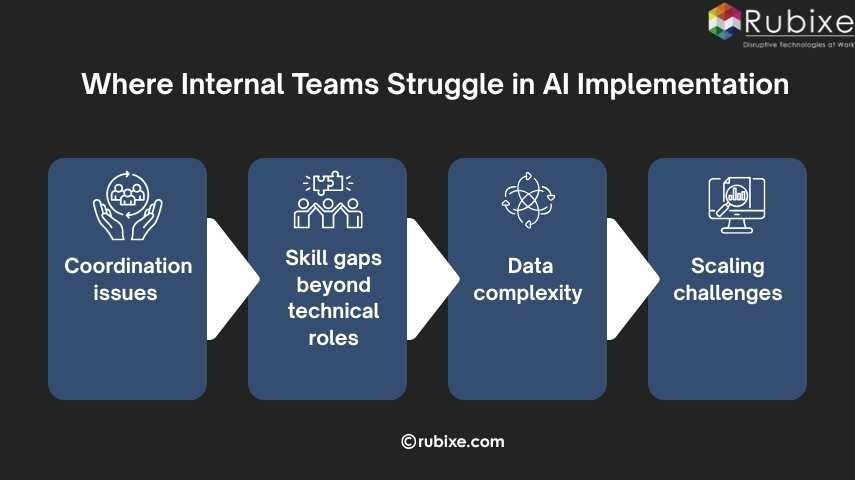 Even strong internal teams face practical challenges when working on AI.
1. Coordination issues: AI projects require collaboration between business, data, and IT teams. Without clear communication, progress slows down.
2. Skill gaps beyond technical roles: Many companies hire data scientists but lack strategic direction. This is where hiring the right AI strategy consultant helps bring clarity and structure.
3. Data complexity: Integrating and cleaning data from multiple systems takes more effort than expected. This often delays projects.
4. Scaling challenges: Moving from pilot to production requires planning at both technical and operational levels.
Risks in AI Implementation Without the Right Framework
AI without structure introduces risks that go beyond technical failure.
-
Financial loss: Investments in tools and talent may not deliver returns if direction is unclear.
-
Compliance issues: Without proper governance, organizations risk violating data and regulatory requirements.
-
Operational disruption: Poor integration can slow down existing workflows instead of improving them.
-
Loss of trust: Inconsistent or inaccurate outputs reduce confidence among stakeholders.
Strong AI governance helps prevent these issues by ensuring transparency and control throughout the lifecycle.
How Rubixe Executes AI Consulting from Strategy to Deployment
The real challenge in AI isn’t deciding what to build, it’s making it work smoothly inside existing business operations. Rubixe focuses exactly there.
-
It starts with business friction, not ideas: Instead of exploring random use cases, the focus is on where operations slow down, delays, manual work, and unclear reporting. AI is applied only where impact is visible.
-
Reality check before commitment: A deep dive (similar to an AI readiness assessment) validates whether data, systems, and teams can actually support the solution, before time and budget are spent.
-
Execution in small, usable steps: No long waiting cycles. Early versions are pushed into real workflows quickly, so teams see results and give feedback.
-
Fits into how teams already work: Solutions are built around existing processes, not forced changes. This improves adoption without resistance.
-
Built with control from day one: Strong AI governance ensures data usage, outputs, and decisions remain reliable as systems scale.
Your Next Step in AI Implementation
If your organization is currently experimenting with AI but struggling to see consistent results, the issue is likely a lack of structure.
Start by understanding where you stand. An AI maturity assessment will give you clarity on your strengths and gaps.
Focus on a few high-impact use cases instead of spreading resources too thin.
Build a roadmap that connects strategy, data, and execution. Make sure governance and scalability are part of the plan from the beginning.
AI is not a one-time initiative. It is a capability that evolves with your business.