







AI and ML Consulting Services for Business Growth
AI and ML consulting services that help businesses grow by automating workflows, improving accuracy, and delivering measurable operational results.
Artificial intelligence has moved beyond experimentation and into core business strategy. Boards expect measurable ROI. Investors expect operational efficiency. Customers expect intelligent, seamless experiences.
According to McKinsey’s Global AI Survey, 65% of organisations report regular AI usage in at least one business function, and companies that scale AI effectively see 20–30% EBIT impact in high-performing use cases. PwC estimates AI could contribute up to $15.7 trillion to the global economy by 2030. The opportunity is significant, but value materialises only through structured execution.
This is why demand for AI and ML consulting services continues to rise. Enterprises are no longer exploring the AI conceptually. They are seeking strategic partners who can align artificial intelligence with revenue growth, cost optimization, risk control, and long-term competitive positioning.
What Are AI and ML Consulting Services?
AI and ML consulting services help organisations translate artificial intelligence initiatives into measurable commercial outcomes. Rather than focusing solely on model development, consulting-led engagements align AI systems with defined business KPIs.
These services typically include AI consulting and strategy development, machine learning model design, enterprise data engineering, predictive analytics deployment, AI governance frameworks, and integration into existing systems such as ERP and CRM platforms.
The objective is not experimentation. It is a structured AI implementation that improves margins, accelerates decisions, and strengthens operational resilience.
For enterprises pursuing digital transformation, AI and ML consulting services bridge the gap between technical capability and financial performance.
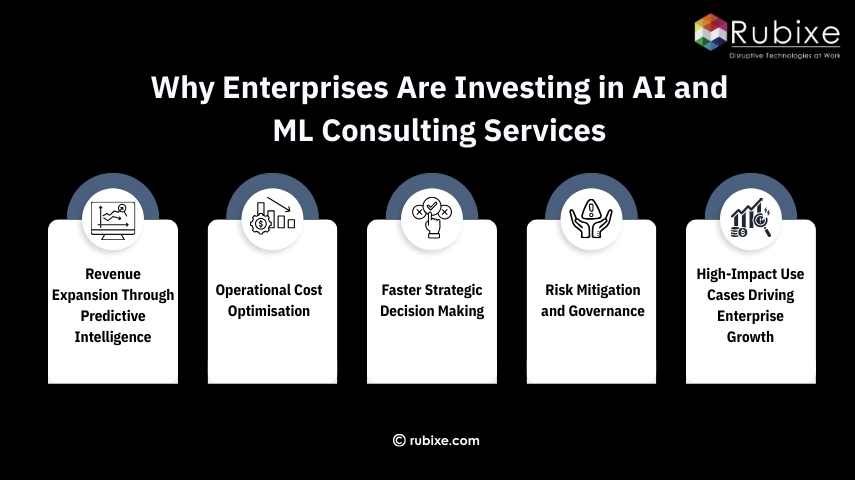
Why Enterprises Are Investing in AI and ML Consulting Services
-
Revenue Expansion Through Predictive Intelligence
Advanced machine learning models improve demand forecasting, dynamic pricing, churn prediction, and customer segmentation. BCG reports that companies applying AI to commercial optimisation achieve 10–15% revenue uplift in targeted segments.
-
Operational Cost Optimisation
Intelligent automation reduces manual workflows across supply chain management, finance operations, compliance monitoring, and customer support. Deloitte research indicates automation initiatives can reduce operational costs by 20–40% in structured processes.
-
Faster Strategic Decision-Making
Real-time analytics enables leadership teams to act on predictive signals rather than historical reports. This improves pricing precision, inventory allocation, and capital planning.
-
Risk Mitigation and Governance
As regulatory scrutiny increases, enterprises require bias detection, explainability mechanisms, audit trails, and secure data handling. Structured governance is now central to responsible AI deployment.
Organisations investing in AI and ML consulting services are focused on measurable growth outcomes rather than isolated AI pilots.
-
High-Impact Use Cases Driving Enterprise Growth
AI deployment generates the strongest ROI when aligned with business priorities.
In manufacturing, predictive maintenance models reduce downtime and extend equipment lifecycle. AI-driven supply chain optimization enhances demand planning and inventory control.
In financial services, machine learning strengthens fraud detection accuracy, automates risk scoring, and improves credit evaluation frameworks.
Retail enterprises leverage AI for personalised recommendations, dynamic pricing, and customer lifetime value optimisation.
Healthcare institutions apply predictive analytics for early diagnostics and operational efficiency.
IDC research indicates that organisations scaling AI across departments achieve significantly higher ROI than pilot-stage adopters. This reinforces the importance of structured execution supported by experienced AI and ML consulting services.
Common Challenges in Enterprise AI Implementation
Despite rising adoption, many AI initiatives underperform due to execution gaps.
-
Data readiness remains a critical barrier: Enterprises often operate with siloed, inconsistent, or incomplete datasets that limit model accuracy. A formal data audit is essential before deployment.
-
Unclear ROI expectations create strategic misalignment: AI initiatives must tie directly to financial KPIs such as revenue lift, cost reduction, or risk exposure mitigation.
-
Integration complexity presents another obstacle: AI models that are not embedded into operational workflows fail to influence decision-making. Enterprise AI requires system-level integration across CRM, ERP, and analytics platforms.
-
Governance risk is increasingly significant: Regulatory frameworks demand transparency, explainability, and compliance monitoring. Without structured oversight, AI adoption can expose organisations to legal and reputational risk.
McKinsey reports that while AI experimentation is widespread, fewer companies successfully scale AI across business functions due to integration and governance challenges. This is where mature AI and ML consulting services deliver long-term value.
Strategic Framework Behind Effective AI and ML Consulting Services
Enterprise AI success depends on a disciplined methodology.
Engagements typically begin with business case prioritisation, identifying use cases linked directly to measurable KPIs. This is followed by a data readiness assessment evaluating infrastructure maturity and governance protocols.
Model development and validation ensure that machine learning systems align with operational objectives. Integration of automation into enterprise systems enables real-time workflow impact.
Ongoing monitoring, bias mitigation, and compliance tracking sustain long-term performance stability.
Enterprises that follow structured deployment frameworks outperform competitors in revenue velocity and operational efficiency. Effective AI and ML consulting services are defined by this architectural discipline.
AI ML Consulting vs Building In-House Capability
Leadership teams often evaluate whether to develop internal AI teams or partner externally.
Consulting-led engagements accelerate deployment through established frameworks and cross-industry expertise. In-house teams may require extended ramp-up periods for hiring, experimentation, and infrastructure maturity.
AI ML transformation requires multidisciplinary expertise across data science, infrastructure engineering, cybersecurity, governance, and enterprise architecture. Consulting firms provide integrated capabilities aligned with enterprise scalability.
Many organisations adopt a hybrid approach - developing internal AI literacy while leveraging AI and ML consulting services for strategy design, architecture development, and governance depth.
How to Select the Right AI and ML Consulting Partner
Choosing the right AI and ML consulting partner determines execution quality and ROI.
Enterprises should evaluate proven enterprise case studies, industry expertise, data engineering strength, scalable architecture capability, and governance frameworks aligned with regulatory standards.
Clear performance metrics and milestone-based delivery models indicate maturity. Strategic partners align AI implementation directly with commercial objectives rather than focusing solely on technical deployment.
A well-structured AI and ML consulting services engagement prioritises measurable business outcomes at every stage.
Frequently Asked Questions
1. What industries benefit most from AI and ML consulting services?
Manufacturing, finance, healthcare, retail, logistics, telecom, and SaaS sectors generate high impact due to data intensity and automation potential.
2. How long does it take to see ROI from AI implementation?
Initial performance improvements may appear within 3–6 months, while enterprise-scale ROI typically materialises within 12–18 months depending on scope.
3. What is the cost structure of AI consulting engagements?
Costs vary based on use case complexity, infrastructure readiness, and integration depth. Enterprise projects often follow milestone-based pricing aligned with measurable KPIs.
4. Do AI consulting services include governance and compliance frameworks?
Yes. Responsible AI frameworks covering bias mitigation, auditability, regulatory alignment, and data security are integral components.
5. Can mid-sized businesses implement AI effectively?
Yes. Targeted use cases with scalable frameworks allow mid-sized organisations to deploy AI without large-scale infrastructure investments.
AI adoption has entered a performance-driven phase. Enterprises are measuring intelligence initiatives against revenue growth, operational efficiency, and risk resilience.
Organisations that operationalise AI with structured frameworks widen the performance gap against slower competitors. The differentiator lies in disciplined execution, governance maturity, and enterprise integration.
Well-designed AI and ML consulting services provide the clarity, architecture, and performance tracking required to scale AI responsibly and profitably.
For organisations preparing their next growth phase, a consulting-led AI strategy aligned with measurable KPIs can accelerate transformation while protecting long-term competitiveness.