













Multilingual AI Chatbot: Challenges and Benefits
Multilingual AI chatbots face challenges like translation, integration, and scalability while providing benefits in automation, customer support, and efficiency.
Why do global businesses still lose customers despite having strong digital platforms?
Why do users abandon websites when support is not available in their language?
The answer is simple - language barriers in customer experience.
Today, customers expect instant support in their native language, whether they are browsing an online store in Europe, booking travel in Asia, or accessing banking services in India.
This is where multilingual AI chatbots are changing the way businesses operate globally.
What Is a Multilingual AI Chatbot?
A multilingual AI chatbot is an intelligent system that understands and responds to users in multiple languages using Natural Language Processing (NLP), machine learning, and real-time translation models.
Unlike traditional chatbots that work in one language, multilingual bots:
- Detect user language automatically
- Understand intent behind queries
- Respond in the same language instantly
- Continuously improve using machine learning
This makes them essential for businesses operating across global markets.
Why Multilingual AI Chatbots Are Important for Global Businesses
 Global digital adoption has expanded customer expectations.
According to CSA Research, around 76% of online consumers prefer purchasing products when information is available in their native language. Companies that fail to support multiple languages often lose potential customers.
A multilingual AI chatbot addresses this challenge by enabling businesses to interact with users regardless of location.
Key reasons global organizations adopt multilingual chatbots include:
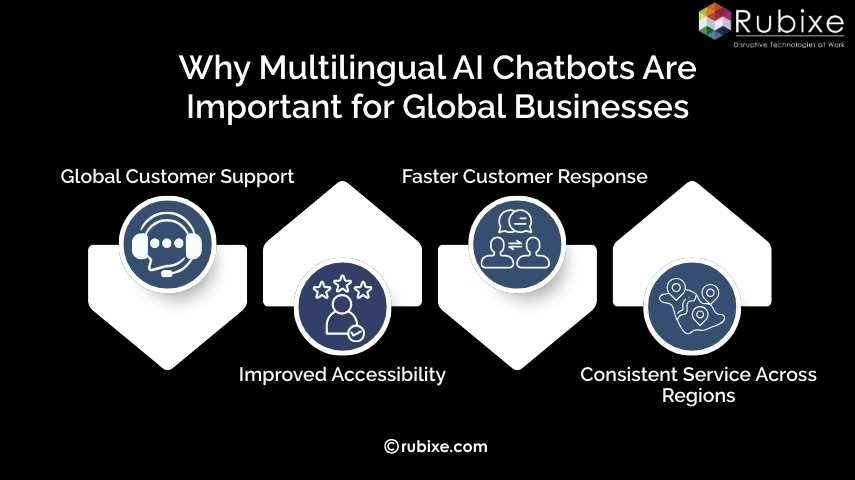
1. Global Customer Support
Customers from different countries can communicate in their native language. The chatbot detects the language and responds accordingly, reducing communication barriers.
2. Improved Accessibility
Multilingual chatbots make services accessible to a broader audience, including users who may struggle with English-only platforms.
3. Faster Customer Response
Instead of routing queries to regional support teams, automated systems provide instant responses across languages.
4. Consistent Service Across Regions
Companies operating in multiple markets can maintain the same quality of support regardless of geography.
Many businesses implement ai chatbot automation to manage international customer queries while maintaining efficiency and response speed.
Challenges in Building Multilingual AI Chatbots & Real-Time Solutions
Creating a multilingual chatbot involves technical complexity. Organizations often encounter several challenges during development and deployment. Understanding these challenges and implementing practical solutions ensures better performance and reliability.
1. Language Detection Accuracy
A chatbot must identify the user's language correctly before generating responses. Errors in language detection can result in incorrect replies or mixed-language conversations.
Solution: Advanced language detection models analyse sentence structure and contextual signals instead of relying solely on keywords. Training the chatbot using diverse multilingual datasets improves accuracy. Many companies integrate AI language models that detect languages even in short phrases or mixed sentences.
2. Cultural Context Understanding
Language communication involves cultural context. A phrase acceptable in one region may carry a different meaning in another. Chatbots that translate words directly may fail to interpret intent.
Solution: Organizations train AI models with region-specific data to capture cultural nuances. Localization teams review responses and adjust conversational flows for each region. This approach improves conversational accuracy and prevents misunderstandings.
3. Data Training Limitations
Machine learning models require large volumes of language data. Some regional languages have limited digital datasets, which reduces chatbot performance.
Solution: Businesses address this challenge by combining open language datasets with domain-specific training data. Continuous training using real user conversations improves accuracy over time. Many modern AI chatbots also use hybrid models combining rule-based and AI responses to handle low-data languages.
4. Real-Time Translation Challenges
Handling real-time translation across multiple languages can create latency issues and inconsistent responses.
Solution: Advanced chatbot frameworks integrate real-time translation APIs with optimized NLP pipelines. These systems process user queries quickly and maintain conversational flow. Edge computing and cloud-based AI models also reduce translation delays.
5. Integration with Business Systems
A chatbot must interact with internal systems such as CRM platforms, support tools, and databases. Integrating these systems across languages becomes complex.
Solution: Modern chatbot platforms use API-based integration to connect with CRM systems, helpdesk software, and knowledge bases. This ensures the chatbot retrieves accurate information regardless of language. Businesses also integrate multilingual knowledge bases to maintain consistent answers across markets.
To build a customer like AI Chatbot, companies usually design scalable architectures that support multilingual workflows, system integration, and centralized knowledge management.
Benefits of Multilingual AI Chatbots for Businesses
When implemented effectively, multilingual chatbots provide measurable advantages for organizations operating in international markets.
1. Global Customer Reach
Businesses can interact with customers across different countries without building separate support teams for each region. This expands market accessibility and improves customer acquisition.
2. 24/7 Support Across Languages
AI chatbots provide continuous support regardless of time zones. Customers receive assistance instantly without waiting for human agents.
3. Cost Reduction
Customer support operations often require large teams and training resources. Automation reduces operational costs while maintaining service availability.
4. Better Customer Engagement
Customers are more comfortable interacting in their native language. Multilingual chatbots encourage longer conversations and improve engagement levels.
5. Improved Conversion Rates
When customers receive clear information during their buying journey, they are more likely to complete purchases. Many businesses use multilingual lead generation chatbot systems to guide visitors through product inquiries and support conversion.
A report by Juniper Research estimates that chatbots will help businesses save over $11 billion annually in customer support costs through automation.
Key Factors to Consider Before Building a Multilingual AI Chatbot
Organizations planning to implement multilingual chatbot systems must evaluate several technical and strategic factors.
1. Supported Languages
Identify the languages most relevant to your customer base. Prioritizing high-traffic languages ensures maximum impact during the initial deployment phase.
2. NLP Capabilities
Strong Natural Language Processing capabilities are essential for understanding complex queries across languages.
3. Scalability
The chatbot infrastructure should support future expansion. As businesses enter new markets, additional languages may need to be added.
4. Integration with CRM and Support Systems
Integration with customer relationship management tools ensures that chatbots access customer data and support records effectively.
5. Data Privacy and Compliance
Handling multilingual customer data requires compliance with regional regulations such as GDPR and other privacy standards.
Careful planning in these areas improves the success rate of multilingual chatbot implementation.
Real-World Use Cases of Multilingual AI Chatbots
Many industries have adopted multilingual chatbot technology to improve service delivery.
-
E-Commerce Customer Support: Online retailers use chatbots to answer product queries, track orders, and provide shipping updates in multiple languages.
-
Travel and Hospitality: Hotels and airlines assist international travellers with booking inquiries, itinerary updates, and customer support.
-
Banking and Fintech: Financial institutions use chatbots to handle account inquiries, transaction assistance, and customer onboarding across regions.
-
Healthcare Appointment Support: Hospitals and healthcare providers enable patients to schedule appointments, receive reminders, and access medical information in their preferred language.
-
SaaS Customer Onboarding: Software companies guide global users through onboarding, troubleshooting, and product usage instructions through multilingual chatbot support.
FAQs
1. How many languages can AI chatbots support?
Modern AI chatbots can support dozens of languages depending on the training data and NLP models used. Many enterprise platforms support more than 100 languages.
2. Can multilingual chatbots translate conversations in real time?
Yes. Many advanced chatbots use real-time translation engines combined with NLP processing to deliver instant responses in multiple languages.
3. Are multilingual AI chatbots expensive to build?
The cost varies depending on features, integration complexity, and the number of supported languages. Cloud-based AI platforms have reduced implementation costs for many businesses.
4. Which industries benefit the most from multilingual chatbots?
Industries with global customer bases, such as e-commerce, travel, banking, healthcare, and SaaS platforms, benefit significantly from multilingual chatbot technology.
Get Started with Rubixe AI Chatbot Solutions
Rubixe provides advanced ai chatbot solutions designed to support multilingual customer interactions, intelligent automation, and seamless business integration. These chatbot systems enable businesses to handle global customer queries, automate support processes, and improve engagement across digital channels. Organizations looking to expand international customer support can implement scalable chatbot systems that deliver consistent service and measurable operational efficiency.