
















How Does IPA Help for Business?
Understand how Intelligent Process Automation (IPA) helps businesses automate tasks, improve efficiency, reduce manual work, and support better decision-making.

Businesses today manage complex workflows involving large volumes of data, multiple systems, and decision-based tasks. Intelligent process automation (IPA) helps organizations streamline these processes by combining artificial intelligence with automation technologies. By enabling systems to analyze data, make decisions, and execute tasks automatically, intelligent process automation improves operational efficiency, reduces manual effort, and helps businesses scale processes more effectively.
Key Takeaways
-
Intelligent process automation combines AI technologies with workflow automation to manage complex business processes with minimal manual intervention.
-
Organizations adopting automation frameworks report a 20 -30% reduction in operational costs and improved process accuracy.
-
Businesses that scale automation across departments experience higher productivity, faster service delivery, and improved decision support.
What Is Intelligent Process Automation?
Intelligent process automation (IPA) is a business automation approach that integrates technologies such as artificial intelligence, machine learning, and workflow automation to automate complex processes that traditionally require human judgment.
Traditional automation tools perform rule-based tasks. IPA expands this capability by allowing systems to interpret data, analyze patterns, and make process decisions automatically.
A typical intelligent automation framework combines multiple technologies, including:
-
AI and machine learning models
-
Natural language processing (NLP)
-
Intelligent document processing
-
Workflow orchestration tools
-
Data analytics platforms
Many organizations begin their automation journey with RPA (Robotic Process Automation), which handles structured and rule-based tasks. IPA extends these capabilities by enabling automation systems to understand unstructured data such as emails, documents, and customer interactions.
For example, an intelligent automation system can read invoices, validate supplier data, update ERP systems, and flag exceptions for human review. This reduces manual workload while improving accuracy and compliance.
Industry research shows that organizations using IPA reduce process cycle times by up to 35% and significantly improve operational productivity.
How Intelligent Process Automation Helps Businesses
Intelligent process automation helps businesses improve efficiency, accuracy, and decision-making by combining automation technologies with artificial intelligence capabilities. Instead of depending entirely on manual processes, organizations use automation tools to execute repetitive and rule-based tasks while AI systems analyze data and support smarter operational decisions. This approach enables companies to streamline workflows across departments such as finance, customer service, supply chain, and human resources.
The impact of intelligent automation becomes clear when businesses integrate it into daily operations. The process typically unfolds in structured stages:
1. Identifying repetitive business processes: Organizations begin by identifying processes that involve repetitive manual work, such as invoice processing, document verification, data entry, or customer query management. These tasks are ideal candidates for automation because they consume significant employee time.
2. Integrating automation technologies: Businesses implement automation tools that combine RPA with artificial intelligence capabilities such as machine learning and natural language processing. These technologies form the components of intelligent process automation, enabling systems to capture data, process information, and execute tasks automatically across digital platforms.
3. Automating workflow execution: Once configured, automation bots begin handling routine processes such as extracting information from documents, validating data, updating enterprise systems, and generating reports. Automated workflows operate continuously, allowing organizations to process large volumes of transactions with consistent accuracy.
4. Enabling intelligent decision support: AI models within intelligent automation platforms analyze operational data to detect patterns, flag anomalies, and generate insights. This helps business leaders make informed decisions based on real-time information instead of relying on manual analysis.
5. Improving operational outcomes: As automation scales across departments, businesses experience measurable improvements such as faster process execution, lower operational costs, reduced human errors, and improved service delivery. Employees can shift their focus toward strategic activities that contribute directly to business growth.
By following these steps, organizations transform manual operations into automated, data-driven workflows. Intelligent process automation, therefore, becomes a practical strategy for companies aiming to increase productivity, improve customer experience, and scale operations efficiently.
Benefits of Intelligent Process Automation in Business
Enterprises adopt intelligent automation because it produces measurable operational and financial results. When implemented across departments, IPA improves efficiency, decision quality, and service responsiveness.
1. Higher Operational Efficiency
Automated workflows complete repetitive tasks continuously without delays. Tasks such as data entry, document validation, and report generation run automatically across systems.
Businesses using IPA report up to 40% reduction in process cycle time in operations such as finance processing and customer onboarding.
2. Reduced Operational Costs
Automation eliminates manual processing costs and reduces error-related rework. Organizations implementing intelligent automation frameworks typically see 20 -30% lower operational expenses in automated processes.
Cost savings also arise from improved process scalability since automated workflows can handle large transaction volumes without additional staffing.
3. Improved Accuracy and Compliance
Human errors in data processing can create regulatory risks and financial losses. IPA ensures consistent execution of workflows while maintaining audit trails for compliance.
Automation tools validate data against defined rules and regulatory policies before completing transactions.
4. Faster Customer Service
Customer support teams benefit from automated workflows that handle routine service requests such as ticket classification, response generation, and service updates.
AI-powered systems analyze customer interactions and route requests to the appropriate teams instantly. Faster resolution improves service experience and reduces operational workload.
Research indicates that 83% of organizations using intelligent automation experience faster resolution of customer service requests.
5. Better Data-Driven Decisions
IPA systems continuously analyze operational data to identify process inefficiencies and performance patterns.
Business leaders gain real-time insights into workflow performance, enabling data-driven decision-making across departments such as finance, HR, procurement, and supply chain.
6. Workforce Productivity Improvement
Automation allows employees to focus on strategic work such as customer engagement, innovation, and problem-solving.
Industry studies show that 70% of employees report improved focus on value-adding tasks after automation implementation.
These improvements are made possible by the coordinated use of technologies that form the core components of intelligent process automation, such as AI, machine learning, analytics, and workflow automation.
Challenges in Implementing Intelligent Process Automation in Business
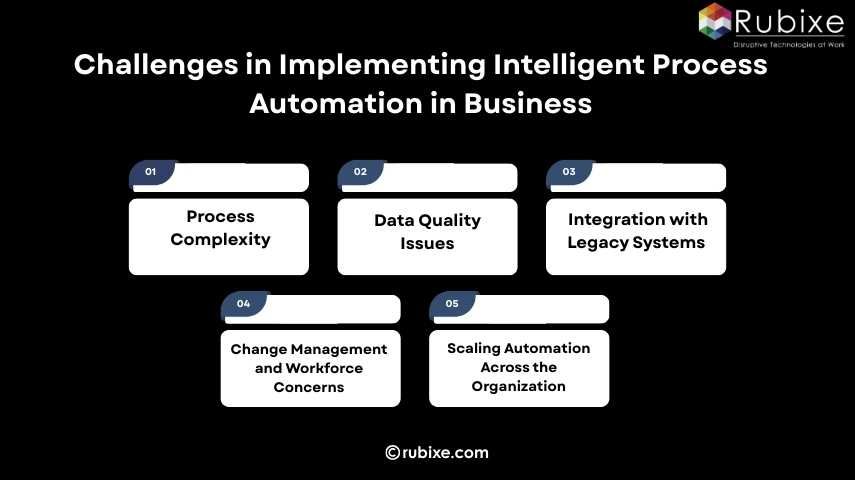
Despite its benefits, implementing intelligent automation requires careful planning and technical preparation. Organizations often face several challenges during adoption.
1. Process Complexity
Many business processes involve multiple systems, manual approvals, and inconsistent workflows. Automating poorly defined processes leads to limited results.
Solution:
-
Conduct detailed process mapping before automation
-
Identify high-volume and stable processes
-
Standardize workflows across departments
2. Data Quality Issues
Automation systems depend heavily on accurate data. Inconsistent or incomplete data sources can reduce automation accuracy.
Solution:
-
Establish data governance practices
-
Implement data validation rules
-
Integrate intelligent document processing tools
3. Integration with Legacy Systems
Older enterprise systems often lack modern APIs, making automation integration complex.
Solution:
-
Use middleware or integration platforms
-
Implement phased automation deployment
-
Modernize critical systems gradually
4. Change Management and Workforce Concerns
Employees sometimes perceive automation as a job replacement risk. Without proper communication, adoption may face resistance.
Solution:
-
Provide automation training programs
-
position automation as a productivity tool
-
involve employees in automation planning
5. Scaling Automation Across the Organization
Many companies successfully launch pilot automation projects but struggle to expand them enterprise-wide.
Solution:
-
develop a centralized automation strategy
-
create governance frameworks
-
measure ROI and performance metrics
Organizations that address these challenges early are more likely to achieve sustainable automation outcomes.
Intelligent Process Automation Trends in Business
Automation adoption continues to grow as companies pursue digital transformation initiatives. Several emerging trends are shaping the future of intelligent automation.
Rapid Growth in IPA Adoption
The global intelligent process automation market is projected to reach USD 63.6 billion by 2032, reflecting strong demand across finance, healthcare, and manufacturing industries.
Integration of AI and Machine Learning
Modern automation systems integrate AI models to analyze data patterns, predict outcomes, and automate decision-making processes.
Intelligent Document Processing
Organizations increasingly automate document-heavy workflows such as invoices, contracts, and claims processing using AI-powered document extraction technologies.
Automation as a Strategic Business Capability
Automation is moving beyond IT initiatives. Business units such as finance, HR, and customer operations now actively invest in automation to improve productivity and service quality.
FAQs
1. What is intelligent process automation in simple terms?
Intelligent process automation combines artificial intelligence and automation technologies to automate complex business workflows that involve data analysis and decision-making.
2. How does IPA improve business productivity?
IPA automates repetitive tasks, reduces manual errors, and speeds up process execution, allowing employees to focus on strategic activities.
3. What industries use intelligent process automation?
Industries such as banking, healthcare, manufacturing, telecom, insurance, and retail widely adopt automation to streamline operations and improve service delivery.
4. What technologies are used in intelligent automation?
Key technologies include artificial intelligence, machine learning, natural language processing, intelligent document processing, and robotic automation tools.
5. How long does it take to see ROI from IPA?
Many organizations recover automation investment within 12 to 18 months, depending on process complexity and implementation scale.
Intelligent process automation helps businesses transform operational workflows by combining automation technologies with artificial intelligence. Organizations implementing IPA achieve faster processing, reduced operational costs, improved accuracy, and stronger customer experiences.
Businesses exploring AI automation often require the right expertise to identify opportunities and implement solutions effectively. Rubixe helps organizations design and deploy intelligent automation strategies that streamline operations, improve efficiency, and support long-term digital transformation.