


















What is Robotic Process Automation (RPA)?
Understand what Robotic Process Automation (RPA) is, how it works, and how businesses use RPA tools to automate repetitive tasks and improve operational efficiency.

Organizations handle thousands of repetitive digital tasks every day, such as data entry, invoice processing, form validation, and system updates. These activities consume time, increase operational costs, and introduce human errors. Robotic Process Automation (RPA) addresses this challenge by enabling software bots to perform routine tasks automatically. Businesses across finance, healthcare, retail, and IT rely on RPA to streamline workflows, improve efficiency, and accelerate digital transformation.
Key Takeaways
-
Robotic Process Automation (RPA) uses software bots to automate repetitive digital tasks such as data entry, report generation, and transaction processing.
-
Organizations adopt RPA automation to reduce operational costs, improve accuracy, and accelerate workflow efficiency across departments.
-
The global RPA market continues to expand rapidly, with projections estimating growth to over $72 billion by 2032, driven by enterprise automation initiatives.
What is Robotic Process Automation?
Robotic Process Automation refers to software technology that uses bots to replicate human actions within digital systems. These bots interact with applications, capture data, process transactions, trigger responses, and communicate with other systems without human intervention.
Unlike physical robots used in manufacturing, RPA automation operates in software environments. It works through user interfaces just like a human employee, logging into systems, copying information, entering data, and executing predefined tasks.
Businesses use RPA to automate high-volume, rule-based processes such as:
-
Invoice processing
-
Customer onboarding
-
Payroll management
-
Data migration
-
Report generation
RPA helps organizations eliminate repetitive manual tasks while allowing employees to focus on analytical and strategic work.
Automation has become a key component of digital transformation. Industry studies show that more than 68% of enterprises have implemented RPA solutions to streamline workflows and improve productivity.
How Does RPA Work?
RPA works by using software bots that mimic human actions across digital systems. These bots interact with applications through user interfaces and execute predefined rules.
A typical RPA workflow follows these steps:
1. Process Identification
Organizations identify repetitive tasks that require structured inputs and predictable outputs. Examples include invoice entry, claim processing, and employee onboarding.
2. Bot Configuration
Developers design automation workflows using RPA tools. The bots are configured with rules that determine how they interact with applications and process data.
3. Data Extraction and Processing
Bots extract information from documents, spreadsheets, emails, or databases. They then process the information according to defined business logic.
4. Execution Across Systems
RPA bots perform tasks across multiple systems - ERP platforms, CRM tools, accounting software, and internal databases.
5. Monitoring and Optimization
Automation dashboards track bot performance, workflow efficiency, and exceptions. Continuous monitoring ensures processes run smoothly and improvements are implemented when required.
Modern automation platforms often integrate artificial intelligence, machine learning, and analytics to improve automation capabilities. This integration supports a more advanced automation framework, RPA for smarter IT, where IT teams automate infrastructure management, system monitoring, and operational workflows.
Evolution and Growth of RPA Over the Years
Robotic Process Automation has evolved significantly as organizations adopt advanced automation technologies.
Early Automation (2000–2010)
Automation began with simple scripts and macros designed to automate repetitive tasks in spreadsheets and desktop applications. These early solutions lacked scalability and enterprise integration.
Enterprise RPA Platforms (2010–2017)
Dedicated RPA platforms emerged, enabling organizations to automate large-scale workflows across departments. Companies began deploying automation bots for finance operations, data processing, and compliance tasks.
Intelligent Automation (2018–2022)
RPA platforms integrated artificial intelligence technologies such as machine learning, optical character recognition (OCR), and natural language processing. This allowed bots to process documents, analyze emails, and interpret unstructured data.
Hyperautomation and AI Integration (2023 - Present)
Modern automation ecosystems combine RPA with AI, predictive analytics, and process mining tools. This approach creates intelligent automation systems capable of handling complex workflows and decision-based processes.
Market growth reflects this adoption trend. Industry projections indicate that the global RPA market could reach $247 billion by 2035, driven by enterprise automation demand and AI integration.
Types of RPA
Organizations implement different types of RPA automation depending on the complexity of workflows and operational requirements.
1. Attended RPA
Attended bots work alongside employees and assist them during tasks. They are triggered manually and provide support in real time.
Example: A customer service agent receives automation support while processing a support ticket.
2. Unattended RPA
Unattended bots operate independently without human involvement. They execute tasks automatically according to scheduled workflows.
Example: Overnight automation of financial reports and database updates.
3. Hybrid RPA
Hybrid automation combines attended and unattended bots. Human employees collaborate with automation systems to complete complex processes.
This model is widely used in industries such as banking and healthcare, where human oversight is required for certain decision points.
Use Cases of RPA with Industry Examples
Robotic Process Automation supports a wide range of business processes across industries.
1. Banking and Financial Services
Financial institutions automate processes such as:
-
Loan processing
-
Fraud detection workflows
-
Compliance reporting
-
Transaction reconciliation
Outcome: Improves accuracy and ensures regulatory compliance.
2. Healthcare
Healthcare organizations deploy RPA for:
-
Patient data management
-
Appointment scheduling
-
Insurance claims processing
-
Medical billing automation
Outcome: Automation reduces administrative workload and improves patient service efficiency.
3. Retail and E-commerce
Retail businesses automate tasks such as:
-
Order processing
-
Inventory updates
-
Customer service workflows
-
Product data management
Outcome: Ensures faster response times and improved operational efficiency.
4. Telecommunications
Telecom providers use RPA to automate processes such as:
-
Service provisioning and activation
-
Billing and invoice processing
-
Network monitoring and alerts
-
Customer data management
Outcome: Faster service delivery, reduced operational errors, and improved customer experience.
5. Human Resources
HR teams automate recruitment processes, employee onboarding, payroll operations, and compliance documentation.
HR teams implement RPA to automate tasks such as:
-
Resume screening and candidate shortlisting
-
Employee onboarding documentation
-
Payroll processing and attendance tracking
-
Compliance and employee record management
Outcome: Faster hiring cycles, improved HR productivity, and streamlined employee management processes.
As automation evolves, organizations combine RPA with artificial intelligence frameworks such as IPA (Intelligent Process Automation) to handle more complex decision-based workflows.
Benefits of RPA
Robotic Process Automation delivers several operational advantages for organizations.
1. Increased Operational Efficiency
Bots execute repetitive tasks faster than humans, enabling organizations to process large volumes of transactions efficiently.
2. Reduced Operational Costs
Automation reduces the need for manual labor in repetitive workflows, lowering operational expenses.
3. Improved Accuracy
RPA eliminates manual errors associated with data entry and repetitive tasks.
4. Faster Processing Speed
Bots operate continuously without breaks, enabling 24/7 process execution.
5. Better Compliance
Automation ensures that processes follow standardized workflows, improving regulatory compliance.
6. Enhanced Employee Productivity
Employees can focus on strategic tasks such as analysis, innovation, and decision-making rather than repetitive administrative work.
Studies show that organizations implementing automation report improved productivity, reduced manual workload, and greater operational transparency.
How to Deploy RPA
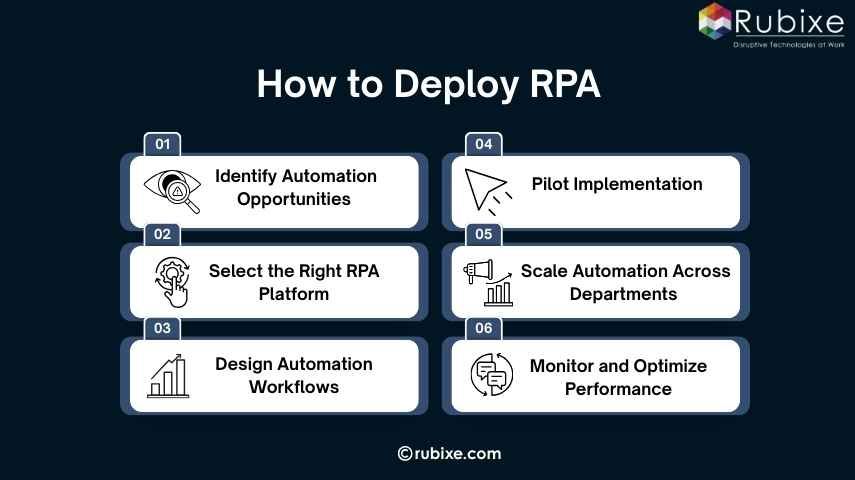 Successful deployment of Robotic Process Automation requires a structured implementation strategy.
1. Identify Automation Opportunities
Organizations begin by analyzing business processes to identify tasks suitable for automation.
2. Select the Right RPA Platform
Businesses evaluate AI products and automation tools based on scalability, integration capabilities, and security requirements.
3. Design Automation Workflows
Developers design workflows that define bot actions, data handling procedures, and system interactions.
4. Pilot Implementation
Automation initiatives often begin with small pilot projects to evaluate performance and identify improvements.
5. Scale Automation Across Departments
Once validated, organizations expand automation across multiple departments and processes.
6. Monitor and Optimize Performance
Continuous monitoring ensures automation systems remain efficient and aligned with business objectives.
A structured automation strategy helps organizations maximize efficiency while minimizing operational risks.
Challenges and Considerations
Despite its advantages, implementing RPA requires careful planning and governance.
1. Process Complexity
Certain workflows require human judgment and cannot be fully automated.
2. Integration Challenges
Legacy systems may require additional integration efforts to support automation.
3. Security and Compliance
Automation systems must follow strict data governance and cybersecurity standards.
4. Change Management
Employees must adapt to automation-driven workflows, which requires training and organizational alignment.
5. Skill Requirements
Organizations need skilled professionals to design, manage, and maintain automation solutions.
Proper planning and governance frameworks help organizations overcome these challenges while ensuring long-term automation success.
Frequently Asked Questions
1. What is Robotic Process Automation in simple terms?
Robotic Process Automation uses software bots to automate repetitive digital tasks such as data entry, report generation, and transaction processing.
2. Where is RPA commonly used?
RPA is widely used in banking, healthcare, retail, telecommunications, and IT operations to automate administrative workflows.
3. Is RPA the same as artificial intelligence?
RPA automates rule-based tasks, while AI enables machines to analyze data and make decisions. Many modern systems combine both technologies.
4. What tasks are suitable for RPA automation?
Tasks that are repetitive, rule-based, and involve structured data are ideal for automation.
5. What is the difference between RPA and Intelligent Process Automation?
RPA focuses on automating repetitive tasks, while intelligent automation combines RPA with AI technologies such as machine learning and natural language processing.
Robotic Process Automation has become a critical technology for organizations seeking efficiency, scalability, and operational accuracy. Organizations that adopt automation thoughtfully can build more efficient operations while empowering employees to focus on innovation and strategic growth.
Rubixe helps businesses evaluate automation opportunities, design intelligent workflows using AI automation, and integrate advanced technologies that improve operational efficiency.