












How to build a multilingual AI chatbot
Step-by-step guide to building a multilingual AI chatbot using NLP, language detection, and localization to boost engagement and conversions.
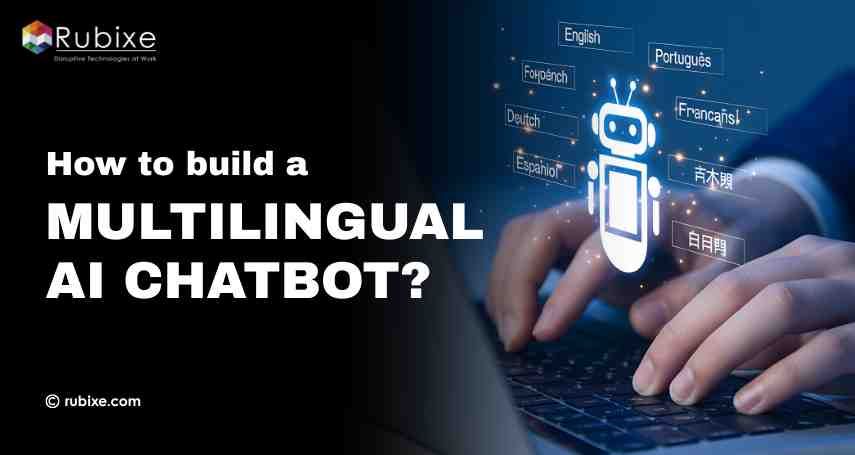
As businesses expand globally and digital interactions grow more complex, the need for conversational systems that understand and respond in multiple languages has never been greater. According to industry research, more than 70% of consumers prefer engaging with brands in their native language, and multilingual support can significantly enhance customer satisfaction and conversion rates.
In 2026, multilingual AI chatbots are evolving from a convenience to a strategic necessity for customer service, sales, and engagement across diverse markets.
What Is a Multilingual AI Chatbot & Why It Matters
A multilingual AI chatbot is an intelligent conversational agent capable of understanding and interacting with users in multiple languages, using advanced Natural Language Processing (NLP) and machine learning. Unlike traditional single-language bots, these chatbots can detect language preferences, switch seamlessly between languages, and provide consistent, natural responses in each supported language.
Businesses need such capabilities for several reasons:
-
Global audience demands: Customers expect brands to communicate in their language of choice.
-
Scalable 24/7 support: Multilingual chatbots serve users around the clock without expanding support teams.
-
Enhanced user satisfaction: Native-language interactions improve comprehension and trust.
This makes multilingual chatbots essential for customer support, e-commerce, and international brand engagement.
AI will be one of the most profound technologies in the history of humanity,” said Sundar Pichai, CEO of Google, emphasizing how AI systems are transforming communication and global accessibility.
Use Cases of AI Chatbots Across Industries
AI chatbots and multilingual variants are widely adopted across many sectors, with measurable impact.
E-commerce and Retail: AI chatbots help customers with product discovery, FAQs, order tracking, and checkout assistance. Multilingual support increases conversion rates and reduces cart abandonment by engaging customers in their language.
Banking & Financial Services: Financial institutions use chatbots to process account inquiries, provide real-time support, and handle compliance inquiries, often in multiple languages to serve global customer bases.
Healthcare: Bots assist with appointment scheduling, triage, and patient support. Multilingual bots improve patient experience and adherence to treatment by communicating clearly across diverse populations.
Travel & Hospitality: AI chatbots manage bookings, itinerary changes, and localized support, especially critical for international travellers.
Technology & SaaS Support: Software providers rely on chatbots for onboarding help, troubleshooting, and documentation delivery, often embedded directly inside platforms for seamless assistance.
Benefits of Using Multilingual Chatbots
Multilingual AI chatbots offer several advantages:
Improved Customer Experience: Providing assistance in a user’s preferred language leads to clearer communication, reduced frustration, and higher satisfaction levels.
Cost Efficiency and 24/7 Support: These chatbots operate without fatigue and reduce the need for hiring multiple language-specific support staff. They handle thousands of interactions simultaneously, lowering operational expenses.
Consistent Brand Communication: Multilingual systems ensure the same level of service and brand voice across all languages, reinforcing brand identity globally.
Stronger Lead Generation and Qualification: A multilingual lead generation chatbot captures inquiries, qualifies prospects, and guides users through the sales funnel in their preferred language.
Faster Market Penetration: Businesses can enter international markets quickly with an AI companion ready to speak local languages, supporting conversions and revenue growth.
According to PwC’s Global AI Study, AI could contribute up to $15.7 trillion to the global economy, with significant value driven by improved personalization and customer engagement.
How to Build a Multilingual Chatbot - A Comprehensive Guide
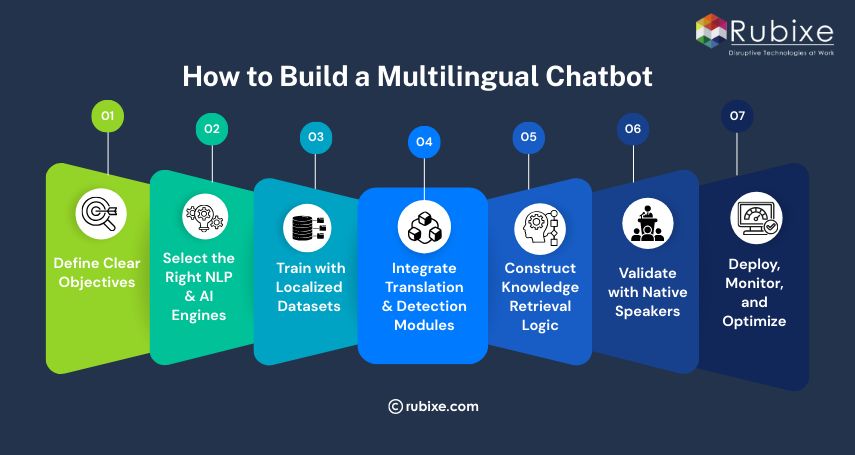
Building a multilingual AI chatbot requires strategic planning and execution. Below is a step-by-step framework that aligns with best practices.
1. Define Clear Objectives
Before building, articulate why the chatbot is needed:
-
Support and service automation
-
Sales and lead qualification
-
Multilingual customer engagement
-
Internal workflows (e.g., HR, onboarding)
Clear goals drive architecture, language selection, and performance benchmarks.
2. Select the Right NLP & AI Engines
Choose a language model and Natural Language Processing (NLP) framework that supports multilingual capabilities, context retention, and dialect understanding. Strong NLP foundations are what differentiate basic rule-based systems from intelligent NLP chatbots capable of understanding intent across languages.
Transformer-based models and advanced semantic embeddings help maintain conversational flow without depending solely on literal translation. Instead of converting words one by one, these systems interpret meaning, allowing NLP chatbots to respond accurately even when phrasing, structure, or regional expressions vary.
A well-selected NLP engine ensures the chatbot delivers consistent, context-aware responses across all supported languages.
3. Train with Localized Datasets
Successful interactions depend on training with context-rich, localized data. Generic translation is not enough; include regional dialects, cultural expressions, and industry-specific terminology to ensure accuracy and relevance.
4. Integrate Translation & Detection Modules
In languages with limited corpora, translation APIs and language detection tools help identify user input. Advanced systems combine real-time detection with pre-trained models to deliver fluent, context-appropriate responses.
5. Construct Knowledge Retrieval Logic
Structure your knowledge base so the bot can fetch relevant responses regardless of language. Semantic search mechanisms and vector databases help match user intent with correct answers even in complex queries.
6. Validate with Native Speakers
Automated testing is necessary but insufficient. Real users provide feedback on linguistic nuances and cultural appropriateness that models may miss. Iterative validation with native speakers ensures natural conversation quality.
7. Deploy, Monitor, and Optimize
After deployment, monitor key metrics such as:
-
User language distribution
-
Satisfaction scores
-
Intent accuracy
-
Task completion rates
Use feedback loops to refine responses and update datasets, maintaining high accuracy over time.
Challenges in Developing Multilingual Chatbots and How to Solve Them
Despite their benefits, building a multilingual AI chatbot has challenges:
Language Nuances and Cultural Context: Languages carry idioms, slang, and cultural subtleties. A chatbot must adapt beyond literal translation to contextually appropriate responses. Regularly updating language data and using localized datasets mitigates this.
Translation Accuracy and NLP Limitations: Machine translation alone may misinterpret intent. Combining translation with trained NLP models and domain-specific data improves accuracy and trust.
Training Data Availability: Languages with limited digital datasets pose model training challenges. Augmenting with parallel corpora and crowdsourced data helps improve performance.
Integration Complexity: Seamless integration with CRM, help desks, and backend platforms ensures unified customer experiences. Using middleware and APIs simplifies this integration.
Legal and Privacy Considerations: Multilingual chatbots must comply with data protection regulations such as GDPR. Ensuring secure data handling builds trust and avoids legal issues.
Future Trends in Multilingual AI Chatbots
The future of multilingual conversational AI includes:
Voice-Enabled Multilingual Interaction: Advancements in speech recognition will allow users to speak naturally in their languages and dialects.
Hyper-Personalized Multilingual Experiences: Chatbots will use contextual user data to craft highly personalized messages in the preferred language, boosting engagement.
LLM-Driven Cultural Understanding: Next-generation LLMs will improve contextual understanding of cultural norms, reducing miscommunication.
Global AI Initiatives: Efforts like Microsoft’s Project Gecko aim to expand multilingual AI inclusivity by developing systems that reflect diverse linguistic and cultural contexts.
Conclusion
Language influences trust, clarity, and buying decisions. When customers can interact with a brand in their preferred language, conversations become smoother, decisions become faster, and confidence increases.
A well-built multilingual AI chatbot supports this at scale. With strong NLP capabilities, localized training data, structured knowledge retrieval, and continuous performance monitoring, businesses can deliver consistent conversations across regions without expanding operational complexity.
The impact goes beyond support automation. Multilingual chatbots strengthen customer relationships, improve conversion rates, and support global expansion with measurable efficiency. Organizations that invest in structured implementation and long-term optimization position themselves to serve wider audiences with precision and reliability.
Clear communication drives growth. Multilingual AI makes that communication scalable.
Summary
A multilingual AI chatbot enables businesses to support users across languages using advanced NLP and contextual understanding. These systems enhance customer satisfaction, reduce operational costs, and accelerate global reach. Strategic planning and continuous refinement are essential to building accurate, culturally aware conversational AI.
Frequently Asked Questions
What is a multilingual AI chatbot?
A chatbot that understands, detects, and responds in multiple languages using advanced AI models.
Why use a multilingual chatbot for business?
They improve engagement with global customers, reduce support costs, and enhance satisfaction by communicating in preferred languages.
What technologies are used to build them?
Multilingual NLP engines, translation APIs, large language models, and semantic embeddings.
How do chatbots detect user language?
They use language detection based on input text, browser settings, or location data to determine the correct response language.
What is the biggest challenge in building them?
Handling cultural nuances and translation accuracy across languages while maintaining context and brand tone.