

















Digital transformation in banking and financial services
Explore how digital transformation in banking and finance modernizes services, boosts efficiency, and leverages AI to enhance customer experience and decision-making.

Fintech startups are launching innovative services faster than traditional banks can adapt.
Mobile-first platforms, instant approvals, and AI-driven financial tools have changed how customers expect to interact with financial institutions. Without a clear modernization strategy, established banks risk losing relevance in a rapidly evolving market.
This competitive pressure has pushed Digital transformation in Banking and finance to the top of strategic priorities for financial institutions. Real progress happens when banks rethink how systems, data, and teams work together to deliver faster, more reliable financial services.
Core Areas of Digital Transformation in Banking
Financial institutions are transforming multiple layers of their operations to remain competitive. From improving customer engagement to strengthening security frameworks, Digital transformation in Banking focuses on several operational areas that directly influence efficiency, decision-making, and service delivery.
Customer Experience Transformation
Customer expectations have shifted toward faster and more convenient financial interactions. Many services that once required a branch visit are now expected to be completed instantly through digital channels. Through Digital transformation in finance, banks are redesigning customer journeys to provide seamless and responsive financial services.
Key elements shaping this transformation include:
-
Mobile banking platforms that enable seamless digital transactions
-
AI-driven support assistants that handle customer queries instantly
-
Real-time financial alerts that keep customers informed about transactions
-
Digital onboarding processes that simplify account creation
-
Personalized financial services based on customer behavior insights
Operational Efficiency and Process Automation
Banking operations traditionally involve complex internal workflows, especially for activities such as loan approvals, compliance checks, and documentation management. Digital systems help simplify these processes by introducing automation and improving operational consistency across departments.
When combined with advanced analytics and AI in Digital Transformation, automation allows financial institutions to improve efficiency while maintaining strong regulatory compliance.
Operational improvements include:
-
Automated document verification for faster loan processing
-
Transaction monitoring systems that detect anomalies quickly
-
Automated compliance workflows that reduce manual review time
-
Digital approval systems that accelerate internal decision-making
-
Process automation tools that improve operational efficiency
Data-Driven Decision Making
Financial institutions generate large volumes of transactional and behavioral data daily. However, the real value of this data emerges when it is structured and analyzed effectively. Digital transformation in Banking helps organizations unify fragmented data systems and build centralized data environments.
This capability strengthens Digital transformation in finance by enabling smarter lending decisions, improved risk analysis, and better financial planning.
Capabilities supporting data-driven banking include:
-
Centralized data platforms that unify financial information
-
Customer behavior analytics that support personalized services
-
Risk analysis models that improve lending decisions
-
Real-time reporting dashboards for financial insights
-
Predictive analytics tools for market forecasting
Security and Fraud Detection
Cybersecurity risks continue to increase across the financial sector. Protecting sensitive financial data and transaction systems is a top priority for banks implementing modern digital strategies.
Advanced monitoring systems powered by AI in Digital Transformation help institutions detect suspicious activity quickly and respond to potential threats before they escalate.
Security capabilities introduced through transformation include:
-
Real-time transaction monitoring systems
-
Machine learning models for fraud detection
-
Behavioral analytics that identify suspicious activity
-
Automated security alerts for rapid threat response
-
Data protection frameworks that safeguard financial information
New Business Models and Innovation
Technological advancements have created opportunities for banks to explore new financial services and revenue models. Fintech companies have shown how digital platforms can rapidly reshape financial products and services.
Through strategic collaboration and Digital transformation consulting, financial institutions can identify innovation opportunities and introduce new digital offerings.
Examples of innovation include:
-
Open banking ecosystems that enable secure data sharing
-
Digital lending platforms that speed up credit approvals
-
Embedded financial services integrated into digital applications
-
Fintech partnerships that expand banking capabilities
-
Data-driven financial products that create new revenue streams
Key Technologies Driving Digital Transformation
A few core technologies are shaping Digital transformation in Banking and accelerating Digital transformation in finance strategies.
-
Artificial intelligence and machine learning for business insights
-
Cloud computing for scalable digital infrastructure
-
Blockchain for secure and transparent transaction verification
-
Advanced analytics platforms for data intelligence
-
Robotic process automation for workflow efficiency
-
API-based systems that enable fintech integration
Together, these technologies create the technical backbone required for modern financial services.
Challenges Banks Face During Transformation
Despite the advantages, financial institutions often encounter practical challenges when implementing transformation programs.
Legacy Infrastructure
Many banks still rely on systems developed decades ago. Integrating modern technology with these platforms requires careful planning and gradual modernization.
Cultural Resistance
Employees who have worked with traditional processes for years may initially hesitate to adopt new digital workflows. Training programs and structured change management play an important role in overcoming this barrier.
Regulatory Compliance
Financial services operate within strict regulatory environments. Digital platforms must maintain transparency, traceability, and compliance with industry regulations.
Talent and Skill Gaps
Implementing Digital transformation in finance requires expertise in areas such as data science, cybersecurity, and digital product development.
Working with an experienced AI Consulting company can help organizations access specialized knowledge while accelerating transformation efforts.
Role of Artificial Intelligence in Financial Transformation
Artificial intelligence is becoming a central component of modern banking innovation.
AI technologies allow financial institutions to analyze large datasets quickly, predict customer needs, and automate complex decision processes.
Banks are using AI to:
-
Detect fraudulent transactions in real time
-
automate customer service interactions
-
improve credit risk assessment
-
analyze market and behavioral data
Solutions developed for AI for Fintech applications strengthen Digital transformation in Banking by enabling faster and more accurate decision-making.
Why AI Adoption Matters in Financial Services
Artificial intelligence is becoming increasingly important for institutions aiming to compete in a digital-first financial landscape.
Several factors explain why AI Adoption matters in banking and finance.
-
Faster Decision Cycles: AI systems can analyze large data sets in seconds, helping banks approve loans, detect fraud, and process transactions more efficiently.
-
Personalized Financial Services: Predictive models help financial institutions recommend products tailored to individual customer needs.
-
Operational Scalability: Automation allows banks to handle growing transaction volumes without significantly increasing operational costs.
-
Risk Reduction: AI-powered monitoring systems identify suspicious patterns faster than traditional rule-based systems.
Organizations exploring AI Consulting in Digital transformation often focus on these capabilities to strengthen their digital infrastructure.
Steps to Implement Digital Transformation in Banking
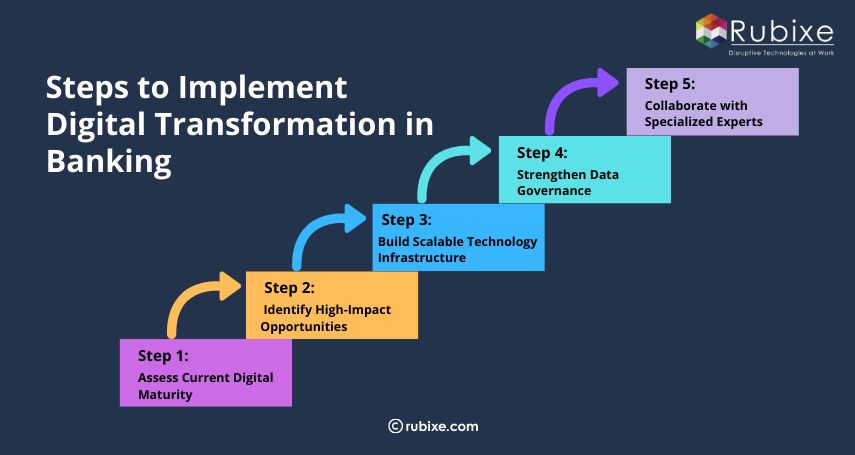
Step 1: Assess Current Digital Maturity
Banks should begin by evaluating their existing technology infrastructure, operational workflows, and data management systems.
Step 2: Identify High-Impact Opportunities
Transformation initiatives should prioritize areas that generate measurable business impact, such as loan processing efficiency or fraud detection improvements.
Step 3: Build Scalable Technology Infrastructure
Cloud platforms and modern API-based architectures create the flexibility needed for digital financial services.
Step 4: Strengthen Data Governance
Reliable data management ensures accurate analytics and regulatory compliance.
Step 5: Collaborate with Specialized Experts
Engaging professionals experienced in AI Consulting for Digital transformation helps banks manage complex implementation projects effectively.
Benefits of Digital Transformation for Financial Institutions
-
Improved customer engagement through digital platforms
-
Faster service delivery and transaction processing
-
Reduced operational costs through automation
-
Enhanced fraud detection and cybersecurity capabilities
-
Data-driven decision-making across departments
-
Stronger regulatory compliance frameworks
-
Greater flexibility to launch new financial products
Institutions that advance Digital transformation in Banking gain the ability to respond faster to changing market conditions while delivering better customer experiences.
Future Outlook for Digital Banking
Financial institutions continue to invest in new digital capabilities as technology evolves.
Key developments shaping Digital transformation in Banking include:
-
AI-powered financial advisors
-
real-time credit decision systems
-
embedded finance within everyday digital platforms
-
advanced fraud prevention technologies
-
predictive financial planning tools
These innovations will further strengthen Digital transformation in finance, enabling banks to deliver faster, more personalized financial services. Institutions that build intelligent digital ecosystems today will be better positioned to compete with fintech innovators and meet evolving customer expectations.
Financial services are evolving quickly, and staying competitive requires more than incremental upgrades. Organizations investing in Digital transformation in Banking should focus on scalable technology, data intelligence, and innovation.
A well-planned approach to Digital transformation in finance can unlock new growth opportunities while strengthening operational resilience.