








AI in Threat Intelligence: Use Cases and Benefits
AI in threat intelligence covers use cases and benefits for detecting risks, analyzing data, improving response time, and strengthening cybersecurity plans.
Cyber threats have become faster, stealthier, and more coordinated than ever before. Modern attackers leverage automation, artificial intelligence, and global infrastructure to execute campaigns that can compromise organizations within hours. From ransomware groups targeting critical systems to sophisticated phishing networks harvesting credentials at scale, the threat environment continues to intensify across every industry.
Traditional security tools struggle to keep pace because they rely heavily on predefined rules and manual analysis. Today’s security operations generate massive volumes of data from networks, endpoints, cloud platforms, and applications - far beyond human capacity to interpret in real time.
This is where artificial intelligence transforms threat intelligence. By processing vast datasets, identifying hidden patterns, and predicting malicious activity, AI enables organizations to move from reactive defense to proactive protection. A robust AI cybersecurity service empowers businesses to detect threats earlier, prioritize risks accurately, and respond before incidents escalate into major breaches.
What Is AI in Threat Intelligence?
Threat intelligence refers to the systematic collection and analysis of information about potential or existing cyber threats. When powered by artificial intelligence, this process becomes continuous, adaptive, and predictive.
AI systems combine machine learning, behavioral analytics, and natural language processing to analyze diverse data sources, including:
-
Network logs and traffic patterns
-
Endpoint activity
-
User behavior
-
Malware indicators
-
Vulnerability disclosures
-
External intelligence feeds
Unlike conventional systems that depend on known attack signatures, AI models learn from evolving data - making it easier to spot unusual behavior through AI anomaly threat detection, even when dealing with unknown threats, subtle anomalies, and complex attack chains.
An enterprise-grade AI cybersecurity service integrates these capabilities into existing infrastructure, providing organizations with actionable insights rather than raw alerts.
How Threat Intelligence Is Powered by AI
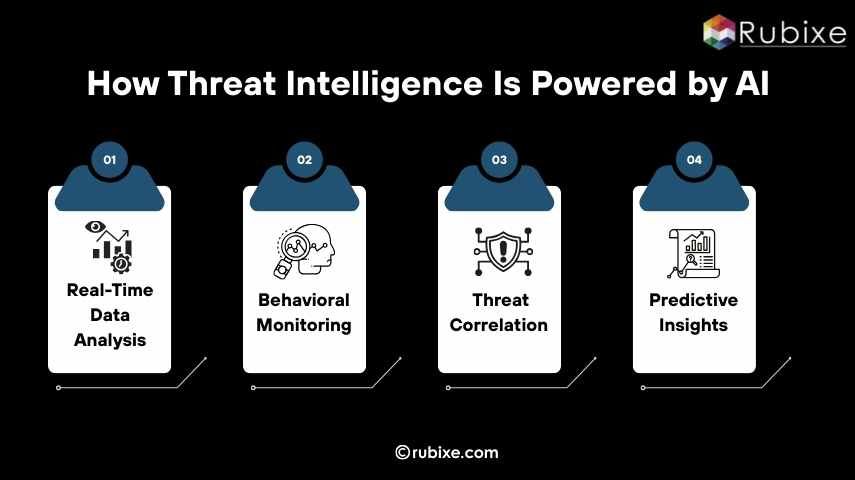
Artificial intelligence enhances every stage of the threat intelligence lifecycle.
1. Real-Time Data Analysis
AI processes enormous volumes of security data continuously, identifying suspicious patterns within seconds. This real-time capability reduces attacker dwell time and limits potential damage.
2. Behavioral Monitoring
Instead of focusing solely on known threats, AI establishes baselines for normal activity across users, devices, and systems. Deviations from these patterns often indicate compromise or misuse.
3. Threat Correlation
AI connects seemingly unrelated signals across different environments to reveal coordinated attacks. For example, unusual login activity combined with abnormal data transfers may indicate account takeover followed by exfiltration.
4. Predictive Insights
By analyzing historical incidents and emerging indicators, AI models estimate future risks and highlight vulnerable areas that require attention.
Organizations leveraging a comprehensive AI cybersecurity services gain continuous visibility and intelligent prioritization, enabling security teams to focus on the most critical threats.
How to Protect Your Business from Threats Using AI
Implementing AI-driven security requires more than deploying standalone tools. A structured approach ensures maximum effectiveness.
1. Integrate Across Security Layers
AI solutions should connect with firewalls, identity systems, endpoint protection, and cloud controls to provide unified visibility.
2. Enable Continuous Monitoring
Round-the-clock surveillance ensures threats are detected regardless of time zone or business hours.
3. Automate Response Mechanisms
AI can isolate infected devices, block malicious connections, or suspend compromised accounts instantly, strengthening AI-driven threat detection in cybersecurity by ensuring threats are not just identified but contained before they escalate.
4. Maintain Human Oversight
Security professionals interpret AI findings, validate decisions, and refine strategies based on organizational priorities.
5. Consider Managed Security Services
Partnering with a specialized AI cybersecurity service provider offers advanced capabilities without the complexity of building in-house systems.
Use Cases of AI in Threat Intelligence
There are numerous use cases of AI in threat intelligence, spanning the entire lifecycle from data acquisition to actionable reporting. AI enables organizations to convert raw security data into contextual insights that support faster, more effective defense.
Specifically, this includes:
1. Aggregating threat data - Collecting intelligence from open sources, security databases, vulnerability disclosures, deep and dark web forums, and commercial feeds to provide a comprehensive view of emerging risks.
2. Natural Language Processing (NLP) - Extracting relevant insights from unstructured text such as threat reports, hacker communications, and advisories, enabling automated understanding of attacker activities.
3. Pattern recognition and anomaly detection - Identifying hidden relationships and unusual behaviors across large datasets, helping analysts detect coordinated campaigns and emerging attack techniques.
4. Discovering Indicators of Compromise (IOCs) - Automatically identifying malicious IP addresses, domains, file hashes, and infrastructure associated with attacks, accelerating threat hunting efforts.
5. Tactics, Techniques, and Procedures (TTPs) analysis - Examining historical attack behaviors to understand how threat actors operate and anticipate future actions.
6. Dark web monitoring - Scanning underground marketplaces and forums for stolen credentials, leaked data, or discussions targeting specific organizations.
7. User and entity behavior analytics - Detecting insider threats or compromised accounts by identifying deviations from normal activity patterns.
8. Contextual threat analysis - Evaluating risks based on industry, geography, technology stack, and business priorities to determine real-world impact.
9. Threat classification and prioritization - Automatically categorizing incidents by severity and relevance to ensure critical issues receive immediate attention.
10. Threat intelligence reporting - Generating structured reports and dashboards that translate technical findings into actionable insights for both security teams and leadership.
AI also plays a critical role in threat detection.
Benefits of AI in Threat Intelligence
Deploying advanced AI cybersecurity services provides measurable advantages that strengthen both security operations and business resilience.
Key benefits include:
1. Accelerated detection and response - Real-time analysis significantly reduces the time between intrusion and containment, limiting damage and recovery costs.
2. Improved accuracy and reduced false alerts - AI filters out benign anomalies, allowing analysts to focus on genuine threats.
3. Predictive security capabilities - Identifying patterns associated with emerging attacks enables preventive measures before exploitation occurs.
4. Scalability across complex environments - AI can monitor large infrastructures, cloud platforms, and distributed networks without proportional increases in staffing.
5. Protection against unknown threats - Behavioral analysis detects malicious activity even when signatures are unavailable.
6. Operational efficiency and cost savings - Automation reduces manual workloads, freeing teams for strategic initiatives.
7. Risk-based vulnerability management - Prioritizing weaknesses based on exploit likelihood and business impact ensures efficient resource allocation.
8. Continuous learning and adaptation - AI systems improve over time as they process new data, strengthening defenses against evolving tactics.
9. Enhanced decision-making - Contextual insights help leadership understand the potential business impact of threats.
10. Support for regulatory compliance - Comprehensive monitoring and reporting assist organizations in meeting legal and industry requirements.
Advantages and Risks of AI in Threat Intelligence
Advantages
-
Continuous monitoring without fatigue
-
Ability to detect sophisticated and stealthy attacks
-
Faster incident handling
-
Reduced human error
-
Improved visibility across environments
Risks and Challenges
-
Dependence on high-quality training data
-
Potential adversarial manipulation of AI models
-
Need for skilled oversight
-
Privacy and governance considerations
-
Integration complexity in legacy systems
Balancing automation with human expertise is essential for effective implementation.
Future of AI in Threat Intelligence
AI will become the central engine of modern threat intelligence programs, enabling organizations to move from periodic assessments to continuous, adaptive defense. Future systems will deliver deeper integration across networks, endpoints, cloud environments, and identity platforms, providing unified visibility into complex attack surfaces. As attackers increasingly use automation and AI themselves, defensive systems will evolve to detect subtle multi-stage intrusions, supply chain compromises, and coordinated campaigns in real time.
Advances in behavioral analytics and contextual risk modeling will improve prioritization, helping security teams focus on threats that pose the greatest business impact rather than simply the highest technical severity. Automated response capabilities will also mature, allowing organizations to contain incidents within seconds while minimizing operational disruption.
At the same time, human expertise will remain essential for strategic decision-making, incident validation, and governance. The future of threat intelligence involves complex, real-world scenarios where judgment, experience, and accountability matter, making the future a collaboration in which AI augments without replacing the skilled security specialists.
Strengthen Your Security with Intelligent Threat Protection
If your organization faces increasing cyber risks or struggles to manage complex security operations, adopting AI-based intelligence can deliver immediate and long-term benefits. Partnering with an experienced AI development company ensures effective implementation, continuous monitoring, and AI-powered cybersecurity protection tailored to your needs.
AI-powered threat intelligence enables organizations to detect, analyze, and respond to cyber threats faster and more accurately by processing vast security data in real time. It shifts security from reactive incident response to proactive, predictive protection across complex digital environments. By automating analysis, prioritizing risks, and identifying unknown attacks, AI improves operational efficiency while reducing false alerts and response times. When combined with human expertise and strategic oversight, AI delivers resilient, scalable defense against increasingly sophisticated cyber threats.