








AI Adoption: Steps for Successful Implementation
Understand AI adoption steps, from planning and data readiness to integration and monitoring, helping businesses implement AI with clear goals and outcomes.
Is your organization investing in AI but still struggling to see real business results?
Many companies are adopting AI, yet a large percentage fail to move beyond early-stage implementation due to a lack of structure and clarity. The difference lies in following the right AI adoption steps, a clear path that turns AI from an idea into real business value.
What is AI Adoption?
AI adoption refers to the process of integrating artificial intelligence into business operations to improve efficiency, decision-making, and growth outcomes.
It is not just about implementing tools. It involves:
-
Aligning AI with business goals
-
Preparing data and systems
-
Training teams
-
Scaling solutions across the organization
Understanding AI adoption is only the starting point. The real shift is happening in how aggressively businesses are investing in it, and how quickly they are expected to deliver results.
Why Most AI Adoption Fails (Before It Even Starts)
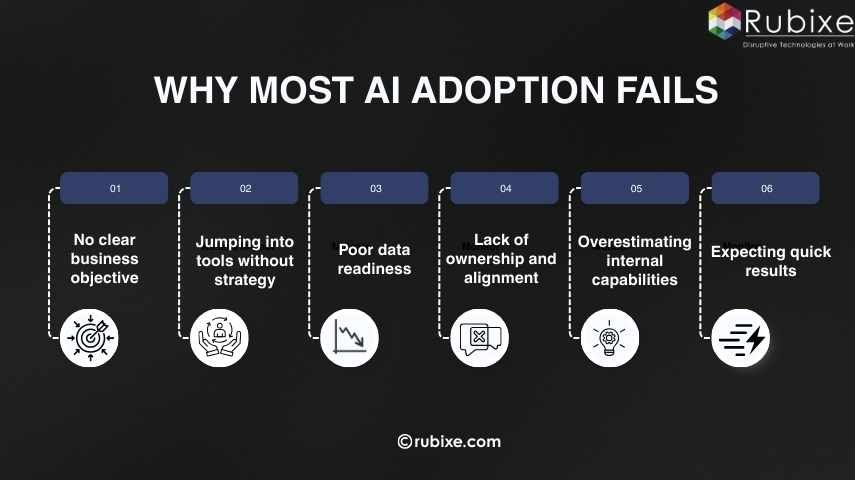
Many AI initiatives fail long before implementation begins. The issue is rarely the technology; it’s the lack of clarity, structure, and readiness at the foundation level.
1. No clear business objective: AI is started without defining what success looks like, leading to confusion and no measurable outcomes
2. Jumping into tools without strategy: Businesses often invest in AI tools too early, companies need to invest in the right AI tools that align with their business goals, use cases, and long-term roadmap.
3. Poor data readiness: Incomplete, unstructured, or inconsistent data makes AI models ineffective from the start
4. Lack of ownership and alignment: No clear accountability across teams slows down decision-making and execution
5. Overestimating internal capabilities: Teams assume they can manage AI implementation without the required expertise
6. Expecting quick results: AI is treated as a short-term solution instead of a structured, long-term investment
10 Proven AI Adoption Steps for Successful Implementation
These AI adoption steps reflect how organizations move from initial interest to fully integrated AI systems that deliver consistent business value. Each step matters, skipping or rushing even one can delay results or lead to failed implementation.
1. Define Business Objectives with Measurable KPIs
Most AI initiatives fail at the starting point, not because of technology, but because the objective is unclear. When goals are vague, teams cannot measure success, and projects lose direction midway.
Avoid broad goals, define specific objectives using measurable metrics. For example:
-
Reduce customer support response time from 10 mins → 3 mins
-
Increase lead conversion rate by 15%
-
Cut operational cost by 20% in a specific process
Output: Clearly defined KPIs directly tied to business outcomes
2. Identify and Prioritize Use Cases
Many businesses try to implement AI across multiple areas at once, which leads to scattered efforts and weak results.
Not every use case delivers equal value.
Use an impact vs feasibility approach:
-
High impact + high feasibility → prioritize first
-
High impact + low feasibility → plan later
Focus on:
-
Repetitive workflows
-
Data-heavy processes
-
Customer interaction points
Output: A prioritized list of AI use cases with clear business value
3. Perform Data Readiness Assessment
This is where many AI projects quietly break.
Organizations assume they have enough data until they find missing fields, inconsistencies, or unstructured formats during model development.
Evaluate:
-
Data availability across systems (CRM, ERP, logs)
-
Data accuracy and completeness
-
Need for data cleaning or labelling
Without reliable data, even the best models fail.
Output: Data readiness report with identified gaps and risks
4. Build a Structured AI Adoption Strategy
Without a structured AI adoption strategy, AI initiatives become isolated experiments instead of scalable solutions.
This step defines how AI connects to long-term business goals.
Include:
-
Use case roadmap (phased execution)
-
Budget and expected ROI
-
Technology approach
-
Risk and dependency mapping
Output: A clear AI roadmap that aligns execution with business priorities
5. Choose the Right Approach: Build vs Buy vs Hybrid
This is a critical decision point, and a common failure area.
Many organizations either:
-
Over-invest in complex custom builds
-
Or rely entirely on off-the-shelf AI products that don’t fit their needs
Choose based on:
-
Complexity of the problem
-
Customization required
-
Available internal expertise
For advanced use cases, working with an experienced AI development company ensures scalability and control.
Output: Defined architecture approach (build, buy, or hybrid)
6. Set Up Data Pipelines and Infrastructure
AI cannot function without a reliable data pipeline.
This step is often underestimated, leading to delays during deployment.
Build:
-
Data ingestion systems (APIs, databases)
-
Data transformation workflows
-
Secure storage (data warehouses or lakes)
Use scalable cloud platforms when needed.
Output: Production-ready data infrastructure supporting AI models
7. Develop and Validate AI Models
Model development is where technical execution begins - but errors here can impact long-term performance.
Process:
-
Select the right model type (ML, NLP, etc.)
-
Train using historical data
-
Validate using test datasets
Track:
-
Accuracy
-
Precision and recall
-
Business relevance of predictions
A model that performs well technically but fails in a business context will not deliver value.
Output: Validated AI model aligned with business use case
8. Deploy AI into Business Workflows
Many AI projects fail after development because they are not integrated properly.
A model sitting in isolation does not create impact.
Deployment includes:
-
API integration with existing systems
-
Embedding AI into workflows (CRM, apps, dashboards)
-
Real-time or batch processing setup
Output: AI actively functioning within business operations
9. Monitor Performance and Optimize Continuously
AI is not a one-time implementation.
Over time, models lose accuracy due to changing data patterns.
Track:
-
Model performance metrics
-
Business KPIs
-
User adoption rates
Create feedback loops to refine performance.
Output: Continuous improvement system for long-term reliability
10. Scale AI Across the Organization
This is where most organizations struggle.
According to Gartner, a large percentage of AI projects fail at the scaling stage due to lack of planning and integration.
To scale successfully:
-
Standardize processes
-
Ensure cross-team adoption
-
Align with compliance and governance
Scaling transforms AI from a pilot project into a core business capability.
Output: Enterprise-wide AI adoption with consistent impact
Benefits of AI Adoption
When implemented correctly, AI creates measurable business value.
Key AI Adoption Benefits
-
Improved operational efficiency
-
Faster decision-making
-
Reduced manual effort
-
Better customer experience
-
Increased revenue opportunities
Challenges in AI Adoption
Despite the benefits, businesses face several challenges.
-
Lack of a clear strategy
-
Poor data quality
-
Skill gaps within teams
-
Integration difficulties
-
Resistance to change
These challenges often delay or limit the success of AI adoption.
How to Overcome AI Adoption Challenges
Overcoming challenges requires a structured and supported approach.
-
Start with Clear Goals: Define measurable outcomes before implementation.
-
Invest in Data Quality: Clean, structured data improves AI performance.
-
Upskill Teams: Train employees to work with AI tools.
-
Use External Expertise: Engaging the right ai adoption services helps avoid common mistakes.
-
Focus on Gradual Implementation: Avoid large-scale deployments without validation.
Professional guidance ensures smoother execution and long-term success.
Choose the Best AI Adoption Service Provider
Selecting the right AI adoption service provider plays a major role in successful implementation.
What to Look For
-
Strong business understanding
-
Proven experience in AI implementation
-
Clear methodology and roadmap
-
Ability to support end-to-end execution
-
Transparent communication
A reliable partner helps connect strategy with execution, ensuring your AI adoption steps deliver real outcomes.
AI adoption delivers results when it is approached with clarity, structure, and the right execution plan. Following the right AI adoption steps helps businesses move from experimentation to real impact. With the right strategy, data readiness, and expert support, AI becomes a powerful driver of efficiency, growth, and long-term success.