















AI Implementation: Steps for a Successful Business
A complete AI implementation framework for business success. Learn key steps, benefits, challenges, governance, and ROI measurement for sustainable growth.

AI implementation in business determines whether artificial intelligence becomes a competitive advantage or an expensive experiment. Many organizations invest in AI tools, yet struggle to translate them into measurable results.
The difference lies in execution. Successful AI implementation requires strategic alignment, strong data governance, workflow automation, risk management, and disciplined ROI measurement. When AI is embedded into core operations and supported by clear accountability, organizations improve decision-making, increase efficiency, manage regulatory risk, and unlock sustainable growth.
A structured AI implementation framework turns innovation into operational impact and impact into long-term business value.
What Is AI Implementation in Business?
AI implementation is the structured process of integrating artificial intelligence technologies into business operations to improve decision-making, automate workflows, and create measurable performance improvements.
Why AI Implementation Fails in Many Organizations
Before exploring the steps, it’s important to understand common failure causes:
-
No clear business case
-
Poor data quality
-
Lack of executive ownership
-
Weak change management
-
No lifecycle monitoring
-
Governance is treated as an afterthought
AI Implementation Steps: A Complete Framework for Business Success
1. Begin with Strategic Clarity and Organizational Alignment
AI success begins by clearly understanding how artificial intelligence can help your business. As recent research shows, businesses with a defined AI strategy and executive commitment outperform reactive or ad-hoc experimentation.
Before any technical work:
-
Clarify business outcomes - revenue growth, cost savings, customer experience enhancements, or operational efficiency.
-
Align objectives with measurable KPIs rather than technology buzzwords.
This establishes a foundation where AI is judged by business impact first, not technical novelty.
2. Evaluate Your Current Capabilities and Readiness
Every AI initiative depends upon realistic assessment of what currently exists: infrastructure, data ecosystems, human skills, and governance. Credible frameworks recommend early evaluation of data accessibility, tool compatibility, and team competencies.
This phase should reveal:
-
Gaps in data quality and availability
-
Skill shortages in analytics or machine learning
-
Infrastructure needs, such as cloud platforms or compute resources
Failing to conduct this assessment often leads to projects being derailed when they encounter unforeseen constraints.
3. Articulate Clear Use Cases with Value Rationalization
AI works best when applied where it can deliver measurable advantage. Rather than broad digital transformation rhetoric, successful adopters define specific, high-value applications such as fraud detection for finance, smart routing for logistics, or automated lead scoring for sales.
These decisions should be based on:
-
Expected ROI
-
Implementation effort
-
Competitive differentiation
This ensures focus on initiatives that are both achievable and aligned with strategic priorities.
4. Build a Strong Data Foundation
Data is the fuel of AI. Across industries, poor data quality is the most common barrier to meaningful implementation. Prioritize establishing robust data management protocols, including data governance frameworks, integration pipelines, and quality oversight.
This includes:
-
Data validation and cleansing
-
Data lineage and cataloging
-
Governance policies for access, privacy, and compliance
AI systems are only as effective as the data that trains them.
5. Choose the Right Tools, Platforms, and Partners Strategically
Technology selection should be based not on trends but on fit: Does the tool help solve the identified business problem? Should the organization build custom models with internal resources or engage external AI Implementation Services experts? Many businesses succeed when they combine in-house expertise with vendor support to accelerate adoption responsibly.
Considerations include:
-
Pre-built AI platforms vs. customized solutions
-
Long-term scalability
-
Vendor support and integration capabilities
This decision shapes not just implementation success but future flexibility.
6. Pilot with Purpose and Measure Early Wins
Rather than rolling out enterprise-wide solutions at once, start with focused pilot projects in controlled environments. These early initiatives should validate whether the chosen AI models produce the expected business value.
A well-run pilot accomplishes:
-
Real-world validation of model performance
-
Faster feedback loops and early course correction
-
Concrete evidence for executive stakeholders
Pilot success builds confidence for broader adoption and reduces risk.
7. Integrate AI into Existing Business Workflows
AI that exists in isolation, for example, a standalone dashboard, rarely delivers sustained impact. Effective implementation embeds intelligence and AI workflow automation into core operational systems such as ERP platforms, CRM systems, supply chain tools, or customer support channels.
Doing so ensures:
-
Consistent use across teams
-
Seamless workflows for employees
-
Direct alignment with business processes
-
Automated task execution powered by intelligent decision logic
Integration gives AI real business relevance beyond proof-of-concept dashboards by transforming insights into automated, action-oriented workflows.
8. Establish Governance, Risk Controls, and Ethical Frameworks
With increasing regulatory scrutiny and societal expectations, responsible AI governance is essential. This should encompass policies for fairness, transparency, privacy, and compliance. Industry frameworks recommend institutionalized checks to prevent unintended consequences such as bias or privacy violations.
Ethical and governance frameworks should include:
Clear Accountability
Assign responsibility for:
-
Model development
-
Ethical oversight
-
Data protection
-
Regulatory compliance
-
Performance monitoring
Model Lifecycle Management (MLOps)
Implement controls for:
-
Model documentation
-
Bias testing
-
Version control
-
Drift detection
-
Automated retraining triggers
AI systems degrade without active monitoring.
Regulatory Alignment
Align with global frameworks such as:
-
EU AI Act
-
General Data Protection Regulation
-
National Institute of Standards and Technology AI Risk Management Framework
These frameworks shape international AI governance standards.
9. Engage Human Expertise Throughout Implementation
Leading thinkers emphasize that workers should be “in the loop” for successful AI adoption, with clear communication about intent, impact, and collaboration between teams and technology.
This goes beyond technical teams, it includes:
-
Operations staff understanding AI decisions
-
Business units co-designing workflows with AI systems
-
Human oversight for edge cases and model interpretation
AI augments human capability; it does not replace it.
10. Monitor, Evaluate, and Iteratively Improve
AI implementation is not a one-time project but an ongoing evolution. Models must be evaluated regularly for accuracy, bias, and alignment with changing data patterns. Continuous performance monitoring using clearly defined KPIs, ensures sustained value over time.
A structured evaluation process should track:
-
Business outcomes tied to KPIs
-
Operational efficiency gains
-
Accuracy and reliability of AI outputs
This feedback loop sustains long-term performance.
11. Scale Responsibly Based on Evidence
Expand AI from pilots to broader organizational use only after proving value and ensuring infrastructure, governance, and adoption mechanisms are in place. Scaling too quickly without these guardrails leads to performance inconsistencies and user resistance.
Responsible scaling includes:
-
Readiness assessment for each new department
-
Training and support structures
-
Incremental expansion with periodic review
This reduces risk and maximizes benefit.
12. Emphasize Change Management and Cultural Adoption
AI adoption affects not just systems but people. Change management is essential for aligning organizational culture, addressing fears of displacement, and ensuring employees understand benefits and new workflows.
This involves:
-
Transparent communication
-
Reskilling and support programs
-
Leadership role modeling
A culture that embraces data-driven decisions will extract more value from AI investments.
13. Maintain Security and Compliance Vigilance
AI systems process sensitive business data, requiring ongoing oversight for data security, access control, and legal compliance. Strong cybersecurity mitigates risks associated with malicious actors or inadvertent exposure.
Security planning should remain integrated with deployment cycles, not an afterthought.
14. Ensure Continuous Learning and Innovation
AI technology evolves rapidly. Organizations must invest in continuous learning, both in technical skills and business applications of AI. Staying current with developments ensures systems remain relevant and efficient over time.
This promotes resilience in the face of change.
15. Evaluate ROI and Reinvest for Long-Term Value
A disciplined focus on measurable outcomes ensures AI remains aligned with business goals. Regular ROI evaluation, tied to strategic KPIs, provides evidence for future investment or course correction.
AI ROI should be measured across four dimensions:
1. Direct Financial Impact
-
Revenue growth
-
Cost savings
-
Margin improvement
2. Productivity Gains
-
Time saved
-
Throughput increase
-
Process acceleration
3. Risk Mitigation
-
Fraud prevention
-
Forecast accuracy improvement
-
Compliance error reduction
4. Strategic Value
-
Customer lifetime value growth
-
Competitive differentiation
-
Faster innovation cycles
Include the total cost of ownership:
-
Infrastructure
-
Data engineering
-
Talent
-
Licensing
-
Monitoring and compliance
Regular ROI evaluation ensures sustainable investment decisions.
What Are the Benefits of AI Adoption in Business
Implementing AI brings measurable advantages across operations and competitive strategy:
-
Enhanced operational efficiency through automation of routine tasks
-
AI improves decision-making powered by predictive analytics
-
Greater customer personalization with intelligent agent interactions
-
Productivity gains without proportional increases in staffing
-
Innovative new services enabled by AI-driven insights
These benefits extend across industry sectors when AI is applied thoughtfully alongside human expertise.
Key Challenges of AI Implementation in Business
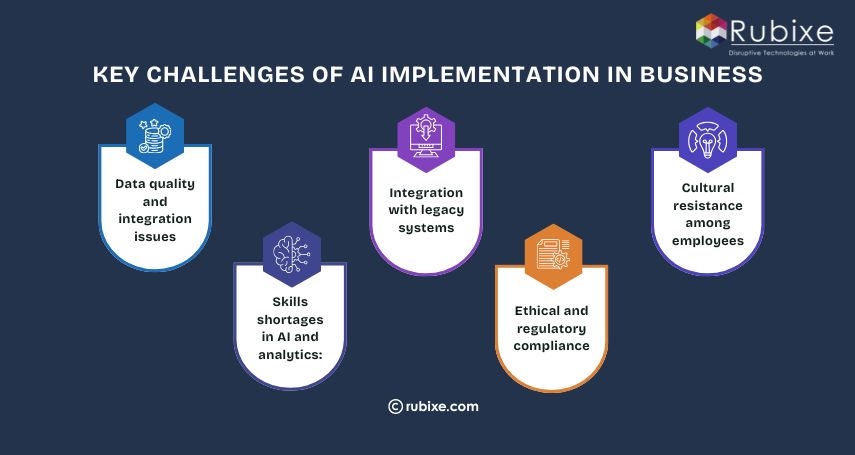
Despite its promise, implementing AI enters complex terrain:
-
Data quality and integration issues: Inconsistent, incomplete, or siloed data limit model accuracy and prevent reliable AI-driven insights.
-
Skills shortages in AI and analytics: A lack of experienced data engineers, machine learning specialists, and AI strategists slows implementation and increases dependency on external vendors.
-
Integration with legacy systems: Older infrastructure often lacks compatibility with modern AI platforms, making seamless deployment complex and costly.
-
Ethical and regulatory compliance: AI systems must meet evolving legal standards and fairness requirements, requiring structured governance and continuous oversight.
-
Cultural resistance among employees: Fear of job displacement or distrust in automated decisions can reduce adoption and undermine AI’s operational impact.
Understanding these challenges helps organizations prepare realistic resource plans.
Mistakes to Avoid in AI Implementation
Avoiding common pitfalls increases the likelihood of success:
-
Initiating technology without a clear business case
-
Skipping data readiness work
-
Treating AI governance as an afterthought
-
Ignoring human adoption barriers
-
Focusing on experimentation without measurable outcomes
Learning from these mistakes preserves investments and accelerates value realization.
Tips for Ethical AI Implementation
Responsible AI strengthens credibility and reduces risk:
-
Standardize bias evaluation procedures
-
Ensure transparency of model decisions
-
Establish governance for accountability
-
Embed privacy protections in all solutions
-
Align with local and global regulatory standards
Ethical AI implementation is both risk mitigation and brand differentiation.
Conclusion
AI implementation succeeds when it is strategic, data-grounded, human-aware, and business-aligned. Enterprises that follow a structured path, from identifying purpose and readiness to scaling responsibly and evaluating outcomes, are most likely to realize measurable value. Selecting experienced AI implementation partners further accelerates deployment and allows teams to focus on core business impact.
Short Summary
AI implementation transforms business when anchored in clear objectives, strong data foundations, and sustainable governance. A structured strategy that includes measurement, human engagement, and iterative improvement drives long-term value. Partnering with experienced service providers ensures efficient deployment and measurable outcomes.
Frequently Asked Questions
1. What are the key AI implementation steps for businesses?
Define business goals, assess data for AI readiness, select use cases, pilot solutions, integrate into workflows, monitor performance, and scale responsibly.
2. How long does AI implementation take?
It varies; small pilots can take a few months, while enterprise-wide implementation may span 9-18 months.
3. How do you choose between building in-house and outsourcing AI?
Assess internal expertise, resource availability, timeline, and strategic control needs; partners can accelerate deployment with best practices.
4. What skills are needed for successful AI implementation?
Data engineering, machine learning, business analysis, change management, and governance capability.
5. How is AI success measured?
Through KPIs tied to business outcomes such as cost reduction, revenue impact, process efficiency, and customer satisfaction.