







Chatbots vs Conversational AI - Key Differences & Use cases
Understand the difference between chatbots and conversational AI, their features, use cases, and how businesses use them to improve automation and customer support.
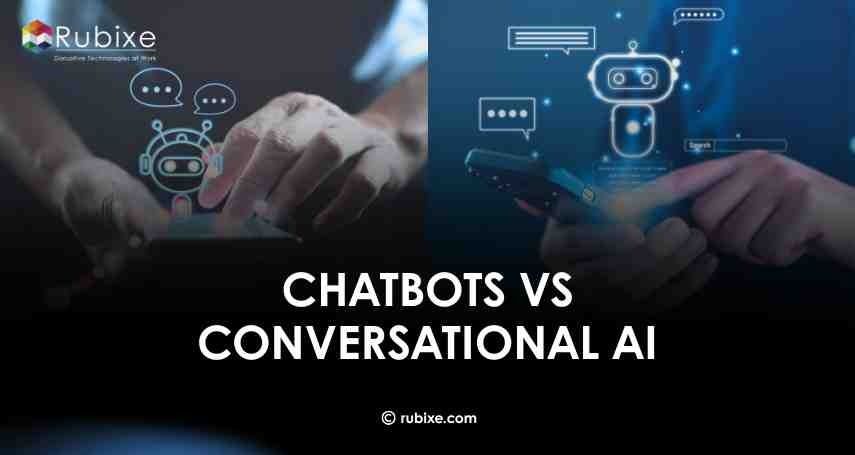
Customer expectations for instant responses and personalized digital interactions continue to rise. Businesses increasingly rely on automated technologies to meet these demands while managing large volumes of customer conversations. Chatbots and conversational AI enable organizations to automate communication, improve support efficiency, and scale engagement across digital channels.
Understanding how these technologies differ helps businesses choose the right approach for delivering intelligent and responsive customer experiences.
Key Takeaways
-
AI chatbots handle structured and repetitive conversations, making them useful for FAQs, customer support queries, and basic automation.
-
Conversational AI enables more advanced interactions using technologies such as natural language processing and machine learning to understand context and intent.
-
Businesses often combine both technologies to automate simple queries while using conversational AI for complex customer interactions and personalized engagement.
Key Differences Between Chatbots vs Conversational AI
Although both technologies automate conversations, their capabilities, intelligence level, and business applications differ significantly.
|
Features |
Chatbots |
Conversational AI |
|
Style of conversation |
Scripted responses |
Dynamic and contextual conversations |
|
Intelligence Level |
Rule-based or limited AI |
Advanced AI using NLP and machine learning |
|
Context Awareness |
Minimal understanding of context |
Understands conversation history and intent |
|
Learning Ability |
Limited improvement over time |
Continuously learns from interactions |
|
Business Applications |
FAQs, basic customer support |
Intelligent support, voice assistants, automation |
|
Integration Capability |
Limited system integrations |
Integrates with CRM, analytics, and enterprise tools |
|
Channels |
Often, website chat widgets |
Multi-channel, including voice assistants, apps, and messaging platforms |
In most organizations, chatbots act as the first layer of automation, while conversational AI handles deeper and more complex interactions.
Types of Chatbots Used in Business
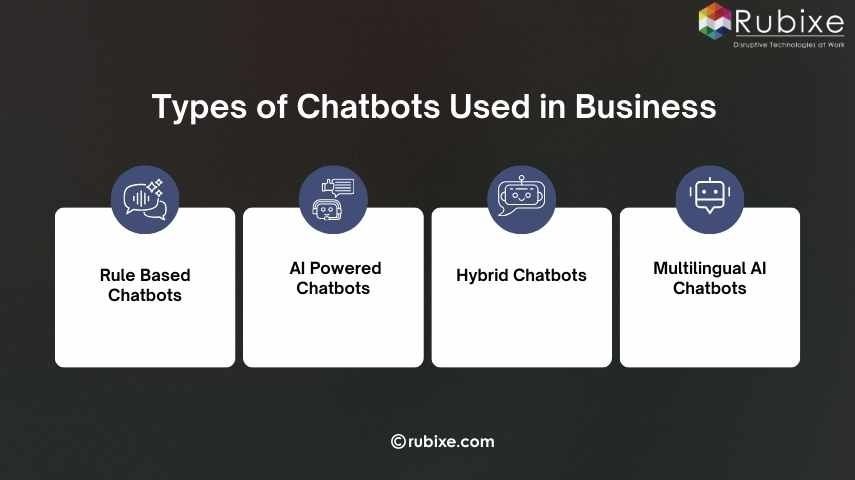
1. Rule-Based Chatbots
These bots follow predefined workflows and decision trees. Users select options or type queries that match specific keywords.
Common applications:
-
FAQ automation
-
Website customer support
-
Lead qualification
2. AI-Powered Chatbots
These chatbots use machine learning and natural language processing to interpret user intent.
Key features include:
-
intent recognition
-
contextual responses
-
personalized interactions
Recent research shows that AI-powered chatbots now account for nearly 89% of chatbot deployments, indicating a major shift toward intelligent automation.
3. Hybrid Chatbots
Hybrid models combine rule-based workflows with AI capabilities. Businesses often implement them for customer support, where predictable queries are automated while complex issues escalate to human agents.
4. Multilingual AI Chatbots
Multilingual AI chatbots are designed to communicate with users in multiple languages, allowing businesses to serve global audiences without language barriers. Businesses implement multilingual AI chatbots to support international customers across websites, mobile apps, and messaging platforms.
Common applications include:
-
global customer support
-
multilingual e-commerce assistance
-
International lead generation
-
cross-border service inquiries
Real-World Use Cases of Chatbots in Business
Chatbots are widely adopted because they automate repetitive interactions and improve response time across digital platforms.
1. Customer Support Automation
Businesses deploy automated AI chatbots to answer frequently asked questions, provide service information, and guide customers through common support issues.
Chatbots reduce response times and help support teams manage high volumes of inquiries more efficiently. Many businesses use AI Chatbots in customer service environments to handle routine interactions before escalating complex issues to human agents.
2. Lead Generation and Qualification
Marketing teams use AI chatbots for lead generation on websites to engage visitors and collect information. The chatbot can ask qualifying questions and direct high-intent prospects to sales teams.
3. E-commerce Assistance
Online retailers implement chatbots to help customers discover products, track orders, and receive shipping updates.
4. Appointment Scheduling
Service providers such as healthcare clinics, consultants, and service businesses use chatbots to automate appointment booking and reminders.
5. Internal Employee Support
Many organizations implement chatbots internally to answer HR questions, provide IT assistance, and help employees access company resources quickly.
Industry studies indicate that more than 60% of consumers prefer messaging a business for quick assistance rather than waiting for traditional support channels, highlighting the growing importance of automated conversational tools.
Limitations of Chatbots Businesses Should Consider
Despite their benefits, chatbots have certain limitations that organizations must evaluate before implementation.
Limited Context Understanding
Rule-based chatbots struggle to understand complex queries or ambiguous language. Conversations that fall outside predefined workflows may lead to incorrect responses.
Lack of Emotional Intelligence
Chatbots cannot fully interpret tone, sentiment, or emotional cues. Industries that require empathy-driven support may find this limitation challenging.
Integration Constraints
Some chatbot platforms operate as standalone tools with limited integration capabilities. Without access to backend systems, their ability to resolve issues becomes restricted.
User Experience Risks
If chatbot responses feel repetitive or inaccurate, customers may experience frustration and prefer human interaction.
For this reason, many organizations combine chatbot automation with advanced conversational AI platforms or human support teams.
What is Conversational AI?
Conversational AI refers to a broader set of artificial intelligence technologies that enable machines to understand, process, and respond to human language in a natural and contextual manner.
Unlike traditional chatbots, conversational AI systems interpret user intent and adapt responses dynamically based on conversation flow and historical interactions.
Conversational AI powers several advanced digital solutions, including virtual assistants, intelligent support agents, voice-based services, and AI-driven customer engagement platforms.
Real-World Use Cases of Conversational AI
Conversational AI enables more advanced automation compared with traditional chatbots.
Intelligent Customer Service
Conversational AI systems analyze customer queries, retrieve data from CRM platforms, and deliver personalized responses.
This approach allows businesses to resolve issues faster while maintaining a consistent support experience.
Voice Assistants and Voice Commerce
Voice-based conversational systems allow users to interact with digital services through speech. Businesses use them to enable voice-driven search, ordering, and service interactions.
Personalized Marketing Engagement
Marketing teams use conversational AI platforms to deliver personalized recommendations, targeted messaging, and conversational engagement across websites and messaging platforms.
Banking and Financial Service Automation
Financial institutions use conversational AI to assist customers with account information, payment queries, and transaction history.
Enterprise Knowledge Assistants
Many organizations deploy conversational AI internally to help employees access information quickly through natural language queries.
Reports from industry analysts suggest that the conversational AI market is projected to exceed $40 billion globally by the end of the decade, reflecting the rapid adoption of intelligent conversational technologies.
Challenges of Implementing Conversational AI
While conversational AI offers powerful capabilities, organizations should consider several implementation challenges.
Higher Implementation Cost
Conversational AI platforms require advanced infrastructure, data training, and system integrations, which increase development costs.
Data Privacy and Security
Conversational systems process large volumes of user data. Businesses must ensure strong privacy protection and regulatory compliance.
Continuous Training Requirements
AI models require ongoing training and monitoring to maintain accuracy and improve performance.
Technical Complexity
Developing conversational AI systems requires expertise in machine learning, natural language processing, and system integration.
Organizations often work with specialized AI solution providers to implement these systems effectively.
When Should Businesses Use Chatbots vs Conversational AI?
Selecting between chatbots and conversational AI depends on business objectives and interaction complexity.
Chatbots are suitable when:
-
automating frequently asked questions
-
managing basic customer service requests
-
providing simple website assistance
-
supporting small or medium businesses with limited automation needs
Conversational AI is more effective when:
-
managing complex customer interactions
-
supporting voice assistants or voice commerce
-
integrating with CRM and enterprise systems
-
delivering personalized customer experiences
Many organizations implement a hybrid approach where chatbots handle routine interactions and conversational AI manages complex conversations.
Future Trends in AI Chatbots and Conversational AI
The evolution of conversational technologies continues to transform how businesses interact with customers and employees.
Generative AI Integration
Generative AI models are increasingly integrated into conversational platforms to produce more natural and context-aware responses.
Voice-First Customer Experiences
Voice assistants and voice bots are becoming important tools for customer interaction, especially in mobile and smart device environments.
Multichannel Conversational Platforms
Businesses are deploying conversational systems that operate across websites, mobile apps, messaging platforms, and voice channels.
AI-Driven Personalization
Conversational AI systems analyze behavioral data to provide personalized recommendations and responses.
AI Agents for Business Automation
Advanced conversational platforms are evolving into AI agents capable of executing tasks such as scheduling, retrieving information, and automating workflows.
Businesses exploring AI-driven communication tools often require the right strategy, technology selection, and implementation expertise to achieve measurable results. Partnering with experienced digital transformation companies helps organizations evaluate conversational technologies and design intelligent automation strategies. This enables businesses to implement scalable AI chatbots and conversational AI solutions that enhance customer engagement and operational efficiency.
FAQs
1. What is the difference between chatbots and conversational AI?
Chatbots typically follow predefined scripts to respond to queries, while conversational AI uses technologies such as natural language processing and machine learning to understand context and conduct dynamic conversations.
2. Are AI chatbots part of conversational AI?
Yes. AI chatbots are considered a component within the broader conversational AI ecosystem.
3. Which industries use conversational AI the most?
Industries such as e-commerce, banking, healthcare, telecommunications, and customer service widely implement conversational AI solutions.
4. Can conversational AI replace chatbots?
Conversational AI enhances chatbot capabilities but does not completely replace them. Many businesses combine both technologies to handle different levels of interaction complexity.
5. Is conversational AI suitable for small businesses?
Small businesses can adopt conversational AI through cloud-based platforms that provide scalable automation without requiring large technical infrastructure.
Organizations that strategically combine both technologies can deliver scalable customer experiences while improving operational efficiency. Businesses exploring intelligent communication solutions should evaluate their interaction complexity, integration needs, and customer expectations before selecting the right approach.