









AI Adoption in Every Industry: Trends and Benefits
Understand AI adoption in every industry, key trends, and business benefits. Learn how AI adoption services support integration, efficiency, and data-driven decisions.

Why Are So Many Businesses Talking About AI but Struggling to Use It?
Most companies agree that artificial intelligence will shape the future of business. Yet many organizations still face a simple but uncomfortable problem: they know AI is important, but they don’t know where to start.
Many leaders invest in AI tools without a clear plan. Others worry about cost, complexity, or lack of technical knowledge. As a result, projects stall before they deliver value.
AI adoption services become critical in this situation. Instead of experimenting blindly with technology, businesses can follow a structured approach that turns AI from a concept into a practical business tool.
Today, companies across industries are moving from curiosity to real implementation. The goal is no longer just to test AI, it is to integrate it into daily operations and decision making.
What Are AI Adoption Services?
AI adoption services help organizations plan, implement, and scale artificial intelligence across their operations. These services guide businesses through the entire journey, from identifying opportunities to integrating AI systems with existing workflows.
Most companies don’t fail with AI because the technology is weak. They fail because they lack a clear AI implementation strategy.
AI adoption services typically focus on:
-
Identifying business problems that AI can solve
-
Creating an AI roadmap aligned with business goals
-
Integrating AI tools with existing systems
-
Training teams to work with AI technologies
-
Measuring results and optimizing performance
This structured approach helps organizations move from AI experimentation to measurable outcomes.
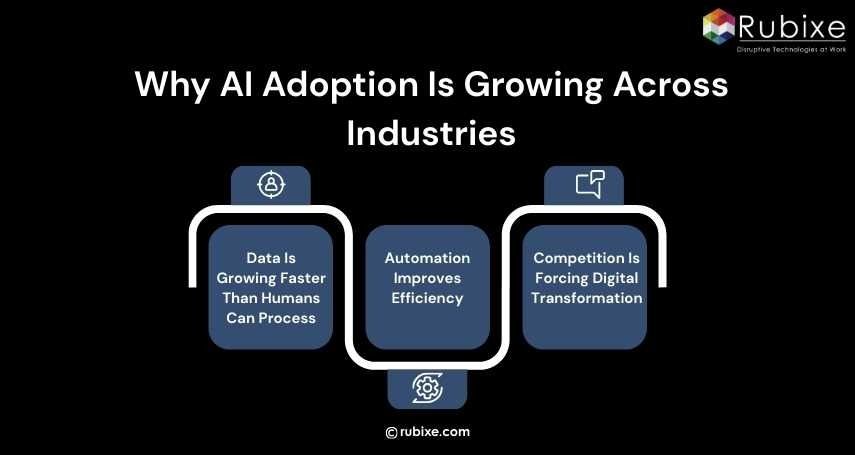
Why AI Adoption Is Growing Across Industries
 A few years ago, AI was mostly limited to large tech companies. Today, it is becoming a standard tool across industries.
Several factors are driving this change.
1. Data Is Growing Faster Than Humans Can Process
Businesses generate massive amounts of data every day, from customer behavior to operational metrics. Humans alone cannot analyze this information effectively.
AI systems can process large datasets quickly and identify patterns that would otherwise go unnoticed.
2. Automation Improves Efficiency
Routine tasks consume time and resources. AI can automate repetitive work such as data entry, document analysis, customer queries, and predictive maintenance.
Companies adopting enterprise AI solutions often reduce operational workload significantly.
3. Competition Is Forcing Digital Transformation
When one company improves efficiency through AI, competitors must respond quickly. AI adoption is increasingly becoming a competitive necessity rather than an optional upgrade.
Industries Where AI Adoption Is Growing Quickly
AI is no longer limited to tech companies. Businesses in many sectors are now using artificial intelligence to solve everyday operational problems. Through AI adoption services, organizations can identify where AI creates real value instead of implementing technology without a clear purpose.
1. Healthcare
Healthcare organizations are using AI to improve diagnostics and patient monitoring. AI systems can review thousands of medical images and highlight patterns that may indicate early-stage diseases. This helps doctors make faster decisions and improve treatment planning.
2. Finance
Financial institutions depend on AI to detect fraud and manage risk. By studying transaction behavior and spending patterns, AI models can quickly flag unusual activity and reduce the chances of financial fraud.
3. Retail and E-commerce
Retail businesses are applying AI to understand customer behavior better. AI-powered recommendation systems analyze browsing history and purchasing patterns to suggest relevant products, which often leads to higher engagement and improved sales performance.
4. Manufacturing
Manufacturers use AI to monitor production equipment and predict possible failures before they happen. This predictive maintenance approach helps companies avoid unexpected downtime and maintain stable production cycles.
5. Marketing and Customer Experience
Marketing teams increasingly rely on AI to analyze audience behavior and optimize campaigns. With AI integration services, companies can automate personalization, deliver targeted content, and improve overall customer engagement.
The Real Benefits of AI Adoption
Businesses that successfully implement AI often see improvements across several areas.
Faster Decision Making: AI systems process data instantly and generate insights that help leaders make informed decisions quickly.
Operational Efficiency: Automation reduces manual work and improves productivity across departments.
Improved Customer Experience: AI-powered systems can personalize interactions, respond faster to queries, and recommend relevant products or services.
Cost Optimization: While AI implementation requires investment, it often leads to long-term savings through efficiency and automation.
Better Risk Management: AI models detect anomalies and patterns that help businesses identify risks earlier.
Why Some Businesses Delay AI Adoption
Although artificial intelligence is widely discussed, many companies still hesitate to implement it. In most cases, the hesitation comes from uncertainty about cost, skills, and complexity.
1. Budget Concerns
Some businesses believe AI requires a large investment. In reality, many organizations start with small projects such as automating customer support or analyzing sales data. Once results are visible, AI can be expanded gradually.
2. Lack of Internal Expertise
Many companies do not have in-house AI specialists. AI adoption services and AI integration services help businesses identify suitable use cases, implement solutions, and train teams to manage AI tools effectively.
3. Perception of Complexity
AI may seem complicated at first. However, with a clear AI implementation strategy, companies can introduce AI step by step, starting with simple use cases and scaling successful solutions over time.
A Practical Approach to AI Adoption
Organizations that succeed with AI usually follow a practical path.
-
Identify high-impact use cases where AI can deliver measurable value
-
Develop an AI roadmap aligned with business goals
-
Implement pilot projects before scaling
-
Integrate AI into workflows and systems
-
Measure outcomes and refine models
This approach ensures that AI adoption produces real operational improvements rather than experimental projects.
The Future of AI Adoption Across Industries
The next phase of AI adoption will focus less on experimentation and more on enterprise wide integration.
Companies will increasingly use AI to support decision-making, automate complex processes, and create intelligent products and services.
Businesses that delay AI adoption may find themselves competing against organizations that operate faster, smarter, and more efficiently.
This shift is why structured AI adoption services are becoming essential for organizations aiming to stay competitive in the digital economy.
AI adoption services help businesses connect new technology with real business results. By finding the right places to use AI, setting up useful solutions, and expanding them step by step, companies can improve efficiency, support new ideas, and grow over time.
For businesses planning their next move, the question is no longer whether they should use AI. The real question is how quickly and effectively they can bring AI into their daily work.