










How AI Is Changing Decision Making in Business
AI supports business decisions by analyzing data, reducing bias, managing risk, and improving accuracy while keeping human judgment in control across industries.
Do businesses really need to make tough decisions themselves, or can AI handle it all for them?
Can artificial intelligence truly decide which products will succeed, which customers to target, or how to manage risks without any human effort? With so many AI tools around, it’s natural to wonder if I can just rely on them completely.
The truth is, AI for decision making can provide guidance and insights, but it doesn’t replace the understanding, judgment, and context that I still need to bring to my decisions.
Why Decision Making Is Hard
Making the right decision isn’t easy. There’s often:
-
Information overload: So much data is available that it’s hard to process it all effectively.
-
Rapid changes: Customer preferences, competitors, and market trends can shift quickly.
-
High stakes: One wrong choice can cause financial losses, operational problems, or damage to reputation.
Relying just on gut feeling, past experience, or simple reports is not enough anymore. AI for decision making can help by giving clear insights, making it easier to handle complicated situations, and making faster, better decisions.
How AI Enhances Business Decisions
AI looks at large amounts of data, finds patterns, and predicts what might happen. Here’s how it helps make better decisions:
-
Reduces Bias: AI looks at all information fairly and doesn’t let feelings or personal opinions affect decisions. This means the choices it suggests are based on facts, not assumptions.
-
Speeds Up Decisions: AI can process data quickly, helping you make faster choices without waiting for long reports. You can act on important opportunities right away instead of spending hours analyzing information.
-
Improves Accuracy: AI spots patterns and details that people might miss, so decisions are more reliable. It helps you see trends clearly and reduces errors that happen when trying to handle too much data manually.
-
Predicts Outcomes: AI can forecast what might happen next, helping you plan ahead and avoid mistakes. By looking at past and current data, it shows possible risks and opportunities.
-
Handles Complex Situations: AI can look at many factors at once, making it easier to understand complicated problems and choose the best option. It can compare different scenarios and show the likely results of each.
Benefits of AI in Decision-Making
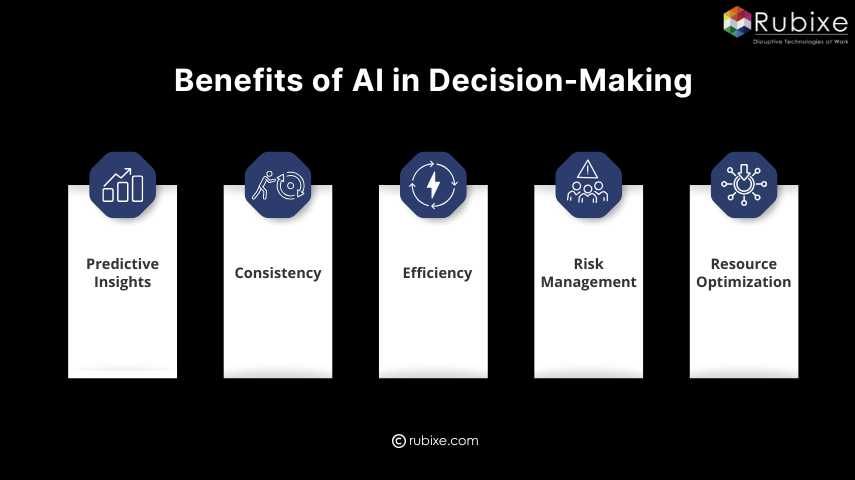 Using AI for decision making brings many advantages. Here’s how it can help:
-
Predictive Insights: AI can forecast customer behavior, market trends, and potential risks. This means you can see what might happen before it does. Knowing possible outcomes helps you plan better, make smarter choices, and avoid surprises.
-
Consistency: AI provides recommendations that are the same every time, reducing mistakes caused by personal opinion or mood. It ensures that decisions are based on facts, not assumptions. This makes your processes more reliable and trustworthy.
-
Efficiency: AI speeds up decision-making by processing large amounts of data quickly. You don’t have to spend hours analyzing reports or spreadsheets. Faster decisions mean you can act on opportunities sooner and respond quickly to challenges.
-
Risk Management: AI can spot potential problems before they become serious. By analyzing data, it supports risk management and highlights risks early, so you can take action to prevent losses. This makes it easier to avoid mistakes and protect your resources, reputation, and plans.
-
Resource Optimization: AI helps you use your resources like money, time, and staff more effectively. It can suggest where to focus efforts for the best results. This ensures that every investment or action has the highest possible impact, reducing waste and improving outcomes.
Common Questions About AI in Decision Making
Will AI replace humans?
No. AI is a tool that enhances human judgment. Humans provide context, ethics, and strategic thinking that AI cannot replicate.
Can AI be trusted?
Yes, when implemented carefully. Trust depends on clean data, proper monitoring, and human oversight. AI should guide, not replace, human decisions.
Is AI expensive?
AI requires investment, but it saves costs over time by improving accuracy, reducing errors, and enabling faster responses to market changes.
How to Implement AI for Decision Making
Using AI for decision making can be very effective if done the right way. Here’s a step-by-step guide:
-
Identify Priority Decisions: Start by figuring out which decisions would benefit most from AI. Focus on areas where there is a lot of data, repeated tasks, or high risk. By targeting the right decisions first, you get the most value without wasting effort on processes that don’t need AI.
-
Collect Quality Data: AI works best with clean, accurate, and reliable data. Make sure your data is complete, well-organized, and up-to-date. Poor data leads to poor recommendations, so spend time checking and cleaning your data before feeding it into AI tools.
-
Select the Right AI Tools: Choose: AI solutions that match your industry, business size, and decision-making needs. Not all AI tools are the same, some are better for analyzing customer behavior, while others are designed for operational or financial decisions. Picking the right tool makes implementation much smoother.
-
Start Small: Begin with a small pilot project instead of applying AI everywhere at once. Test it in one department or process first. This allows you to understand how AI works in practice, fix problems early, and learn before scaling it across the entire organization.
-
Integrate Human Judgment: AI provides recommendations, but it should not replace your judgment. Use AI insights to guide your decisions, but consider context, experience, and intuition before taking action. This combination ensures better, well-rounded decisions.
-
Measure Outcomes: Track how decisions made with AI perform over time. Compare results to previous methods and see where improvements can be made. Continuous measurement helps refine AI’s effectiveness and ensures that it keeps delivering real value.
Difference Between AI for Decision Making and Human Judgment
|
Aspect |
AI for Decision Making |
Human Judgment |
|
Basis |
Uses data, patterns, and algorithms |
Uses experience, understanding, and context |
|
Speed |
Very fast and processes data in seconds |
Slower and depends on thinking and discussion |
|
Consistency |
Gives the same output for the same data |
Can change based on mood or situation |
|
Bias |
Reduces personal bias when the data is clean |
Can be influenced by emotions or beliefs |
|
Handling Complexity |
Manages large and complex data easily |
Struggles with too much data at once |
|
Creativity |
Follows learned patterns |
Thinks creatively and breaks patterns |
|
Ethics & Values |
Does not understand ethics or values |
Considers ethics, impact, and responsibility |
Challenges of Using AI for Decision Making
Before using AI for decision making, it’s important to understand a few challenges:
-
Data Quality: AI depends fully on the data it receives. If the data is incomplete, outdated, or incorrect, the results will also be unreliable. Clean and accurate data is essential for meaningful insights.
-
Over-Reliance on AI: AI supports decisions, but it should not be followed blindly. Final responsibility still lies with humans. Decisions need common sense, context, and accountability alongside AI insights.
-
Skills Gap: Not everyone may understand how AI tools works or how to read its results. Basic training is often needed so teams can trust, interpret, and use AI insights correctly.
-
Implementation Costs: Setting up AI requires an initial investment in tools, systems, and skilled people. While the long-term benefits are high, planning the budget in advance is important.
The Future of Business Decisions
The future of decision-making lies in collaboration between humans and AI. Low-stakes, repetitive decisions will be automated, while high-stakes strategic decisions will rely on human judgment guided by AI insights.
AI continues to improve in speed, accuracy, and predictive ability, but humans provide the context, ethics, and creativity that AI cannot replicate.
AI for decision making is a tool. Humans provide purpose, context, and oversight. Together, they create decisions that are faster, more accurate, and more successful than either could achieve alone.