









AI Strategy vs AI Execution: Why Businesses Need Both
Understand the difference between AI strategy and AI execution and why businesses need both to plan, implement, and manage AI initiatives across business operations.
Artificial intelligence initiatives often begin with ambitious plans but fail to deliver real results. Many organizations invest time in building an AI strategy, yet struggle when it comes to implementation. Others rush into development without a clear roadmap.
Both situations lead to wasted investment and slow adoption. Understanding the relationship between AI strategy and AI execution helps businesses move from planning to measurable outcomes while ensuring AI initiatives support long-term growth and operational efficiency.
Strategy vs Execution: Understanding the Gap
An AI strategy defines how artificial intelligence will support business goals, improve processes, and create a competitive advantage. It includes identifying use cases, evaluating data readiness, choosing technologies, and setting measurable objectives.
AI execution, on the other hand, focuses on implementation. It involves building models, integrating systems, deploying solutions, and ensuring the technology works within daily operations.
The gap between strategy and execution appears when planning and AI implementation move in different directions.
Typical examples include:
-
Leadership teams define AI initiatives without evaluating whether data is available or usable.
-
Technical teams build models that solve technical problems but do not address business priorities.
-
Organizations launch pilot projects but struggle to scale them across departments.
Research from McKinsey & Company shows that many AI initiatives remain stuck in experimentation because organizations fail to connect strategic planning with operational execution.
Businesses that align these two areas are significantly more likely to achieve measurable value from AI adoption.
Bridging this gap requires structured planning, realistic implementation processes, and collaboration between business leaders and technical teams.
Common Mistakes Companies Make When Implementing AI
Organizations across industries recognize the potential of AI, yet many projects fail because of avoidable mistakes.
1. Treating AI as a technology project: AI initiatives often begin inside IT departments without clear business objectives. Artificial intelligence works best when tied directly to measurable goals such as improving customer experience, reducing operational costs, or increasing productivity.
2. Starting with tools instead of problems: Sometimes, purchase AI automation tools before identifying practical use cases. Successful adoption begins with understanding where AI can deliver measurable value.
3. Ignoring data readiness: AI systems depend on clean, structured, and accessible data. Without proper data preparation, models fail to deliver accurate results.
4. Lack of cross-functional collaboration: AI initiatives require cooperation between technical teams, business units, and leadership. When teams operate independently, projects lose direction and momentum.
5. No clear implementation roadmap: A strong AI strategy should define how solutions move from experimentation to deployment. Without a structured roadmap, organizations struggle to scale successful prototypes.
These mistakes explain why many businesses seek guidance from experienced AI consulting companies that understand both strategic planning and technical implementation.
Steps to Bridge the Gap Between AI Strategy and AI Execution
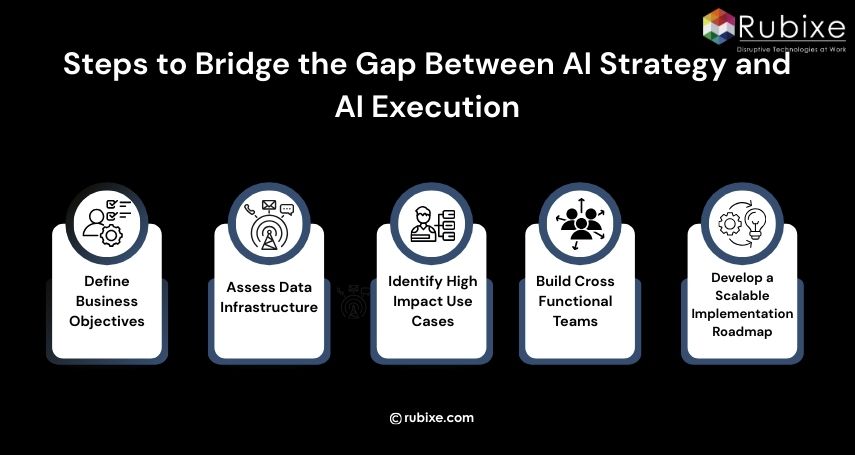 Turning an AI vision into an operational reality requires a clear and structured approach. Businesses that successfully implement AI typically follow a sequence of practical steps.
1. Define Business Objectives
AI initiatives should begin with clear goals. Examples include improving supply chain forecasting, enhancing customer support automation, or detecting fraud in financial transactions. Defining the business outcome ensures technology development aligns with organizational priorities.
2. Assess Data Infrastructure
Data quality and accessibility determine whether AI models will work effectively. Organizations must evaluate existing datasets, data pipelines, and storage systems before development begins.
3. Identify High-Impact Use Cases
Rather than attempting large transformations immediately, businesses should start with high-value use cases that demonstrate measurable results. Early success builds confidence and encourages broader adoption.
4. Build Cross-Functional Teams
AI initiatives perform best when data scientists, engineers, domain experts, and business leaders collaborate. This structure ensures technical development supports operational goals.
5. Develop a Scalable Implementation Roadmap
A structured roadmap outlines the transition from pilot projects to enterprise-level deployment. The roadmap also defines performance metrics, testing processes, and integration requirements.
Companies that successfully move from planning to execution treat AI as a long-term capability rather than a single project.
AI Strategy Framework for Enterprise Adoption
Successful AI initiatives often follow a structured framework that connects strategic planning with execution. Expert AI strategy consulting helps businesses define the right roadmap, prioritize high-impact use cases, and ensure implementation aligns with long-term business objectives.
A practical AI strategy framework typically includes the following stages:
-
Business Problem Identification: Define the operational challenges or opportunities where AI can create measurable value.
-
Data Readiness Assessment: Evaluate available datasets, data pipelines, and data quality to determine feasibility.
-
AI Use Case Prioritization: Identify high-impact use cases that can deliver early results and demonstrate value.
-
Model Development and Testing: Develop algorithms, train models, and validate performance using relevant datasets.
-
System Integration and Deployment: Integrate AI solutions into business applications, dashboards, and operational systems.
-
Continuous Monitoring and Optimization: Monitor model performance, update datasets, and refine algorithms as business conditions evolve.
Organizations implementing this structured approach often achieve better outcomes when adopting ai services across business functions.
What Successful AI Execution Looks Like
When strategy and execution align, AI becomes part of everyday business operations.
Successful AI implementation typically includes several characteristics.
-
Operational Integration
AI systems integrate with existing tools such as CRM platforms, analytics dashboards, and operational systems. This ensures employees can use AI insights within their daily workflows.
-
Continuous Learning and Improvement
AI models improve over time as new data becomes available. Monitoring model performance and retraining algorithms ensures sustained accuracy.
-
Clear Business Impact
Successful projects demonstrate measurable improvements such as:
-
faster decision-making
-
improved demand forecasting
-
reduced manual workload
-
enhanced customer experience
A report from Gartner highlights that organizations focusing on practical deployment rather than experimentation gain greater value from artificial intelligence initiatives.
Companies implementing scalable AI services often experience improvements in operational efficiency and decision accuracy.
How to Choose the Right AI Strategy Consulting Partner
Selecting the right AI strategy consulting partner plays a key role in the success of artificial intelligence initiatives. While many organizations recognize AI’s potential, turning strategy into real implementation often requires specialized expertise. A strong consulting partner helps businesses define a clear roadmap, prioritize high-value use cases, and guide implementation across the organization.
When evaluating partners, consider the following factors:
-
Industry Understanding: The partner should understand sector-specific challenges and data environments to identify relevant AI opportunities.
-
End-to-End AI Implementation Experience: Capability to support strategy, model development, deployment, and system integration.
-
Data and Infrastructure Expertise: Ability to assess data readiness, build pipelines, and design scalable AI architecture.
-
Scalability and Security: Knowledge of enterprise security standards and scalable system design.
-
Proven Track Record: Review case studies, previous projects, and measurable business outcomes
Rubixe: AI Technology Partner for Successful AI Execution
Organizations planning to implement artificial intelligence often require support in transforming strategic vision into operational systems. Rubixe helps businesses move from concept to deployment through structured planning, development, and integration of AI solutions.
The company supports organizations by identifying high-impact use cases, evaluating data readiness, and designing scalable AI frameworks aligned with business objectives.
Rubixe develops intelligent systems across several domains, including automation platforms, predictive analytics models, and enterprise-grade AI products designed to improve efficiency and decision-making.
If you are looking to explore AI adoption, you can book a free consultation with Rubixe experts to evaluate your readiness and identify practical AI opportunities. A short strategy session can help your organization understand the right starting point and implementation approach for AI initiatives.
Frequently Asked Questions
1. Why do many AI projects fail during implementation?
Many AI projects fail because organizations focus heavily on planning but underestimate the complexity of deployment. Challenges related to data quality, system integration, and organizational adoption often slow implementation.
2. What is the difference between AI strategy and AI execution?
AI strategy defines how artificial intelligence supports business goals, while AI execution focuses on building, deploying, and operating AI systems that deliver measurable outcomes.
3. How long does it take to implement an AI project?
The timeline varies depending on complexity, data availability, and integration requirements. Smaller projects may take a few months, while enterprise-level systems can require longer implementation phases.
4. Do companies need AI consultants to implement AI?
Organizations with limited internal expertise often benefit from working with specialists who provide both technical guidance and strategic direction.
5. Which industries benefit the most from AI adoption?
Industries such as healthcare, finance, manufacturing, retail, and logistics frequently use AI to improve decision-making, automate processes, and enhance customer experience.
Successful AI adoption requires more than technology experimentation. Organizations achieve measurable results when AI strategy and AI execution move in alignment. A structured roadmap helps identify high-value use cases, prepare data infrastructure, and deploy scalable solutions. Businesses that connect strategic planning with practical implementation gain stronger operational efficiency, better decision-making, and long-term competitive advantage.