



















AI Farming Secrets That Turn Low Yields Into Profits
AI farming uses data analytics, automation, and precision tools to increase crop yields, reduce costs, and turn low farm productivity, into higher profits.
AI farming is the practice of using machine learning, sensor networks, and predictive analytics to make field-level decisions that directly improve crop revenue and reduce input waste. These applications are among the most impactful AI use cases in agriculture, especially where margins depend on precision and timing.
Rising fertilizer costs, unpredictable weather, and uneven yields are squeezing farm margins. Many farms have adopted AI, yet results vary widely.
Across crop monitoring, yield prediction, and irrigation automation, proven AI use cases in agriculture can directly improve revenue and reduce costs. The difference comes from how these systems are set up and used in daily decisions.
Two farms using the same tools often see very different outcomes. Calibration, timing, and decision-making determine whether AI delivers small efficiency gains or clear profit growth.
Inside these systems are mechanisms that influence pricing, input use, and yield consistency. When applied correctly, AI moves from monitoring to profit generation.
Why Do Most AI Farming Implementations Fall Short of Their Profit Potential?
While most discussions around AI use cases in agriculture focus on technology adoption, very few focus on how those use cases translate into profit at the farm level.
AI farming systems are often deployed correctly, yet profitability depends on how they’re configured.
Because farms adopt the tool but skip the configuration that makes it profitable.
An AI irrigation system installed with default soil moisture thresholds delivers average results. The same system calibrated to your specific crop's root depth, growth stage, and local evapotranspiration rate delivers 25% water reduction and a measurable yield uptick.
Same tool. Completely different outcome.
The profit gap in AI-powered farming is seldom about access to technology. It lives in the activation layer, the decisions made during setup, integration, and interpretation that most vendors never walk farmers through.
If you’re exploring broader AI use cases in agriculture, this is where the shift happens from understanding tools to actually extracting profit from them.
6 AI Farming Secrets That Directly Increase Farm Profit
The gap between average and high-performing farms is not access to technology. It’s how specific AI use cases in agriculture are applied at the right moment and in the right way.
The following six profit levers show how farms convert the same tools into stronger margins, lower costs, and better price realization.
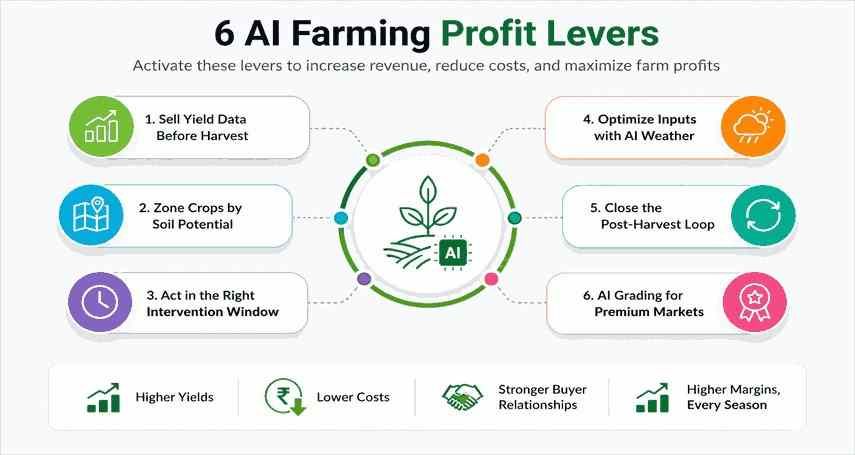
1. Selling Yield Data Before the Harvest Happens
Most farmers use AI yield prediction to know what they'll harvest. Smart farmers use that same data to sell before they harvest and at better prices.
When a buyer negotiates with a farmer who has no data, the buyer controls the price. When that same farmer arrives with an 88% accuracy AI forecast showing 340 tonnes of Grade A tomatoes arriving in 23 days, the dynamic reverses. The farmer is selling certainty, and certainty commands a premium.
This is what machine learning in business has done in commodities trading for years. Agriculture is the last major sector to apply it at the farm level.
The activation step most farms miss: Sharing yield forecast reports with buyers 4–6 weeks before harvest, not just using them internally for logistics. Buyers who plan procurement around your data become repeat buyers. Over two to three seasons, that relationship alone adds 8–12% to effective price realization.
2. Turning Soil Variability Into a Zoned Pricing Strategy
Every farm has high-yield zones and low-yield zones. Most farmers average them out and grow the same crop across all of it. AI soil mapping makes that a costly mistake.
When AI analyzes multi-year yield data, soil composition scans, and satellite imagery together, it produces a zone map, areas of the farm ranked by production potential.
Among the most underutilized AI use cases in agriculture, this approach directly improves how land is allocated for maximum return.
The profit lever here is crop zoning: placing premium crops only in high-potential zones, and shifting low-margin or cover crops to underperforming zones.
A 100-acre farm might discover that 35 acres consistently underperform due to drainage patterns. Planting that zone with a drought-tolerant legume rather than the main cash crop reduces input waste on those 35 acres by 40%, while improving soil nitrogen for the following season, which boosts the high-yield zones.
Data science in business operations calls this resource allocation optimization. In farming, it means stopping the habit of treating unequal land as if it were identical.
3. The Intervention Timing Window That Most AI Alerts Miss
AI crop monitoring systems generate alerts. The problem is that most farms respond to alerts reactively; when the alert fires, they act. The actual profit lever is understanding the economic intervention window that sits inside each alert.
Take a fungal disease alert on a wheat crop. The AI detects early spore signatures 12 days before visible symptoms. Most farmers treat within 48 hours of the alert. Agronomic research shows that treatment applied on days 8–10 after initial detection, when the infection is localizing but before it spreads systemically, costs 30% less in fungicide volume and achieves a 15% better containment rate than day-1 treatment.
The alert tells you something is wrong. Understanding the intervention window tells you exactly when acting costs the least and saves the most.
According to the Food and Agriculture Organization of the UN, pests and diseases account for up to 40% of global crop losses annually, losses that precise, timely intervention directly reduces.
Generic alert thresholds do not capture this. Custom-calibrated systems built on data science in business principles do.
4. Using AI Weather Data to Arbitrage Input Costs
AI weather forecasting in agriculture is typically used for planting and harvest timing. Almost no one uses it for input cost arbitrage, and that gap is pure lost margin.
Here is how it works. Fertilizer application is most efficient when soil temperature sits between 10°C and 30°C and when rain is 48 - 72 hours away, sufficient to drive nutrients into the root zone without washing them out.
AI hyper-local weather models can predict that exact window with 6–10 days of lead time.
Farms that apply fertilizer inside this window use 12 - 18% less product to achieve the same soil nutrient uptake compared to farms applying on a fixed weekly schedule.
At current urea prices, that efficiency on a 200-acre operation saves ₹80,000–₹1,20,000 per application cycle.
The same logic applies to pesticide timing. Applying contact pesticides within 6 hours before a forecast rain event wastes the entire dose. AI weather data prevents that loss entirely.
The activation step: Integrate your AI weather forecasting feed directly into your input purchase and application scheduling calendar, not just your planting calendar.
5. The Post-Harvest AI Loop That Compounds Returns Every Season
This is the most overlooked profit lever in all of AI-powered farming.
Every harvest generates data: actual yields per zone, pest incidence rates, irrigation consumption, fertilizer response by soil type, and weather deviations from forecast.
When that data feeds back into the AI models, the following season's predictions get sharper. Intervention thresholds get more precise. Resource recommendations get tighter.
Most farms treat harvest as the end of the AI cycle. Farms that treat it as the beginning of next season's calibration cycle see compounding accuracy improvements and compounding cost reductions, year over year.
The World Resources Institute confirms that precision agriculture systems, including AI-driven irrigation and resource management, consistently reduce input consumption by 20–30% when continuously optimized with real farm data.
That optimization does not happen at installation. It happens through the post-harvest feedback loop.
By season three of a well-managed AI farming setup, yield prediction accuracy typically improves from 82% to 91–94%. Input cost optimization tightens by an additional 8–11% compared to year one.
6. AI-Driven Grading to Capture Premium Market Segments
Most farms sell into a commodity price pool. AI computer vision grading at harvest opens access to premium market segments, and that price differential is often 30–60% above commodity rates.
Computer vision systems scan harvested produce at a speed of 8 to 12 items per second and sort by size, colour uniformity, surface defect, and sugar content via near-infrared scanning. The output is a tiered grade report with full batch traceability.
Grade A output goes to premium retail buyers and export channels at ₹80–120/kg. Grade B goes to institutional buyers at ₹45 - 60/kg. Grade C goes to processing at ₹20–30/kg. Without AI grading, most farms blend all three and sell at a weighted average that captures none of the premium segment's value.
According to MarketsandMarkets, the AI in agriculture market is expected to grow to USD 4.7 billion by 2028, and computer vision grading and sorting is among the fastest-growing segments within it.
The activation step most farms miss: Documenting AI grading reports as proof of quality for buyer negotiations. Consistent grading data over two seasons becomes a brand asset that commands preferred supplier status with premium buyers.
How Rubixe Activates These Levers for Farms
Understanding profit levers and implementing them are two separate problems. The implementation layer, sensor integration, model calibration, intervention window mapping, and post-harvest data loops require engineering and data science depth that most farm operations do not carry in-house.
Rubixe has spent over a decade building AI Agriculture services that go beyond deployment. Every engagement covers configuration, calibration, and the specific activation steps that convert AI tools from dashboards into profit drivers. Rubixe's AI consulting team works from your farm's commercial targets backwards, identifying which levers move your margins fastest.
Start a conversation with Rubixe →
Frequently Asked Questions
1. Which profit lever delivers the fastest return for a mid-size farm?
Input cost arbitrage using AI weather data typically delivers measurable savings within the first application cycle, often 60 - 90 days after implementation. It requires no new field equipment, only integration between your weather data feed and your scheduling calendar.
2. How does AI yield data actually change buyer negotiations?
Buyers discount prices when supply is uncertain. A documented AI forecast with historical accuracy data gives buyers enough certainty to commit to volumes and prices earlier. Farms using yield forecast reports in negotiations consistently report 8 - 12% better price realization versus farms selling at spot rates.
3. Do these profit levers work for farms under 50 acres?
Most do. Zone-based crop planning, intervention window timing, and post-harvest data loops require no minimum farm size. AI grading systems have higher upfront costs but are increasingly available as shared infrastructure through agri-cooperatives and FPOs.
4. How long before the post-harvest AI feedback loop produces noticeable improvement?
Most farms see statistically measurable accuracy improvements after two complete harvest cycles fed back into the model. The compounding effect becomes commercially significant by season three, typically an additional 8–11% reduction in input costs beyond year-one baselines.
5. What data does Rubixe need to identify which levers apply to a specific farm?
Rubixe typically starts with three to five years of yield history, current input cost breakdowns, and existing sensor or equipment inventory. From that baseline, the team maps which levers are immediately activatable versus which require infrastructure investment first.
Key Takeaways
-
The profit gap in AI farming almost never lives in access to tools; it lives in the activation layer that most implementations never reach
-
Yield forecasts shared externally with buyers 4–6 weeks before harvest recover 8–12% more revenue per season than the same forecasts used only for internal logistics
-
AI weather forecasting applied to input timing, not just planting, reduces fertilizer and pesticide spend by 12 - 18% per application cycle
-
The post-harvest data loop is the most overlooked lever: the World Resources Institute confirms 20 - 30% input reduction is achievable when AI systems are continuously optimized with real farm data.