






AI Software Solutions for Enterprises & Startups
AI software solutions for enterprises and startups to automate processes, improve efficiency, and scale faster with intelligent, data-driven technology.
The global AI market is projected to surpass $1.81 trillion by 2030, and the businesses scaling fastest understood one thing early: AI software solutions are infrastructure, not innovation theatre.
AI software is not a single product. It is a category of intelligent systems, each built for a distinct business problem. Choosing the wrong type or deploying it without a clear business case is how organisations burn six-figure budgets with nothing to show for it.
Let's break down what AI software solutions for enterprises and startups are, which types deliver real ROI in 2026, and how to make a sound selection decision, whether you are a startup making your first AI investment or an enterprise evaluating a platform shift.
What Are AI Software Solutions?
AI software solutions are applications built on machine learning, natural language processing, computer vision, and generative AI that learn from data, adapt over time, and improve with use, unlike conventional software that follows fixed rules.
In practice, this means software that can analyse customer sentiment in real time, predict equipment failure weeks ahead of time, or generate a draft legal contract from your firm's historical templates, without being explicitly reprogrammed for each task.
AI software solutions are intelligent systems that automate complex, data-driven tasks, reducing costs, accelerating decisions, and personalising experiences at a scale that human teams cannot match alone.
Traditional Software vs AI Software
|
Category |
Traditional Software |
AI Software |
|
Decision Logic |
Hard-coded rules |
Learned from data |
|
Adaptability |
Manual updates required |
Self-improves over time |
|
Scale |
Linear scaling |
Exponential with data |
|
Best For |
Predictive, rule-based tasks |
Complex, data-rich tasks |
|
Examples |
ERP, CRM, Billing Software |
Fraud detection, NLP, AI Agents |
7 Types of AI Software Solutions for Enterprises and Startups in 2026
 Understanding the category you actually need is the most important step and the one most businesses skip. Here are the seven primary types of AI software solutions driving business results in 2026 for enterprises and startups.
1. Machine Learning Platforms
ML platforms allow businesses to build predictive models from their own data without writing algorithms from scratch. They identify patterns invisible to human analysts and make probabilistic predictions about future outcomes.
JPMorgan Chase deployed ML-based systems across 60,000+ developers, reporting a 30% improvement in developer velocity alongside measurable reductions in fraud. Enterprise-wide AI coding rollouts followed in Q1 2026.
Best for: Demand forecasting, churn prediction, risk scoring, pricing optimisation
2. Natural Language Processing (NLP) Solutions
NLP software enables machines to read, understand, and generate human language, written or spoken. This category has seen the most dramatic advancement in the past two years, driven by large language models.
McDonald's partnered with IBM to build NLP-powered automated order-taking technology capable of handling multiple languages, dialects, and menu variations, scaling across markets without proportional headcount.
Best for: Chatbots, voice assistants, document analysis, sentiment analysis, contract review
3. Robotic Process Automation (RPA)
RPA sits at the intersection of AI and workflow automation. Software bots handle high-volume, rule-based tasks like data entry, invoice processing, and compliance monitoring, with greater speed and accuracy than human operators.
Silverlake Group's AI-powered CatgWorkz platform automates up to 80% of routine tasks at financial institutions.
Best for: Finance operations, HR onboarding, supply chain data entry, compliance reporting
4. Computer Vision Systems
Computer vision software processes and interprets visual data, images, video, and live feeds. It has matured significantly beyond simple image tagging into real-time quality inspection, medical imaging, and autonomous navigation.
Best for: Quality control, retail shelf monitoring, security surveillance, medical diagnostics
5. Generative AI Tools
Generative AI produces original content: text, code, images, audio, and video from natural language instructions. In 2026, this category has moved from experimental to operational across marketing, engineering, and legal teams.
Goldman Sachs announced an enterprise-wide rollout of AI coding tools in Q1 2026. Marketing teams across sectors now deploy generative AI for campaign copy, A/B testing variants, and email personalisation at a scale that was previously cost-prohibitive.
Best for: Content creation, software development, personalised marketing, design prototyping
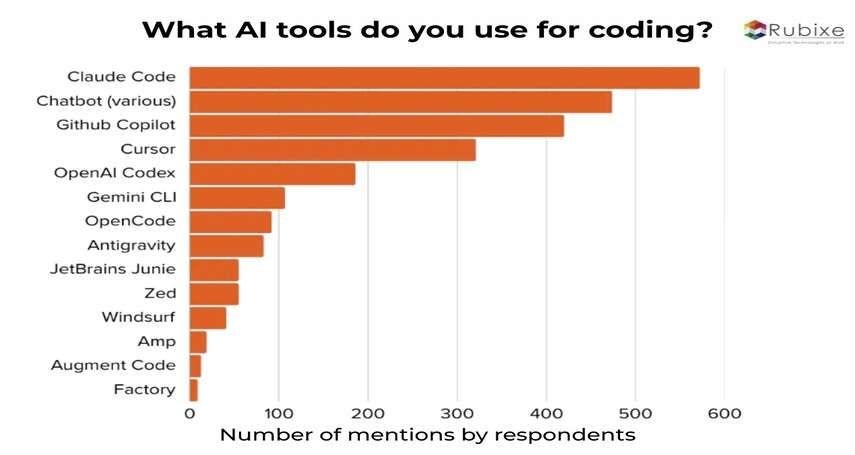 According to Precedence Research, the AI market is growing rapidly, while Developer Surveys (2026) indicate that AI-assisted tools can achieve up to 55% faster task completion.
6. AI-Powered Analytics & Business Intelligence
These platforms go beyond dashboards and historical reports. They apply ML to business data in real time, surfacing insights, detecting anomalies, and generating recommendations that analyst teams would take weeks to produce manually.
Best for: Executive reporting, market trend analysis, customer behaviour modelling, financial forecasting
7. Autonomous AI Agents
This is the category defining 2026. Unlike earlier AI tools that required a human to prompt each action, autonomous agents plan, execute, and iterate across multi-step tasks without constant supervision. They are fundamentally changing how knowledge work gets done.
As per The Pragmatic Engineer report, 55% of developers surveyed in early 2026 reported using AI agents regularly, up from under 5% in 2024. These agents handle code review, pull request creation, bug triage, and documentation generation autonomously.
Best for: Sales pipeline management, customer onboarding, IT ops, research synthesis, complex multi-step workflows.
At Rubixe, we work with enterprises and growth-stage startups to identify which AI software category aligns with their specific bottleneck, before recommending any technology. The wrong type of AI software, even when implemented well, will not move the business needle.
How AI Software Solutions Actually Work
Understanding the mechanics helps you evaluate vendors, ask better questions, and avoid expensive implementation failures. Here is the lifecycle, simplified.
1. The Core AI Software Lifecycle
-
Data Input: The system ingests structured data (databases, spreadsheets) or unstructured data (emails, images, call recordings).
-
Model Training: Algorithms are trained on historical data to identify patterns, relationships, and rules. This is where intelligence is built.
-
Inference: The trained model processes new, live data and produces predictions, classifications, or generated outputs.
-
Feedback Loop: Human feedback and new data continuously refine the model, improving accuracy over time.
2. Pre-Built vs Custom AI Software
This decision determines both cost and capability:
-
Pre-built AI software (SaaS AI tools, API-based models): Faster to deploy, lower upfront cost, limited customisation. Best for common use cases like chatbots, content generation, or basic analytics.
-
Custom AI software development: Built on your proprietary data, tailored to your specific workflows, and compliant with your industry regulations. Takes longer to build but delivers compounding ROI and competitive differentiation.
The businesses getting the highest returns from AI software in 2026 are those that start with pre-built tools for speed, then invest in custom development for the workflows that represent their actual competitive moat.
However, choosing the right category is only part of the decision. The next question most businesses face is: Should you rely on individual AI tools or invest in a scalable AI platform?
AI Tools vs AI Platforms: What Should You Choose?
One of the biggest mistakes in AI adoption is treating tools and platforms as the same thing. They solve very different problems.
AI Tools: Fast, Task-Focused
AI tools are built for specific use cases: content generation, summarisation, coding, or automation.
They work best when:
-
The task is clearly defined
-
Speed matters more than integration
-
You need quick results without infrastructure
They are ideal for early adoption. But as usage grows, tools create fragmented workflows, data silos, and management overhead.
AI Platforms: Scalable, System-Level
AI platforms are designed to connect multiple use cases, data sources, and workflows into a single system.
They become essential when:
-
AI is used across teams and functions
-
Data needs to flow between systems (CRM, ERP, etc.)
-
Custom workflows and long-term scalability matter
At this stage, AI shifts from a tool to a core business infrastructure.
Most organisations don’t choose one, they evolve:
Start with tools for speed → Identify high-impact use cases → Move to a platform for scale.
Simple rule:
If AI is solving tasks, use tools.
If AI is driving operations, build on a platform.
Key Business Benefits of AI Software Solutions
The strongest argument for AI software is not theoretical. It is financial and operational. Here are the key benefits of AI software solutions across enterprises.
1. Cost Reduction Through Intelligent Automation
Organisations using RPA and AI-powered workflow automation reduce operational costs by eliminating repetitive tasks and manual effort. It improves efficiency, minimises errors, and allows teams to focus on high-value work.
2. Faster, Higher-Quality Decision-Making
AI analytics platforms process datasets in seconds that would take analyst teams days to review.
The impact is not only speed, but it is the ability to detect patterns humans would miss.
Organisations using AI for market analysis and demand forecasting report faster time-to-market and fewer inventory errors.
3. Customer Experience That Scales
AI-powered customer service platforms handle most queries without human intervention, increasing customer satisfaction while reducing support costs.
Companies like Netflix, Spotify, and Amazon have built revenue models around AI personalisation, now accessible to mid-market businesses through cloud-based solutions.
4. Developer Productivity and Velocity
Development teams using AI coding assistants complete more work at the same time.
AI tools speed up coding, testing, and deployment, enabling faster builds, better quality, and reduced time-to-market.
5. Scalability Without Linear Cost Growth
Traditional scaling requires proportional headcount growth, but AI changes that.
A support team of 20 can handle the workload of 200 with the right AI platform, maintaining consistent response quality at scale.
Where AI Software Projects Fail And How to Avoid It

Based on our implementation experience across enterprise workflows, the biggest failure point is rarely the model; it’s misaligned use cases and poor data readiness.
1. Choosing Technology Before Defining the Problem
Starting with "we need AI" instead of "here is the bottleneck" is how six-figure budgets disappear without ROI.
Define the problem in financial terms first, and what does this inefficiency cost per quarter? What would a 20% improvement be worth?
2. Underestimating Data Readiness
AI software is only as good as the data it learns from. Inconsistent, siloed, or poorly labelled data consistently produce poor model performance.
A six-week data readiness assessment before project launch can save eighteen months of rework after it.
3. Treating Implementation as a One-Time Event
AI models degrade as data patterns shift. This is model drift. Without a maintenance and monitoring plan, fraud detection accuracy drops, recommendation engines serve stale content, and NLP models start misclassifying tickets. Build AI Ops from day one, not as an afterthought.
4. Ignoring Change Management
Technical implementation is 40% of the challenge. Adoption is the other 60%. Teams that view AI as a threat will find ways to work around it, and a functioning AI system that nobody uses produces zero business value.
5. Compliance as an Afterthought
The EU AI Act took full effect in February 2026, classifying AI in safety-critical applications as high-risk.
AI Governance, audit trails, and explainability must be built in from day one, not retrofitted.
How to Choose the Right AI Software Solution
-
Map your five most resource-intensive workflows. Prioritise those that are data-rich, pattern-dependent, and currently bottlenecking growth.
-
Decide: Buy (SaaS AI tool for speed), Build (in-house for full control), or Partner (custom development without internal hiring cost).
-
Evaluate vendors on: scalability, stack integration, compliance readiness, ongoing model support, and client references in your industry.
-
Run an 8–12 week proof of concept on one high-value workflow before committing to enterprise-wide rollout.
How Rubixe Approaches This
Every Rubixe engagement begins with a structured discovery phase: mapping workflows, auditing data infrastructure, and defining the optimal outcome the solution must achieve. We do not scope or build until that foundation is clear. Visit rubixe.com to learn more.
Frequently Asked Questions on AI Software Solutions
Q1. What is the difference between AI software and regular software?
Regular software follows hard-coded rules and produces the same output every time. AI software learns from data and improves with use, it asks 'What does the data tell us?' rather than What is the rule?'
Q2. How much does custom AI software development cost in 2026?
Proof-of-concept projects typically range from $25,000 to $75,000. Enterprise deployments range from $150,000 to over $1 million, depending on integration complexity and compliance requirements. Most well-scoped AI investments pay back within 12 - 18 months.(Data Source: Apidots)
Q3. Which industries benefit most from AI software solutions?
Financial services, healthcare, retail, manufacturing, and logistics consistently report the highest ROI. The real differentiator is not industry; it is the presence of high-volume, data-rich workflows that are currently bottlenecks to growth.
Q4. What is the biggest risk when implementing AI software?
Strategic misalignment. AI software that solves the wrong problem, runs on poor-quality data, or is deployed into unprepared teams will fail regardless of how sophisticated the technology is. Start with the business problem, not the technology.
The Decision in Front of You
AI software solutions have moved past the hype cycle into operational reality. The organisations extracting optimal value from them share a common pattern: they defined the business problem before evaluating technology, invested in data readiness before deployment, and treated AI as ongoing infrastructure.
The businesses that will capture the largest share of a $1.81 trillion market are making informed AI investment decisions in 2026, not waiting for the technology to become even more obvious.
Start with the workflow. Validate with data. Pilot before you scale. Partner with people who have delivered results in your context.
Rubixe builds custom AI software solutions for enterprises and growth-stage startups, from intelligent automation and NLP systems to AI-powered analytics and autonomous agent deployments.
Every engagement starts with a structured discovery process tied to your specific business outcomes.
If you're evaluating AI software solutions for your business, connect with the Rubixe team to map the right use case before you invest and explore what we have delivered for clients in your industry.