















Planning a Startup? Here's Why AI Is Dominating India
Planning a startup in India? AI is dominating industries with smarter automation, faster innovation, improved efficiency, and scalable business growth.

Indian startups are operating in one of the most competitive business environments ever. Rising acquisition costs, lean funding cycles, and faster-moving competitors are making it harder for traditional startups to scale with manual operations alone.
AI is changing that completely.
Startups using AI are automating workflows, reducing operational costs, improving customer acquisition, and scaling faster with leaner teams. In 2026, AI is no longer a competitive advantage in India , it is becoming the baseline for survival.
From Bangalore startups to growing businesses in tier-2 cities, founders are now using AI to execute faster without increasing headcount at the same pace.
At Rubixe, we have helped 200+ businesses across India implement AI systems that improve efficiency, reduce repetitive work, and accelerate growth within months.
Why AI-First Startups Are Growing Faster in India
AI startups in India are growing faster because they solve real problems with less money and fewer people. Automation, smarter tools, and data-driven decisions give them an edge from day one.
India is the third-largest startup ecosystem in the world. But most startups still fail within the first two years. The ones that survive share one common trait: they use AI early, not late.
The numbers tell the story clearly:
-
India had nearly 6,200 AI startups, and that number is growing fast.
-
AI startups in India raised $643 million across 100 deals in 2025 alone.
-
India's cumulative private AI investment between 2013 and 2024 stood at $11.1 billion.
This is not hype. This is capital flowing toward a proven opportunity.
Why are traditional startups struggling while AI-First startups grow?
Traditional startups burn cash on manual operations, large teams, and slow processes. AI startups automate those same operations from week one.
A customer support team of 10 people handling 500 queries a day can be replaced or significantly reduced, with an AI system handling 5,000 queries a day at a fraction of the cost. That cost advantage compounds every month.
Traditional Startups vs AI-Driven Startups
|
Traditional Startup |
AI-Driven Startup |
|
Manual daily operations |
Automated workflows |
|
Larger teams required |
Lean and efficient teams |
|
Slower customer support |
AI-powered instant support |
|
High operational costs |
Reduced operating costs |
|
Delayed decision-making |
Real-time business insights |
|
Slower scaling |
Faster business growth |
How AI Solves Startup Problems
AI directly solves the five biggest problems every Indian startup founder faces: high competition, lack of funding efficiency, slow growth, manual work, and poor customer acquisition.
Let us go through each one.
1. How does AI help startups deal with brutal competition?
AI gives smaller teams the output of much larger ones. A 5-person startup using AI tools can outproduce a 20-person team that is still working manually.
AI handles content creation, market research, competitor tracking, and customer outreach - all simultaneously. Your team focuses only on decisions that require human judgment.
2. How does AI make a limited startup budget go further?
AI reduces your cost-per-output across almost every function. Spending less on repetitive tasks means more runway for growth.
One Rubixe startup client reduced their monthly operational cost by 35% within 90 days by automating invoice processing, customer follow-ups, and sales reporting. That money went directly into paid acquisition instead.
3. How does AI fix slow growth for early-stage startups?
AI accelerates growth by removing the manual bottlenecks that slow every startup down. Lead generation, onboarding, reporting, and customer success can all run faster with AI.
Growth is slow when your team spends 60% of its time on tasks that do not directly generate revenue. AI flips that ratio - so your team spends more time on what actually grows the business.
4. How does AI solve the customer acquisition problem?
AI-powered tools identify high-intent leads, personalise outreach, and convert customers faster - at lower cost per acquisition.
Paid ads, cold outreach, and content marketing all perform better when AI is used to target the right audience, at the right time, with the right message. Rubixe's AI solutions have helped startups cut their cost per lead by up to 48%.
A Strong Example of India's AI-First Startup Model
 One of the strongest examples of India's AI-first startup momentum is Sarvam AI.
Instead of competing broadly with global AI companies, Sarvam focused on a uniquely Indian problem, building AI systems for regional languages and local use cases.
That focus helped the company raise millions in funding within months and gain recognition under the IndiaAI Mission.
The lesson for founders is important: the biggest AI opportunities in India are often local problems global companies are not optimized to solve.
What Sectors Are Winning with AI Startups in India?
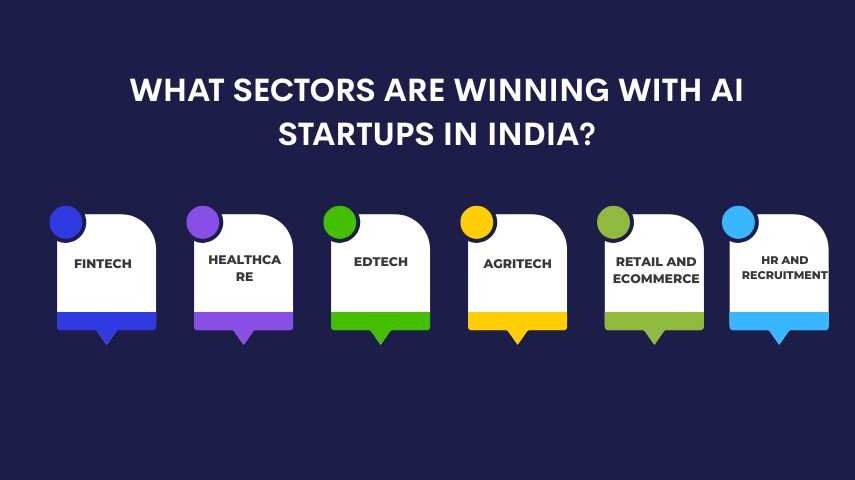 AI is not limited to tech or software. It is creating competitive advantages in every major Indian industry.
The sectors delivering the strongest early results are:
-
Fintech - AI credit scoring for users with no traditional credit history
-
Healthcare - AI diagnostics and multilingual patient communication tools
-
EdTech - Personalised learning in regional Indian languages
-
AgriTech - AI crop health monitoring delivered by voice in local dialects
-
Retail and eCommerce - Demand forecasting, smart inventory, and personalisation engines
-
HR and Recruitment - AI resume screening and attrition prediction models
What Results Should a Startup Realistically Expect from AI?
Q: How quickly will AI show results for my startup?
Most startups see measurable improvement within 60 to 90 days of their first AI deployment. Full impact cost savings, faster growth, and better conversion are typically visible within 6 months.
Q: Do I need a big technical team to use AI in my startup?
No. Most AI tools and platforms are designed to be used without deep technical knowledge. For custom builds, a partner like Rubixe handles the entire development and hands over a working system with training.
Q: How much should an early-stage Indian startup budget for AI?
Budgets vary widely. Off-the-shelf AI tools start at a few thousand rupees per month. Custom AI solutions from Rubixe typically start at ₹3 lakhs for a focused project and scale based on complexity and scope.
Q: Will AI make my startup look less personal to customers?
The opposite is usually true. AI enables hyper-personalisation at scale - sending the right message to the right customer at the right time. This feels more personal, not less.
Q: What if my startup does not have much data yet?
You can start with publicly available datasets and third-party data enrichment. As your startup grows, your proprietary data becomes your biggest competitive asset. Starting early, even with small data, is better than waiting.
Q: Is the Indian government supporting AI startups?
Yes, strongly. The IndiaAI Mission launched in 2024 with an outlay of ₹10,372 crore over 5 years. It funds compute infrastructure, supports LLM development, and provides resources directly to eligible AI startups.
How Do You Start Building an AI-Powered Startup in India?
Starting with AI does not mean building an AI company. It means using AI as infrastructure inside whatever company you are building.
Here are 5 actionable steps to get started:
Step 1:- Audit your manual work. List every task your team does repeatedly. That list is your first AI automation roadmap.
Step 2:- Identify your highest cost or bottleneck. Is it customer support? Lead generation? Data entry? Operations? Pick the one that costs the most time or money. Start there.
Step 3:- Choose the right AI approach. Some problems need off-the-shelf tools. Others need custom-built models. Rubixe's AI consulting team helps early-stage founders make the right call before spending a rupee on development.
Step 4:- Start with a focused 6–8 week pilot. Do not try to automate everything at once. Pick one problem, solve it completely, measure the result, then expand.
Step 5:- Build data habits from day one. Every customer interaction, every transaction, every support ticket is data. Capture it, store it cleanly, and use it. Your data is your moat.
How does Rubixe help startup founders specifically?
Rubixe works with founders from the idea stage through to scale - building custom AI systems, advising on AI strategy, and delivering measurable results.
Unlike large consulting firms that hand over strategy documents, Rubixe builds and deploys working AI systems inside your startup. With 200+ clients served across India and an average ROI of 3.5x within the first year, the results are trackable from day one.
Key Takeaways
-
AI is not a future advantage for Indian startups - it is a present necessity. Founders who delay adoption fall behind competitors who have already automated.
-
The biggest startup pain points have AI solutions. High costs, slow growth, poor conversion, and manual work are all fixable with the right AI systems.
-
You do not need to be a tech startup to benefit from AI. Any business with data, customers, or repetitive processes can see results within 60 to 90 days.
-
India's AI ecosystem has never been better funded or better supported. Over $11.1 billion in cumulative AI investment and ₹10,372 crore in government support create real tailwinds for new founders.
-
Rubixe has helped 200+ businesses in India implement AI - from early-stage startups to established enterprises - with measurable results in under 6 months.
Frequently Asked Questions: AI Startups in India
1. What is an AI startup in India?
An AI startup in India is a business that uses artificial intelligence as a core part of its product or operations. This includes startups building AI tools as well as traditional businesses using AI to work smarter.
2. Why is India a good place to start an AI company?
India has a massive pool of AI and engineering talent, a huge and diverse domestic market, and strong government support through the IndiaAI Mission.
3. How much funding do AI startups in India raise?
Early-stage AI startups in India typically raise between ₹50 lakhs and ₹5 crores in their first round, depending on the sector and traction. In 2025, Indian AI startups collectively raised over $643 million, with the majority going to early and growth-stage companies.
4. Can a startup in a non-metro Indian city use AI effectively?
Absolutely. AI tools work regardless of geography, and many of the biggest opportunities are in tier-2 and tier-3 markets where digital adoption is accelerating fast. Rubixe has delivered AI projects for clients in cities including Pune, Coimbatore, Jaipur, and Kochi.
5. What is the biggest mistake startup founders make with AI?
The most common mistake is waiting too long to start or trying to build too much at once.
6. How do I know if my startup idea is right for AI?
If your idea involves data, repetitive processes, customer interactions, or decisions that need to be made at scale, AI is relevant.
Thinking about building an AI startup or adding AI to your existing business idea? Talk to Rubixe today →